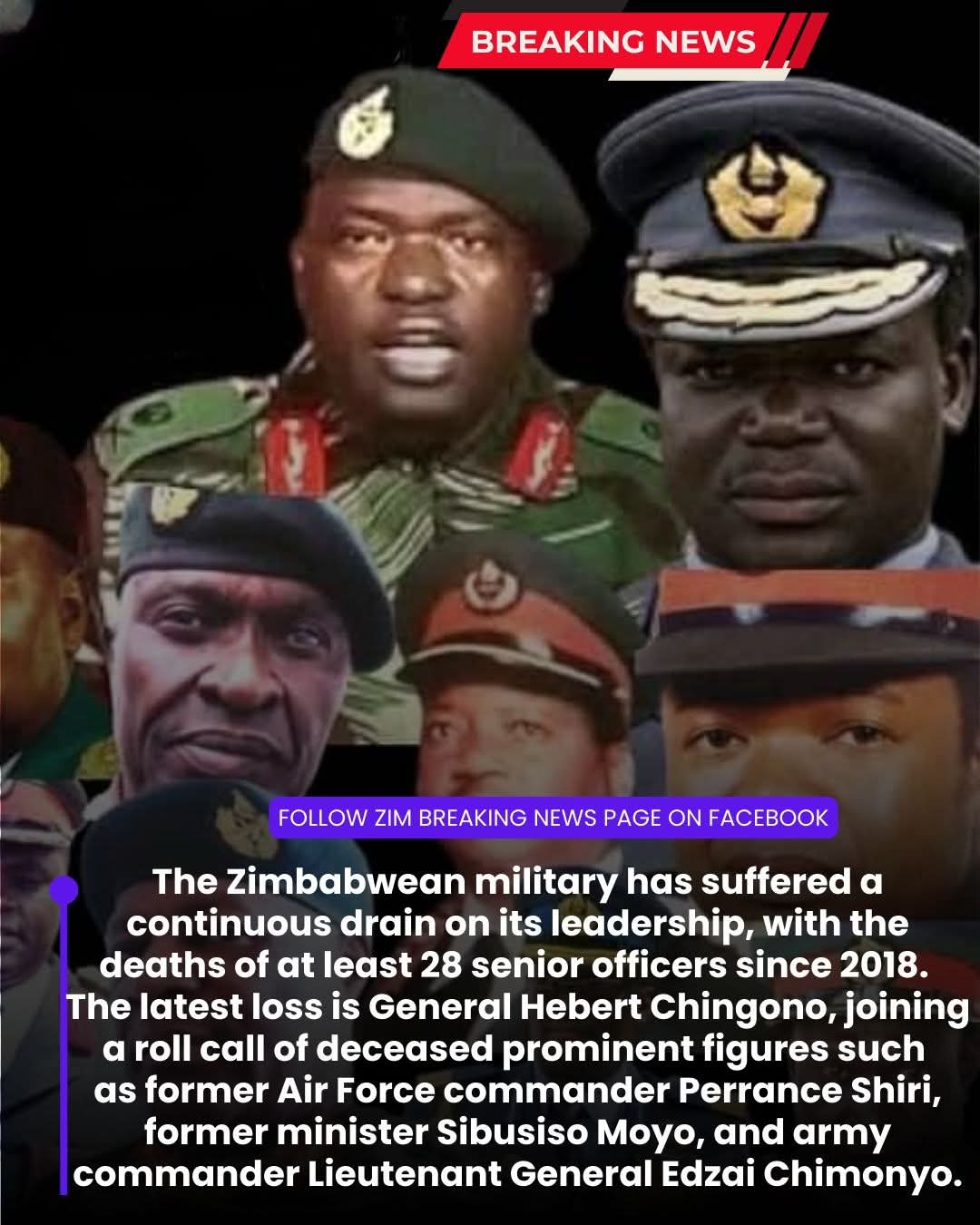
Zimbabwe’s military establishment is facing an unprecedented leadership crisis as a relentless succession of deaths among senior officers continues to hollow out the Zimbabwe Defence Forces (ZDF). Since 2018, the state has lost a staggering array of top-tier commanders, ranging from coup architects to seasoned strategists, with the March 2026 passing of Major General Herbert Chingono marking the latest blow to the institution’s structural integrity. This high-mortality trend is not merely a statistical anomaly; it represents a profound security vacuum at the heart of Southern Africa’s most volatile political theater.
A Decade of Decimation: The Erosion of the Old Guard
The roll call of the deceased reads like a biography of the ZANU-PF era. From the COVID-19-linked deaths of former Air Force commander Perrance Shiri and coup-architect Sibusiso Moyo in 2021, to the recent loss of Brigadier-General Jonathan Willie Hungwe in February 2026, the attrition rate is unprecedented. Between 2018 and 2026, dozens of generals and colonels have succumbed to illnesses, accidents, and short-term health crises. This systematic loss of the ‘Liberation War’ generation—the men who built the security state—has left the Zimbwabwean military architecture fractured and struggling to maintain its historically iron-fisted control over the country’s political machinery.
Geopolitical Destabilization in Southern Africa
Security analysts warn that the vacuum created by these deaths poses a regional risk. Zimbabwe serves as the linchpin for SADC security operations, and the loss of institutional memory among top brass invites instability. “When you lose this many high-ranking officials in such a short window, you aren't just losing individuals; you are losing the glue that holds the security state together,” says Dr. Tendai Mupandawana, a regional security fellow. With the ZDF weakened, the risk of factional infighting increases, potentially spilling over borders and impacting regional trade routes and refugee flows into neighboring South Africa and Botswana.
Impact: A Military in Search of Identity
The data is stark: with at least 30 senior officers deceased in under eight years, the military’s command-and-control hierarchy is effectively being forced through a rapid, untested transition. The impact is felt most acutely in resource allocation and intelligence gathering. As veteran commanders depart, the institutional knowledge required to manage the country’s complex economic and social crisis is evaporating. This leaves the current administration reliant on a younger, less battle-tested cadre, creating a fragile environment where the military’s traditional role as the ultimate arbiter of power is increasingly contested.
Internal Strife and the Public Sentiment
Within the barracks, the atmosphere is reportedly one of anxiety. A senior military source, speaking on condition of anonymity, noted: “There is a sense of unease. We are losing mentors, friends, and the architects of our doctrine in rapid succession. It feels as though the foundation is shifting beneath our feet.” On the streets of Harare, citizens are more cynical, questioning whether these deaths are merely natural or symptomatic of deeper, internal power struggles within the ruling party. The government, meanwhile, maintains a stoic front, repeatedly declaring the deceased as ‘National Heroes’ to preserve a veneer of continuity and unity.
The Future: A State at a Crossroads
What happens next for Zimbabwe depends on how the leadership addresses this depletion. If the current trend continues, the ZDF risks losing its status as a cohesive force, potentially leading to a fragmentation of loyalty. The regional bloc, SADC, will likely be forced to intervene or increase oversight to prevent a total security failure. For now, the nation watches as the old guard is laid to rest, and the question remains: who will inherit the mantle of power in a military that is rapidly running out of its most experienced defenders?