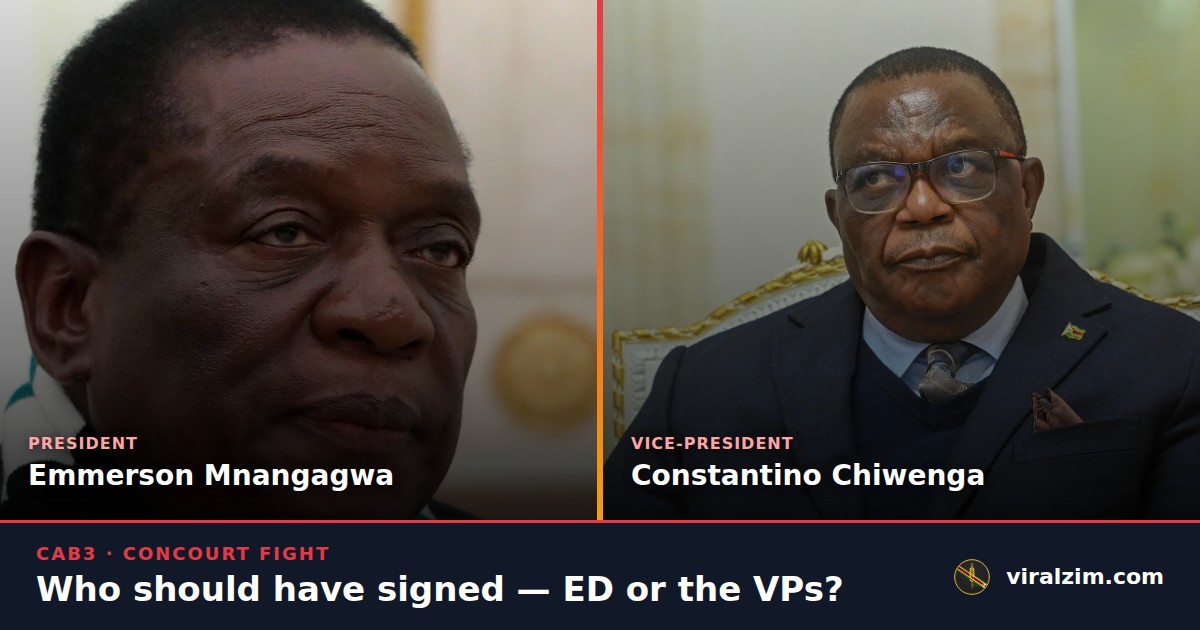
Harare, Zimbabwe — Zimbabwe’s two vice presidents, Constantino Chiwenga and Kembo Mohadi, failed to attend a high-level ZANU-PF meeting convened by President Emmerson Mnangagwa this week, a public snub that has laid bare the deepening fissures inside the country’s ruling party and raised fears of a fresh leadership crisis in a nation already buckling under economic collapse.
The meeting, described by party insiders as a routine consultative gathering of the Politburo, was held at the party’s headquarters in Harare. While Mnangagwa presided, the empty seats of his two deputies sent a clear and deliberate message: the factional war that has simmered since the 2017 military-backed ouster of Robert Mugabe is no longer being fought in whispers. Chiwenga and Mohadi, representing different wings of the party, have publicly embarrassed the president in a move that analysts say could accelerate a succession struggle still years from resolution.
A Public Snub
The snub comes at a particularly volatile moment. Zimbabwe is grappling with hyperinflation, a collapsing currency, and widespread public anger over corruption and mismanagement. Mnangagwa’s government has faced increasing international isolation, and the ruling party’s internal cohesion is seen as the last pillar holding the regime together. That pillar is now visibly cracking.
Chiwenga, a former army general who orchestrated the 2017 coup that brought Mnangagwa to power, has long been seen as the president’s most formidable rival. His absence from a meeting chaired by Mnangagwa is widely interpreted as a declaration that he no longer considers himself subordinate. Mohadi, the other vice president, is a veteran party loyalist but has recently aligned himself with Chiwenga in a tacit coalition against Mnangagwa’s inner circle.
Political analyst Dr. Tawanda Nyambirai, a lecturer at the University of Zimbabwe, said the walkout—or rather, the no-show—represents a “dangerous escalation.” He noted: “When vice presidents openly defy the president in a party that operates on absolute loyalty, you are not looking at a disagreement over policy. You are looking at a coup in slow motion.”
The incident echoes the months leading up to Mugabe’s downfall in 2017, when senior party figures began skipping public engagements and the military started positioning itself. Then, too, the trigger was a succession dispute. Today, Mnangagwa is 81, Chiwenga is 68, and the question of who will lead ZANU-PF after Mnangagwa remains unresolved.
Factional Fault Lines
ZANU-PF’s factional landscape has shifted dramatically in recent years. Mnangagwa, who came to power promising economic recovery and a break from Mugabe’s authoritarianism, has failed to deliver on either front. The economy has contracted by more than 40% since 2018, and the Zimbabwean dollar has lost over 90% of its value. The opposition, though weakened, continues to challenge the ruling party’s legitimacy. In this environment, the party’s internal battles have become more naked.
The so-called “Lacoste” faction, loyal to Mnangagwa, is increasingly pitted against a military-aligned camp that sees Chiwenga as the natural successor. Mohadi, once considered a neutral figure, has reportedly been drawn into the anti-Mnangagwa coalition after being sidelined in key appointments. The decision to skip the meeting is believed to be coordinated: both vice presidents sent the same signal at the same time.
“This is not a spontaneous act,” said Pedzisayi Ruhanya, a political commentator and director of the Zimbabwe Democracy Institute. “It was planned, and it tells you that the alliance against Mnangagwa is consolidating. The question is whether the president still has the loyalty of the security forces. If he does, he can survive. If not, the end could be swift.”
The implications for Southern Africa are significant. Zimbabwe remains a geopolitical linchpin in the region, hosting key infrastructure and serving as a conduit for trade between South Africa and East Africa. A destabilized Zimbabwe would send shockwaves through the Southern African Development Community (SADC), which has already struggled to manage crises in Mozambique and the Democratic Republic of Congo. South Africa, whose own political and economic troubles have been compounded by the war in Ukraine and internal energy shortages, can ill afford another crisis on its border.
For ordinary Zimbabweans, the political drama offers little hope. The country’s unemployment rate stands at over 80%, and the majority of the population lives below the poverty line. Health and education systems have collapsed. A power struggle at the top only distracts from the urgent need for reform. “We are watching them fight over a sinking ship,” said a small business owner in Bulawayo who asked not to be named for fear of reprisal. “Meanwhile, the water is rising.”
No official statement has been issued by President Mnangagwa’s office regarding the snub. The president is expected to address the party’s central committee in the coming days. Whether Chiwenga and Mohadi will attend that meeting remains an open question—one that could determine the future of Zimbabwe’s ruling party and, by extension, the country’s fragile stability.
Political analysts warn that the coming weeks are critical. “If this breach is not healed quickly, you could see a split in the party, a purge, or even a military intervention,” said Nyambirai. “In Zimbabwe, history has a way of repeating itself with tragic consequences.”