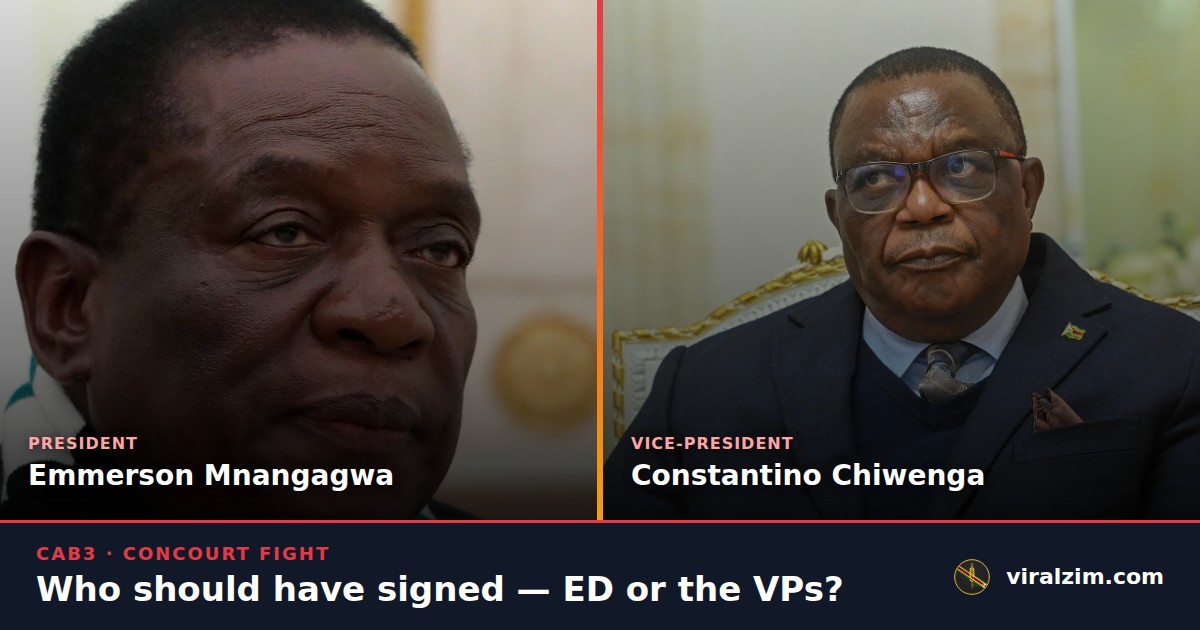
Harare, Zimbabwe – A fresh wave of explosive allegations has gripped Zimbabwe’s political elite, with unverified reports claiming that Vice President Constantino Chiwenga survived yet another assassination attempt while President Emmerson Mnangagwa is facing imminent arrest on undefined charges. The claims, circulating widely on social media and among exiled opposition networks, threaten to further destabilise a ruling ZANU-PF party already fractured by a bitter succession struggle.
Political context: the succession powder keg
The allegations cannot be understood outside Zimbabwe’s volatile internal politics. Chiwenga, 68, who led the 2017 military coup that ousted Robert Mugabe and installed Mnangagwa, commands significant loyalty within the armed forces. He has long been viewed as Mnangagwa’s heir apparent, but tensions between the two have intensified since 2022, when Chiwenga publicly criticised the government’s handling of the economy and the military’s dwindling privileges. Mnangagwa, 81, is widely expected to seek a third term in 2028, though the constitution currently bars him from doing so – a potential flashpoint that has fuelled rumours of a pre-emptive power grab.
The latest claim that Mnangagwa himself is to be arrested is even more startling. No judicial body or law enforcement agency has announced any warrant. If true, it would mark an unprecedented move against a sitting president in post-independence Zimbabwe. Some analysts interpret the rumour as a trial balloon floated by anti-Mnangagwa factions within ZANU-PF to test public reaction and foreign support. Others dismiss it as a crude disinformation campaign designed to undermine the President ahead of the ruling party’s congress later this year.
Regional and geopolitical stakes
The instability in Zimbabwe has immediate repercussions for Southern Africa. As a landlocked state dependent on South Africa for trade routes and energy, any sharp escalation in Harare could disrupt regional supply chains, particularly in mining and agriculture. ‘The Southern African Development Community (SADC) is watching this closely,’ said a political analyst based in Johannesburg who requested anonymity because of the sensitivity of the subject. ‘If the claims of an assassination attempt are true, or even if they are strategically leaked, it signals that the internal contest in ZANU-PF has moved from backroom deals to direct physical threat. That is a very dangerous line to cross.’
Zimbabwe’s economy, already reeling from hyperinflation, currency collapse, and chronic power shortages, would face further capital flight and investor paralysis. The international community, including the African Union and the United Nations, has in the past expressed concern over political violence in Zimbabwe, but has taken little concrete action beyond targeted sanctions against Mnangagwa and his inner circle.
The timing of the claims is also significant. They emerge just weeks after the Zimbabwean government expelled the U.S. ambassador for alleged ‘interference’ and amid increased military drills near the Mozambique border. Some independent observers suggest that the arrest rumour may be linked to a long-dormant corruption trial that Mnangagwa’s allies fear could be revived by a faction within the intelligence services.
As of this writing, neither Vice President Chiwenga nor President Mnangagwa has made any public appearance since the reports surfaced. The VP’s office declined to comment when contacted, citing ‘security protocols’. The Ministry of Information has not responded to repeated requests for clarification.
The credibility of the sources behind these claims remains unknown. What is clear is that Zimbabwe’s ruling elite is locked in its most dangerous fight for power since the 2017 coup. If even a fraction of the allegations prove true, the country could be on the brink of another political earthquake – one that will be felt across the entire Southern African region.