
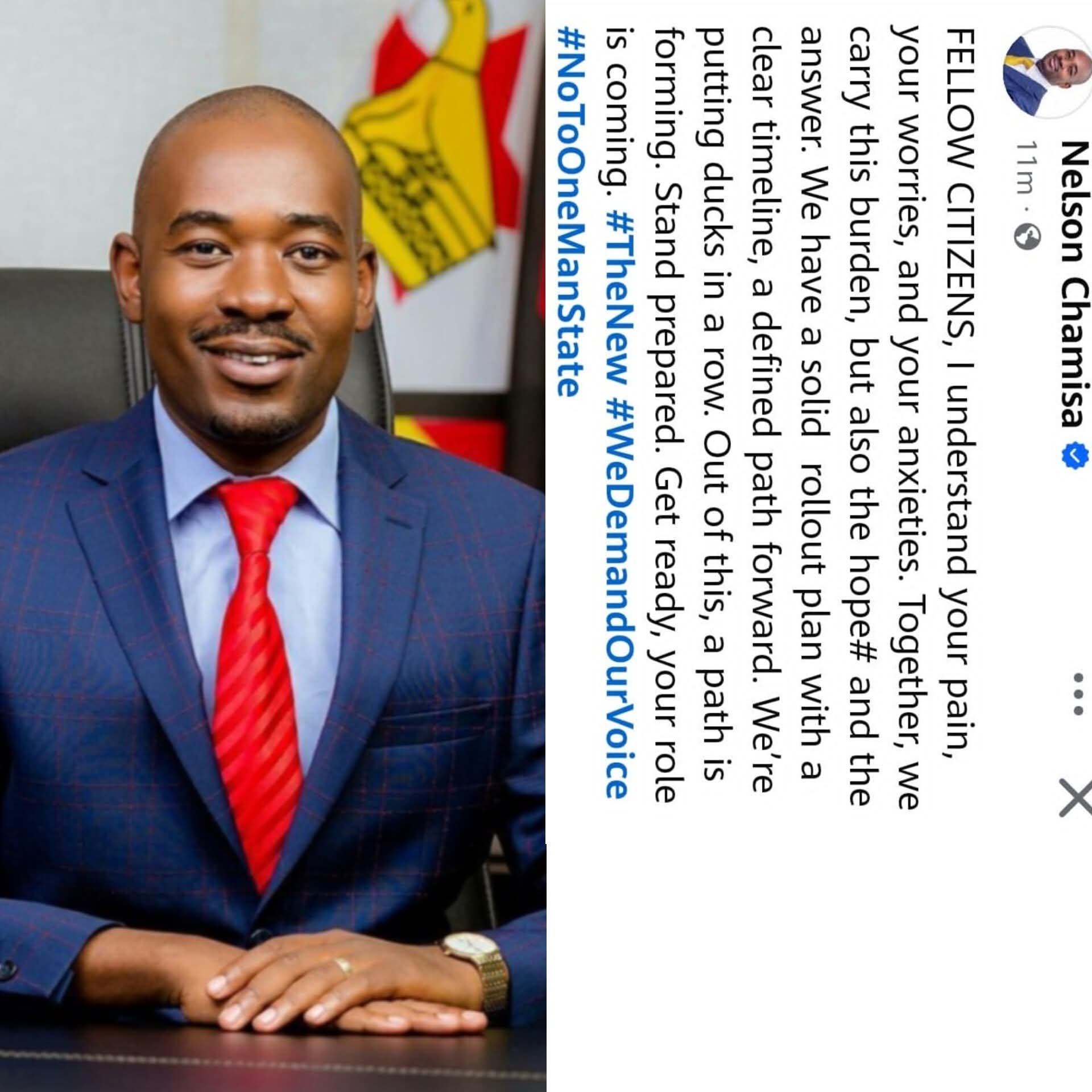
Nelson Chamisa, the charismatic architect of Zimbabwe’s fractured opposition, has issued a cryptic but urgent directive to his supporters, signaling the imminent launch of a strategic campaign to challenge the legitimacy of President Emmerson Mnangagwa’s administration. Declaring that his movement is 'putting ducks in a row,' the former leader of the Citizens Coalition for Change (CCC) has signaled an end to his period of post-election silence, reigniting fears of renewed state-sponsored crackdowns in a nation already suffocating under 30% inflation and systemic corruption. This maneuver, whispered in the corridors of Harare’s political elite, suggests that the opposition is moving from passive observation to a calculated, potentially disruptive, phase of resistance.
A History of Stolen Mandates
The roots of this current tension trace back to the contested August 2023 general elections, which international observers—including the SADC Election Observer Mission—roundly criticized for failing to meet regional and international standards. According to the Zimbabwe Election Support Network (ZESN), the pre-election environment was marred by the systematic intimidation of voters and the illegal banning of opposition rallies. Since the ZANU-PF government retained power, the political landscape has seen the systematic dismantling of the CCC, with the regime-backed 'Sengezo Tshabangu' faction effectively seizing control of parliamentary seats. This historical context of legislative capture and judiciary bias has left the electorate feeling disenfranchised, creating the exact vacuum of hope that Chamisa is now attempting to fill with his talk of a 'defined path forward.'
Geopolitical Destabilization in Southern Africa
The implications of a renewed Zimbabwean crisis extend far beyond the borders of the Zambezi. For Southern Africa, a volatile Zimbabwe acts as a pressure cooker that risks spilling refugees into South Africa, Zambia, and Botswana. Political analyst Dr. Tapiwa Mashayamombe notes, 'The SADC bloc has historically been hesitant to intervene in Harare, but if Chamisa’s rollout involves mass civil disobedience, the regional status quo becomes untenable.' With South Africa already grappling with its own internal political instability following the 2024 elections, an influx of economic migrants fleeing a collapsed Zimbabwean state would push regional infrastructure to the brink. The 'path' Chamisa speaks of is not just a Zimbabwean strategy; it is a regional stress test that could either force democratic reform or trigger an authoritarian hardening across the SADC region.
The Human Cost of Political Stagnation
The human reality behind these high-level maneuvers is devastating. Zimbabwe’s economy remains in a state of 'managed decay,' where the cost of basic commodities has outpaced the average civil servant’s salary by nearly 400%. Independent economists point out that the lack of political certainty—driven by the regime’s refusal to engage in meaningful electoral reform—has effectively frozen foreign direct investment. 'Investors do not put capital into a country where the rule of law is a suggestion,' says economist Tendai Biti. As Chamisa rallies his base, the immediate consequence will likely be an increase in surveillance and a tightening of the NGO Act by the state, further restricting the humanitarian aid that millions of Zimbabweans rely on to survive the current food security crisis.
The Regime’s Calculated Response
The response from ZANU-PF has been one of predictable vitriol, with party spokespeople labeling Chamisa’s messages as 'subversive' and 'bordering on treason.' Behind the scenes, however, the anxiety is palpable. A senior intelligence source within the Central Intelligence Organisation (CIO) admitted, 'We are monitoring the chatter. The concern isn't just the message; it's the fact that he still commands the loyalty of the urban youth.' Meanwhile, civil society leaders are cautiously optimistic. 'If this rollout is as substantive as he claims, it offers a lifeline to those who felt abandoned after the August results,' says human rights activist Hopewell Chin’ono. The tension is palpable in Harare, where the presence of security forces has increased significantly in areas previously considered opposition strongholds.
What Comes Next: A Dangerous Gambit
Moving forward, the success of Chamisa’s strategy hinges on his ability to mobilize without triggering a 'Tiananmen-style' response from the state. The coming weeks will likely see a series of 'soft' protests—digital activism, localized boycotts, and a push for international diplomatic pressure—designed to test the state’s resolve before moving to broader civil action. The danger is that if the state reacts with lethal force, the 'path forward' could quickly devolve into a period of prolonged instability. Zimbabwe stands at a fork in the road: either a managed transition toward legitimate governance or a slide into further isolation. Chamisa has drawn the line in the sand; now, the citizens must decide whether to cross it.

