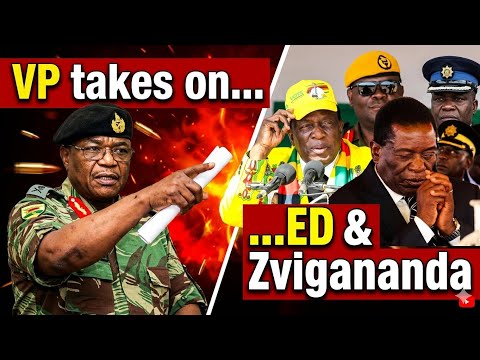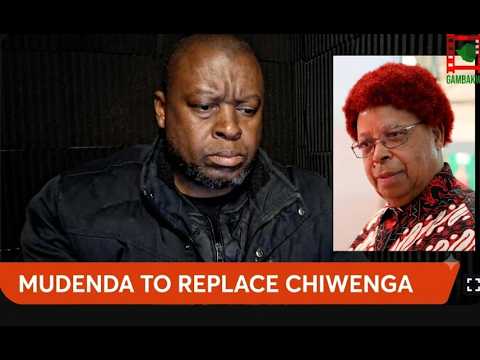
HARARE – President Emmerson Mnangagwa is actively plotting to purge his long-time rival and deputy, Vice President Constantino Chiwenga, and replace him with the current Speaker of Parliament, Jacob Mudenda, in a clandestine cabinet reshuffle that could fracture Zimbabwe’s ruling party and provoke a decisive military intervention, former ZANU-PF political commissar Temba Mawarire has alleged in a live broadcast.
The stunning accusation, aired during a Gambakwe Media livestream, lifts the lid on a festering power struggle that has gripped the country’s top leadership since the 2017 coup that toppled Robert Mugabe. Mawarire, once a fervent insider who later turned against the establishment, warned that the move is designed to neuter Chiwenga’s formidable influence over the military and security apparatus before the 2028 general elections – or even sooner, should Mnangagwa succeed in extending his tenure beyond the constitutional two-term limit.
The Alleged Plot
“What I am telling you is not rumour,” Mawarire stated, his voice cutting with urgency. “The President believes that as long as Chiwenga remains VP, his own position is temporary. Mudenda is the new face of the succession line.” He added that the Speaker’s recent elevation in party rituals – including presiding over key provincial coordinating meetings – was a deliberate signal to the military that a new civilian figurehead was being groomed.
The allegation lands at a perilous moment. Zimbabwe’s economy is in freefall, with annual inflation running above 55% and the Zimbabwe dollar losing over 40% of its value on the parallel market in the first quarter of 2024 alone. A protracted internal conflict within the ruling elite would shatter what fragile investor confidence remains, deepen the humanitarian crisis, and likely spill into wider social unrest.
A Rivalry Forged in the 2017 Coup
The Mnangagwa-Chiwenga rivalry is not new. It was the military-led Operation Restore Legacy in November 2017 that first hoisted Mnangagwa into power after Mugabe’s resignation, but the muscle behind the operation belonged to then-General Chiwenga. The two men were bound by a Faustian pact: Mnangagwa got the presidency, and Chiwenga became one of two vice presidents, retaining enormous control over the defence forces and the party’s extra-judicial levers.
That pact began to fray within months. In 2019, Mnangagwa stripped Chiwenga’s allies from key government positions, while the VP’s camp blamed the president for failing to deliver on promises of economic revival. The tension boiled over during the COVID-19 pandemic when Chiwenga, acting as health minister, assumed visible authority, often overshadowing Mnangagwa. By 2023, open factional warfare inside ZANU-PF saw Chiwenga’s loyalists purged from critical provincial structures, with the president’s “ED2030” slogan signalling his ambition to stay in office beyond 2028.
Replacing Chiwenga with Mudenda would be a definitive move to clinch that ambition. Speaker Mudenda, a former minister and diplomat, has never commanded a military constituency. His appointment would, de facto, strip the security apparatus of its most powerful political champion and consolidate civilian control under Mnangagwa – but it would also raise an existential question: will the generals accept being sidelined by a man they installed only seven years ago?
Political analyst and long-time observer of Zimbabwe’s succession battles Dr. Philan Zamchiya, of the University of Oxford’s African Studies Centre, warned in a recent interview with this correspondent that “any unilateral removal of Chiwenga would be perceived by the military command as a decapitation of their institutional interests. The response could be swift and extra-legal.” Regional security sources, speaking on condition of anonymity because they were not authorised to brief the press, echoed that assessment, noting that troop movements and command postures were already being monitored by neighbouring intelligence agencies.
Southern Africa on Edge
The reverberations of a ZANU-PF implosion would stretch far beyond Zimbabwe’s borders. South Africa, which hosts an estimated 2.5 million Zimbabwean nationals – many undocumented – would face an immediate migration surge. The South African government, already grappling with its own domestic crises and a tense election cycle, has little bandwidth for a Zimbabwean refugee wave. Ambassador John Dube, South Africa’s former envoy to Harare, told this network that “Pretoria is watching carefully. Any instability in Zimbabwe directly impacts our labour markets, our crime statistics, and our diplomatic standing in the region.”
The Southern African Development Community (SADC) has a mixed record on Zimbabwe. Its 2017 mediation helped manage the post-coup transition, but the bloc has been largely absent as democratic backsliding accelerated. A fresh power struggle inside Harare would force SADC’s hand, and the likely outcome – a hurried, face-saving compromise – would leave Zimbabweans no closer to constitutionalism. Botswana and Zambia, whose presidents have become increasingly vocal about democratic governance, may break ranks and impose targeted sanctions, further isolating the ruling party and deepening the economic misery for ordinary people.
Mnangagwa’s spokesperson, when reached for comment, did not immediately respond. Chiwenga’s office declined to address the allegations, calling them “baseless sensationalism.” Mudenda, through a parliamentary aide, said he was “unaware of any such discussions and remains focused on his legislative duties.” Mawarire, however, has a track record of revealing internal ZANU-PF feuds that later proved accurate. In 2021, he predicted the ouster of several cabinet ministers weeks before it happened, citing the same network of disaffected insiders.
If Mnangagwa proceeds, he risks igniting the very instability that the 2017 coup was supposed to end. Zimbabwe’s security forces are not a monolith; junior officers and mid-level commanders from Masvingo, Midlands, and Matabeleland provinces have their own grievances over patronage and ethnic balancing. Mudenda, a Kalanga from the south, might soothe some regional tensions but would lack the coercive power to impose discipline should Chiwenga’s loyalists within the army push back.
The stakes are now as high as at any point since independence. Zimbabwe’s next few weeks will reveal whether Mnangagwa can execute a bloodless internal coup – or whether the centre will not hold.