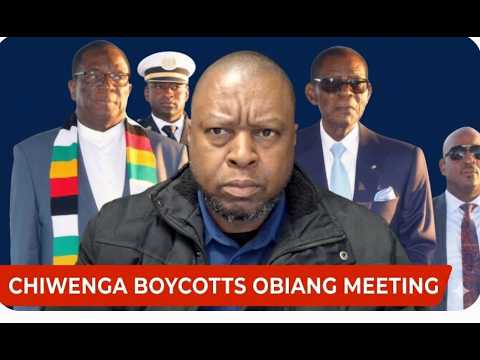
Harare, Zimbabwe – In what analysts are calling the most public display of discord within Zimbabwe's ruling ZANU-PF since the 2017 coup, Vice President Constantino Chiwenga snubbed a state dinner hosted by President Emmerson Mnangagwa in honour of Equatorial Guinea’s President Teodoro Obiang Nguema Mbasogo. The boycott, confirmed by multiple diplomatic sources and live footage from the event, has sent shockwaves through the Southern African political landscape and raised urgent questions about the stability of Zimbabwe’s leadership transition.
The dinner, held at State House in Harare on the evening of March 28, 2025, was intended to cement bilateral ties between Harare and Malabo. Obiang, Africa’s longest-serving head of state, arrived in Zimbabwe earlier this week for a three-day state visit focused on oil, gas, and mining cooperation. Yet the ceremonial occasion was overshadowed by the conspicuous absence of Zimbabwe’s second-in-command. State media initially listed Chiwenga as attending, but live broadcasts showed his seat empty, with Mnangagwa flanked only by senior cabinet ministers. The Vice President’s office has not issued any official statement, though sources close to the VP cite a scheduling conflict, a claim dismissed by political watchers as implausible given the high-profile nature of the event.
A Rivalry Written in Plain Sight
The rift between Mnangagwa and Chiwenga has been an open secret since the 2017 military intervention that ousted Robert Mugabe. Chiwenga, then army chief, led the operation that propelled Mnangagwa to power. But the alliance has frayed as Mnangagwa has consolidated control, sidelining allies of the military faction. In recent months, Chiwenga has been stripped of several key dossiers, including oversight of the security sector. The boycott of the Obiang dinner appears to be a deliberate escalation. “This is no minor diplomatic gaffe — it is a direct challenge to presidential authority,” said Dr. Pedzisayi Ruhanya, a political analyst at the University of Zimbabwe. “When a vice president publicly boycotts a state dinner for a visiting African head of state, it signals that the internal contest for succession is now being fought in full view of the international community.”
The timing is particularly charged. Mnangagwa, 82, has not publicly named a successor, though the ruling party’s constitution suggests he may seek a third term in 2028. Chiwenga, 68, is widely seen as the leading contender within the military wing of ZANU-PF. However, Mnangagwa has been grooming a younger generation of technocrats, including his son, Emmerson Mnangagwa Jr., further alienating the old guard. “You are seeing a bifurcation of the state,” remarked Dr. Knox Chitiyo, a fellow at Chatham House’s Africa Programme. “The civilian executive and the military hierarchy are no longer singing from the same hymn sheet. That is dangerous for any country, but especially for one with Zimbabwe’s recent history of coups and contested transitions.”
Geopolitical Stakes for Southern Africa
The spat carries implications far beyond Harare. President Obiang’s visit was part of a broader push by Equatorial Guinea to secure energy partnerships with Southern African nations. Zimbabwe, facing chronic fuel shortages and a crippling foreign currency crisis, had hoped to secure a preferential crude oil supply deal. Equatorial Guinea, the fourth-largest oil producer in sub-Saharan Africa, is also looking for downstream market access via Zimbabwe’s landlocked position. The boycott may have damaged those negotiations. “Foreign investors and visiting heads of state will take note of this internal chaos,” said Tinashe Chigumira, an economist based in Johannesburg. “If the second most powerful man in the country won’t even show up for a photo op with the guest of honour, how can there be policy continuity?”
Neighbouring countries are watching warily. Botswana and Zambia have already experienced contested transitions in recent years. South Africa, which mediates regional stability through the Southern African Development Community (SADC), may be forced to intervene if the Zimbabwean leadership dispute escalates into a full-blown crisis. A SADC communique on the situation is expected within days. Meanwhile, ordinary Zimbabweans bear the cost. The country is experiencing hyperinflation — the latest official inflation figure hit 347% in February 2025 — and a deepening humanitarian crisis. “While the elites fight over chairs, people are dying for lack of medicines and electricity,” said Joan Chirisa, a civil society activist in Bulawayo. “This is the real Zimbabwean tragedy.”
As the region holds its breath, one thing is clear: the dinner that Chiwenga skipped may prove to be the point of no return for Zimbabwe’s fragile political order.