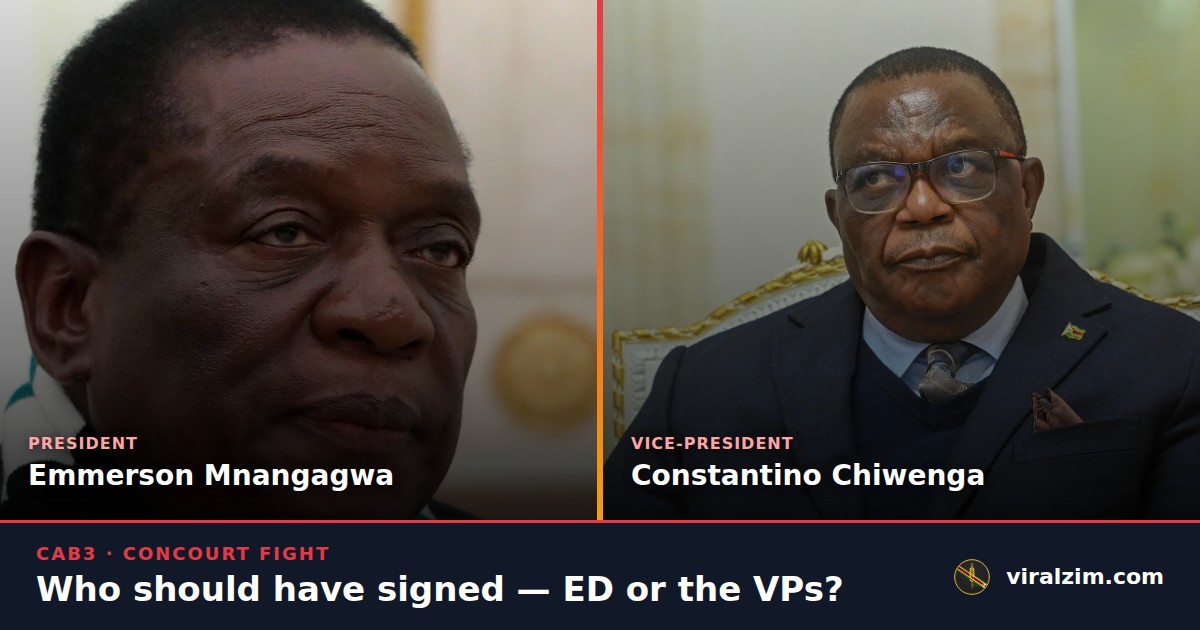
HARARE, Zimbabwe — President Emmerson Mnangagwa is effectively a trapped man, encircled by his own vice president and the military establishment that installed him, as a revitalized opposition front declares political war on the regime’s most contentious power grab yet.
“We are witnessing the final act of a tragic power play,” Coltart is heard saying in the recording, referencing what he describes as an internal army mutiny waiting to erupt. “Mnangagwa thought he could outmaneuver the very generals who placed him in State House. Now they’ve trapped him. The question is not if, but when the next coup happens.”
The timing of the threat is devastating. CAB3, currently before parliament, would eliminate the two-term presidential limit, allow the incumbent to appoint his own successor without an election, and neuter judicial oversight. Opposition parties, civil society groups, and even some factions within the ruling ZANU-PF see it as a legislative rubber stamp for Mnangagwa to rule for life — a proposal that has ignited a firestorm across the country.
The Chiwenga Factor
Vice President Chiwenga, 67, remains the most powerful man in Zimbabwe outside of the presidency itself. As the former commander of the Zimbabwe Defence Forces and the architect of Operation Restore Legacy — the military intervention that ended Mugabe’s 37-year grip — Chiwenga controls the loyalty of the army’s top brass. Since assuming the vice presidency, he has kept an unusually low public profile, but his silence has often signaled brewing storms. Last year, a series of unexplained troop movements near Harare and a purge of Mnangagwa-aligned commanders stoked rumors of a rift. Now, Coltart’s claims suggest that rift is a chasm.
“Chiwenga never fully handed over the levers of hard power,” said Dr. Tarisai Mutasa, a political scientist at the University of Zimbabwe. “The police commissioner reports to Mnangagwa, but the battalions still answer to Chiwenga. That’s the reality. CAB3 is the tripwire — because it threatens to make Mnangagwa a civilian dictator, sidelining the security apparatus that sees itself as the custodian of the state.”
Southern Africa is watching anxiously. Zimbabwe’s economic freefall — inflation at 176%, a currency that has lost 80% of its value since January, and a youth unemployment rate above 60% — already hemorrhages refugees into South Africa, Botswana, and Zambia. A fresh violent power struggle in Harare would send shockwaves through a region still recovering from the Mozambican insurgency and the lingering effects of Cyclone Freddy. The Southern African Development Community (SADC), often criticized for its toothless approach to Harare’s serial governance crises, has yet to issue any statement on the latest tensions, a silence opposition figures describe as complicity.
CAB3 and the Opposition's Ultimatum
“This is not just about term limits; it’s about the survival of the Zimbabwean nation,” Coltart said. “CAB3 is a constitutional coup d’état dressed in legislative robes. And we will not allow another generation to be condemned to poverty and repression under a one-man dictatorship.”
The bill has also exposed long-suppressed tribal and factional rifts within ZANU-PF. Mnangagwa’s loyalists, largely from the Karanga clan, are pitted against Chiwenga’s Zezuru-dominated military clique. Analysts say the power struggle has already paralyzed government decision-making, delaying critical debt restructuring talks with the IMF and the Paris Club. Zimbabwe’s external debt stands at over $17 billion, and without a credible political stabilization, any bailout is impossible.
The impact on ordinary Zimbabweans is catastrophic. The Zimbabwe dollar has depreciated so severely that a loaf of bread now costs ZWL$15,000, pushing millions deeper into food insecurity. The World Food Programme has warned that 4.1 million people — a third of the population — will require emergency assistance by the end of the year if instability persists.
For the Southern African region, a new military takeover in Zimbabwe would represent a terrifying regression. South Africa, which hosts an estimated three million Zimbabwean economic refugees, could face an unmanageable new influx. Botswana and Zambia, already grappling with drought and shrinking copper revenues, would see their own fragile economies buckle. Regional trade routes through Beitbridge — the continent’s busiest land border post — would be disrupted, costing the Southern African Customs Union billions in lost revenue.
Coltart’s warning may prove prophetic. Early this morning, unconfirmed reports on social media — picked up by military monitoring groups — indicated an unusual concentration of armored vehicles at Inkomo Barracks, 35 kilometers west of Harare. The government has not commented. But in a country where coups are announced by texts and tweets before state broadcasters, the silence is deafening.