HARARE — A fresh Constitutional Court application is putting Vice-President Constantino Chiwenga back at the centre of the CAB3 storm — not as the Bill’s champion, but as the official challengers say should have signed the law instead of President Emmerson Mnangagwa.
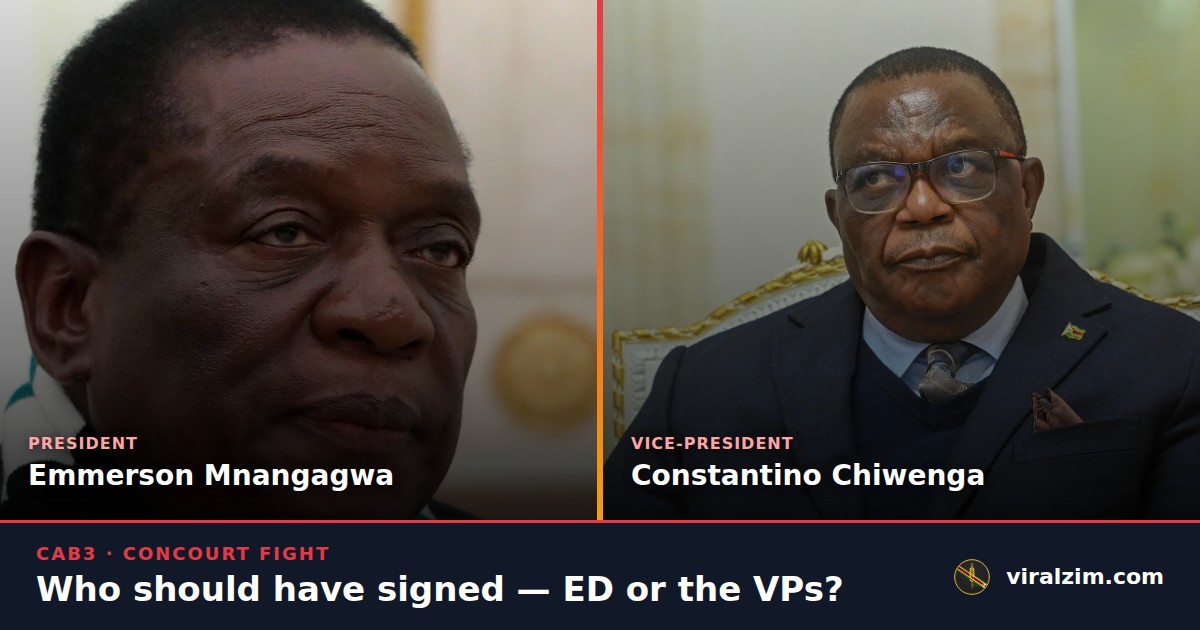
The application, reported this week by NewsDay Zimbabwe and covered across local outlets, argues that Mnangagwa was conflicted when he assented to the Constitution of Zimbabwe Amendment Act No. 3 because he stood to personally benefit from its term-extension provisions. On that reading, assent should have been left to an Acting President — either Chiwenga or fellow Vice-President Kembo Mohadi.
What the new court papers say
Applicant Vhurande Mahlupeko, a National Constitutional Assembly (NCA) member, is represented by constitutional lawyer Lovemore Madhuku. Respondents named in the coverage include Parliament, President Mnangagwa, Attorney-General Virginia Mabhiza, and Justice, Legal and Parliamentary Affairs Minister Ziyambi Ziyambi.
In his founding affidavit, as quoted in NewsDay, Mahlupeko argues the President failed a basic constitutional duty: not to assent to and sign Bills where he has a direct personal interest. The papers cite sections 196(2) and 110(2)(a) of the Constitution on avoiding conflicts between personal interests and official duties.
“I am advised that where a prohibited conflict arises, assenting to and signing a particular Bill must be left to an Acting President,” Mahlupeko’s affidavit states, according to the NewsDay report. The application therefore argues one of the Vice-Presidents should have signed while acting as President.
Mahlupeko wants the amendment declared invalid — part of a wider push to have Constitutional Amendment Act No. 3 struck down as null and void.
CAB3 is already law — that is why this fight matters
President Mnangagwa signed CAB3 into law on or about 7 July 2026. Reporting by ZimLive and other outlets identifies the statute as the Constitution of Zimbabwe Amendment Act (No. 3), 2026, gazetted as Act No. 6 of 2026.
Among its most contested changes, the amendment:
- extends the terms of the President, Parliament and local authorities from five to seven years;
- effectively pushes the next harmonised elections from 2028 toward 2030; and
- replaces direct popular election of the President with election by Members of Parliament sitting jointly.
Parliament cleared the Bill in late June: the National Assembly voted 216–42 on 18 June, the Senate 75–4 on 24 June, and the lower house adopted Senate amendments 226–41 on 30 June.
Why Chiwenga’s name is all over this case
Chiwenga has been the most prominent internal opponent of CAB3 inside ZANU-PF. ViralZim previously reported his camp’s warning that MPs should not celebrate parliamentary passage prematurely — and his coded public messaging after the Bill cleared both houses.
Related ViralZim coverage:
- Chiwenga Warns ZANU-PF MPs Not to Celebrate CAB3 Prematurely
- VP Chiwenga’s Lazarus Sermon as Mnangagwa Signs CAB3
- VP Chiwenga’s War on Corruption Collides With CAB3
- VP Chiwenga Objects to CAB3 and Fights Back
That history makes the new court argument politically explosive even if it is framed as a technical conflict-of-interest point: challengers are saying the man who fought CAB3 publicly is exactly the kind of Acting President who should have handled assent — not the President who benefits from a longer term.
Not the only ConCourt challenge
Mahlupeko’s application is one of several Constitutional Court challenges reported since the Bill passed and was signed. Coverage has also pointed to earlier or parallel filings linked to Prince Dubeko Sibanda, Youngerson Matete, Tambara Casper, and an MDC challenge led by Douglas Mwonzora arguing, among other things, that key changes should have gone to a national referendum.
ZimLive reported Mahlupeko filed around 18 July 2026 and is seeking to invalidate the entire amendment exercise — not only isolated clauses — with an alternative ask to strike affected portions if the court will not void the whole Act.
What happens next
Nothing in the published court papers, as reported so far, has suspended CAB3. The Act remains in force unless and until the Constitutional Court says otherwise. The political stakes are obvious: if the court accepts a conflict-of-interest attack on Mnangagwa’s assent, the entire 2030 term-extension project is back in play. If the court dismisses it, Mnangagwa’s camp will treat CAB3 as locked in — and Chiwenga’s succession path stays squeezed.
For ordinary Zimbabweans, the fight is no longer only about parliamentary numbers. It is about whether the country’s highest court will allow a President to sign a constitutional change that lengthens his own term — or whether that pen should have been in a Vice-President’s hand.
Sources: NewsDay Zimbabwe — “Mnangagwa erred in signing CAB3” (22 July 2026 reporting); ZimLive / 263Chat / CITEZW coverage of ConCourt filings and assent date; Parliament vote tallies as previously reported on ViralZim and in contemporaneous local press. Court outcomes can change — this article reports applications and published claims, not a final judgment.