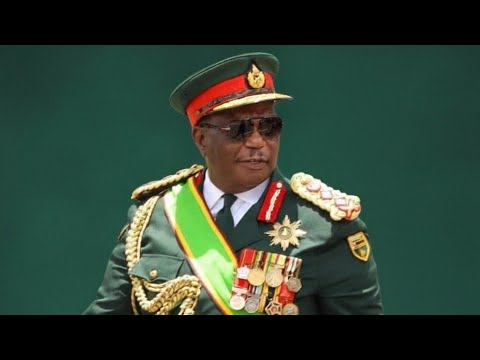
In a blistering address that sent shockwaves through Zimbabwe's political establishment, Vice President Constantino Chiwenga has declared that 'no one is above the law' and launched what he described as a 'total war against corruption' — an extraordinary statement from a man who himself helped topple a government on those very grounds, and whose own inner circle now stands directly in the crosshairs. The most startling revelation came when Chiwenga explicitly warned that even the country's most senior officials, including those within the ruling ZANU-PF party and state security apparatus, would face immediate arrest and asset freezes. 'The days of using political office as a shield for criminality are over,' he declared, in a speech that many are interpreting as a direct challenge to entrenched patronage networks that have plundered Zimbabwe for decades.
The announcement, delivered during a televised press briefing in Harare and broadcast live on state media, marked a significant escalation in rhetoric from the former military strongman who orchestrated the 2017 coup that ended Robert Mugabe's 37-year rule. Chiwenga's statement comes as Zimbabwe's economy teeters on the brink of collapse, with inflation galloping at triple digits, a currency that has lost over 90% of its value against the US dollar, and a public health system starved of resources. Analysts say the timing is no accident: with the country facing its worst economic crisis since 2008, Chiwenga is positioning himself as a reformist crusader while simultaneously undermining his rivals ahead of a predicted succession battle within ZANU-PF.
Is Zimbabwe's new anti-corruption drive genuine or a political purge?
The Frontline: Cronies, Generals, and Missing Billions
The move has been greeted with a mix of terror and cynicism in Harare's political clubs. 'This is either the beginning of a genuine clean-up or the most sophisticated factional purge we've ever seen,' said Dr. Pedzisayi Mashingaidze, a Harare-based political analyst who has advised the government on governance reforms. 'Chiwenga knows that the system is rotten, but he also knows that whoever controls the anti-corruption narrative controls the succession. The question is whether he will touch the sacred cows, including his own allies in the military, or whether this is just a weapon to eliminate competitors.'
Zimbabwe's missing billions: Where did the money go?
Regional Shockwaves: Debt, Laundering, and the Southern African Fallout
Zimbabwe's corruption crisis is not an island. Illicit financial flows from the country have long been laundered through the property markets of Sandton in Johannesburg, the luxury estates of Cape Town, and the opaque banking systems of Mauritius and the British Virgin Islands. A 2021 report by the Financial Action Task Force's Eastern and Southern Africa Anti-Money Laundering Group found that politically exposed persons from Zimbabwe had moved an estimated US$2.5 billion through regional financial centres over the past decade, fuelling property bubbles and distorting real estate markets in neighbouring South Africa. Should Chiwenga's taskforce succeed in tracing and recovering those assets, it could trigger diplomatic crises with countries that have turned a blind eye to the inflows.
The anti-graft drive also carries profound implications for Zimbabwe's US$14 billion external debt, which has locked the country out of international capital markets. The International Monetary Fund and African Development Bank have repeatedly conditioned any debt restructuring on demonstrable anti-corruption reforms. Chiwenga's offensive, if credible, could unlock the first staff-monitored programme the IMF has granted Zimbabwe in two decades. Western diplomats in Harare privately acknowledge that they are watching closely. One European ambassador, who spoke on condition of anonymity, told this reporter: 'We have heard the words before. This time we want to see arrests, convictions, and asset returns. Then we will talk about bridging finance.'
The regional security dimension is equally fraught. Several of the military figures suspected of being targets are key players in the Southern African Development Community's (SADC) mission in Mozambique's Cabo Delgado, where Zimbabwean troops have been deployed to fight an Islamist insurgency linked to natural gas infrastructure. Removing those commanders abruptly could jeopardise SADC's military operations and the energy security of the entire region. Analysts caution that Chiwenga must navigate the clean-up without destabilising the military structures that sustain his own base.
Will Zimbabwe finally be readmitted to the international community?
Chiwenga's declaration is a high-stakes gamble. If he delivers even a fraction of the arrests and prosecutions promised, he could reshape Zimbabwe's political landscape and its standing in the region. If it collapses into factional score-settling, the country risks a return to the violent internal power struggles that have defined its post-independence history. For now, the nation — and the entire Southern African region — waits to see whether the man who once held the gun against Mugabe now has the will to turn it on the system he helped create.