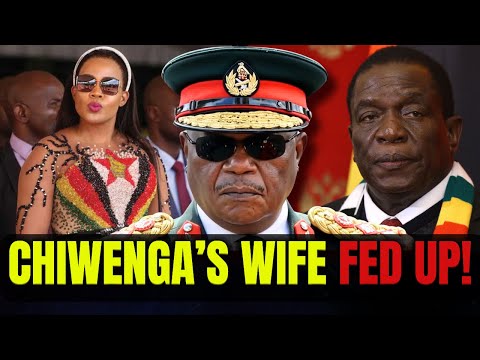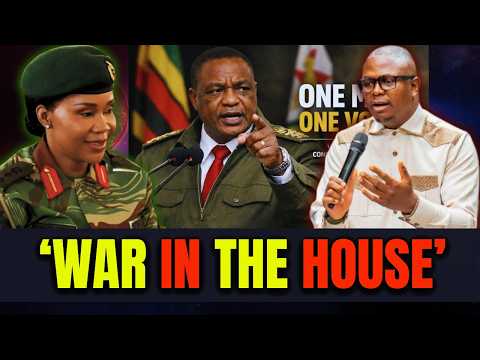
HARARE — A blistering family feud involving Zimbabwe's Vice President Constantino Chiwenga has spilled into the open, with his wife Miniyothabo Chiwenga publicly accusing his brother, Apostle Andrew Chiwenga, of orchestrating a campaign of calumny and material greed that threatens to destabilize the country's already fragile political landscape.
In a video statement circulated widely on social media, Miniyothabo, who holds the title of Dr. and is known for her business interests, directly challenged the Apostle over his reported attempts to 'take control' of the Vice President's public image and private affairs. She labeled his actions 'a fire lit against our family' and warned that she would 'strike back with equal force' to protect her husband's legacy and their children's future.
The outburst marks an extraordinary breach of the normally guarded personal lives of Zimbabwe's political elite. Vice President Chiwenga, a former army general who led the 2017 coup that ousted Robert Mugabe, has been hospitalized in China for months, leaving a power vacuum in the ruling ZANU-PF party. His absence has emboldened internal rivalries, and the Chiwenga family rift is now being read by political analysts as a proxy for deeper factional struggles within the government.
Family Feud Threatens ZANU-PF Unity
At the heart of the conflict is a dispute over financial and symbolic control. Apostle Chiwenga, a prominent pastor in Harare, has reportedly positioned himself as the Vice President's spiritual guardian, amassing influence over the general's followers and even collecting donations in his name. Miniyothabo's retaliation suggests she views this as a direct threat to her own position and to the proper management of the Vice President's estate and political network.
'When the head of a ruling party is incapacitated, family disputes become national security issues,' said Dr. Tendai Biti, a former finance minister and political analyst who has observed ZANU-PF infighting for decades. 'The Chiwenga family row is not merely personal; it reflects the scramble for succession that has already paralyzed government decision-making.'
Zimbabwe's economy, already reeling from hyperinflation exceeding 500% in 2023 and a collapsing currency, faces additional uncertainty as key ministries operate without clear direction. The Vice President, once seen as the party's strongest figure for post-Mnangagwa leadership, now commands a divided loyal base. His brother's public ministry and his wife's counter-accusations are tearing that base apart.
Data from the Zimbabwe Statistics Agency shows that foreign direct investment fell by 22% in the first quarter of 2024, as investors shy away from a country where the line between family drama and high politics has blurred. The Chiwenga affair has become a cautionary tale for diplomatic missions in Harare, who now treat the family's statements as signals about the country's leadership direction.
Regional Implications for Southern Africa
The feud's timing could not be worse for the Southern African Development Community (SADC). Zimbabwe was already under scrutiny for its uneven application of the rule of law, electoral irregularities, and human rights abuses. The Chiwenga family crisis reinforces a narrative of elite impunity and instability that SADC has tried to contain.
'When a Vice President's family takes their grievances to social media, it sends a message that the state is weak and its leaders are distracted,' argued Dr. Moeletsi Mbeki, a South African political economist. 'For the region, this means Zimbabwe cannot be relied upon for coordinated responses to shared challenges like the drought crisis, energy shortages, and cross-border crime.'
Already, South Africa's presidency has expressed 'concern' over Zimbabwe's internal political drift, though it stopped short of direct intervention. The Chiwenga saga amplifies those worries. Landlocked countries like Zambia and Botswana, which depend on Zimbabwean transport corridors, face renewed risks as governance lapses could lead to border delays and corruption spikes.
The Vice President's office in Harare has remained silent, releasing only a terse statement that 'family matters are being handled appropriately.' That silence, however, is being interpreted by diplomats as an admission that the situation is beyond quick resolution.
For ordinary Zimbabweans, the spectacle is both alarming and exhausting. A street vendor in Harare's Mbare township, who asked not to be named, summed up the mood: 'We see these rich people fighting over power and money while we cannot even buy bread. Who is fighting for us?'
As the fire between Miniyothabo and Apostle Chiwenga intensifies, the entire Southern African region may find itself caught in the blaze.