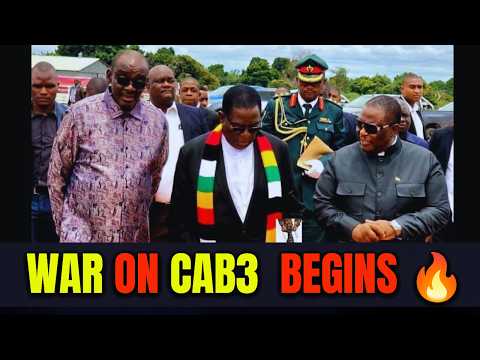
The most urgent fact in this political storm is not the sermon itself—it is the accusation that a senior state figure is using religious messaging as a vehicle for succession pressure, factional mobilisation, and public undermining of President Emmerson Mnangagwa.
In a forceful intervention, Themba Mliswa framed Vice President Chiwenga’s widely circulated ‘King Hezekiah’ message as more than disagreement with the President. He argued that criticism of Mnangagwa has become socially “palatable,” while similar scrutiny of Chiwenga is treated as “kufarisa,” exposing what he called a dangerous double standard inside the ruling party’s political ecosystem.
For Mliswa, the issue is discipline and national stability. He insisted that politics is not meant to be conducted through intimidation, coded messaging, or public grandstanding at the level of the Vice President. In his view, when a Vice President repeatedly signals resistance while remaining inside the party structure, the effect is not debate—it is erosion of unity.
From scripture to succession: Mliswa’s charge against ‘Hezekiah’ messaging
Mliswa’s argument begins with interpretation. He said the sermon was not being treated as faith alone, but as political theatre—an attempt to influence the direction of leadership and the internal balance of power. He characterised the message as an “attack” on Mnangagwa, arguing that the Vice President’s public posture is being used to generate momentum outside formal party channels.
He also rejected the idea that such messaging can be dismissed as mere expression. Mliswa argued that a Vice President should not “pander” to social media and opposition sentiment through content designed to provoke reaction while the party is navigating major political processes. In his framing, the Vice President’s approach is not simply dissent; it is undermining the superior he serves and the party machinery he is expected to strengthen.
Crucially, Mliswa went beyond criticism to a warning about consequences. He said Chiwenga is effectively operating as an internal opposition figure—questioning party decisions and feeding public narratives that Mliswa described as “treasonous thoughts.” The charge is stark: that Chiwenga’s continued presence within the ruling party, paired with public signals of resistance, is politically self-defeating and destabilising.
Mliswa’s position also contains a rhetorical safeguard. He claimed that if the roles were reversed—if Chiwenga were the one in the presidency—he would still defend him against similar “subversive actions.” The point, in Mliswa’s telling, is to present his stance as principle rather than factional opportunism.
But the practical demand embedded in his remarks is hard discipline. Mliswa told the Vice President to stop grandstanding and choose a clear path: align with party decisions or step aside and seek support elsewhere. In other words, he is arguing that ambiguity at the top is not tolerated—because ambiguity becomes a tool for factional mobilisation.
That is why Mliswa warned that leaving the current manoeuvres unchecked could sow “dangerous seeds of discontent.” His fear is not disagreement itself; it is the institutionalisation of discontent as a strategy—where loyalty tests replace internal debate and where punishment becomes the default response to dissent.
Zimbabwe’s internal power fight and the regional risk of precedent
Mliswa argued that ZANU-PF remains the only viable instrument for “assumption of power,” but he accused Chiwenga of thrashing “the water” out from under the very party that could carry him forward. In his metaphor, the party is the environment that sustains political survival; undermining it is self-condemnation.
He also warned against building a support base by appealing to the wrong constituency. Mliswa’s critique is that a politician cannot simultaneously court opposition sentiment and expect to ride to power on internal support. That contradiction, he argued, is politically fatal—because internal structures do not reward public undermining of the leadership they are meant to defend.
There is another layer to his warning: the risk of destabilising precedent. Mliswa suggested that Chiwenga is operating within a “controlled environment” despite the veneer of potency projected by his words. He noted that some have dared ZANU-PF to fire the Vice President, but he warned that such a move could be a mistake—because it would shift Chiwenga from a controlled internal context to an external one, where he could operate with fewer constraints and potentially more leverage.
That is a geopolitical problem as much as a domestic one. When senior officials fracture the ruling coalition, the ripple effects extend beyond borders. Neighbouring governments and regional institutions watch closely for signs of instability because succession fights can quickly become security issues, disrupt policy continuity, and complicate negotiations on trade, migration, and regional cooperation.
Mliswa’s remarks also reflect a broader pattern in Zimbabwean politics: the tension between social media gravitas and institutional power. He argued that while Chiwenga’s online influence appears to be flaring, the party base that could have been built through conventional mobilisation has been “slowly but effectively decimated.” In his view, the Vice President is focusing on the wrong political constituency—chasing viral momentum rather than durable internal legitimacy.
He even drew a comparison to past opposition dynamics, describing the current approach as resembling a cycle of “words, verses and social media coronations” that look powerful but remain structurally vulnerable. The implication is that charisma without organisational discipline does not translate into real control.