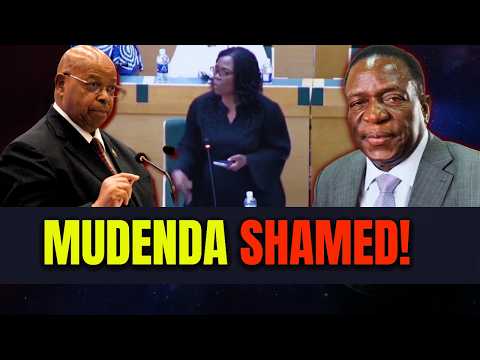
Harare, Zimbabwe – In an extraordinary and fiery session that threatened to spiral into physical confrontation, opposition Members of Parliament Johanna Mamombe and Hon. Muneri effectively brought proceedings in Zimbabwe’s National Assembly to a halt, directly challenging Speaker Jacob Mudenda and Justice Minister Ziyambi Ziyambi on what they termed “a deliberate subversion of parliamentary privileges and the Constitution of Zimbabwe.” The dramatic scene, captured in widely circulated video clips, has sent shockwaves through the political establishment and reignited fears of a deepening democratic crisis in a country already under intense scrutiny from its neighbors and international partners.
The confrontation began when Mamombe, a fiery backbencher from the Citizens Coalition for Change (CCC), rose on a point of order as Minister Ziyambi was delivering a ministerial statement on proposed security legislation. Eyewitness accounts and parliamentary sources indicate that Mamombe accused the minister of misleading the House and violating Standing Orders by failing to circulate the draft bill within the mandatory 14-day period. When Speaker Mudenda attempted to rule her out of order, Mamombe refused to sit down, launching into a detailed recitation of Section 119 of the Zimbabwean Constitution, which mandates the full participation of all MPs in legislative matters. Muneri, standing in solidarity, interrupted the Speaker’s repeated calls for order, shouting, “You cannot silence the people’s voice. This House is not your personal court.”
A Constitutional Clash or a Calculated Disruption?
The incident has exposed the deep fault lines within Zimbabwe’s Parliament, which has been increasingly paralysed by partisan rancor since the disputed 2023 elections. For Mamombe, 38, this is not her first standoff with the Speaker. She was previously arrested and allegedly tortured in 2020—a case that drew condemnation from the United Nations and the African Union. Her presence as a human rights activist turned legislator has made her a polarising figure. Supporters see her as a fearless defender of democratic accountability; critics within ZANU-PF label her a “disruptive agitator” bent on paralyzing government business.
“What we witnessed yesterday was not just a procedural squabble—it was a fundamental collision between an emboldened executive and a legislature that still believes it has a role to play in checking power,” said Dr. Tafadzwa Chikwanha, a political analyst at the University of Zimbabwe who has followed parliamentary developments for two decades. “Mamombe and Muneri are using every tool at their disposal—including public shaming and direct confrontation—because they feel that the formal channels of redress have been closed off by a Speaker who openly sides with the ruling party.”
The Speaker’s office has not issued an official statement, but a senior parliamentary staffer who spoke on condition of anonymity confirmed that Mudenda had summoned the sergeant-at-arms to restore order, a step that was ultimately avoided when the two MPs abruptly walked out, followed by the entire CCC caucus. The walkout effectively shut down the sitting for the rest of the day, forcing the cancellation of three scheduled committee meetings and a vote on an appropriation bill.
Geopolitical Fallout: A Test for Southern Africa’s Democratic Resilience
While the drama unfolded in Harare, its reverberations were felt across the region. Zimbabwe’s economy remains in a deep crisis—inflation topped 55 percent in March, the currency has lost 80 percent of its value in six months, and millions face food insecurity. The political instability in Parliament only exacerbates the investment climate, with the International Monetary Fund delaying its latest review of Zimbabwe’s economic reform program. South Africa, Botswana, and Zambia, which have all struggled with their own domestic political turbulence, are watching closely.
“Zimbabwe is the canary in the coal mine for Southern Africa,” said Dr. Mpho Ndlovu, a senior researcher at the Institute for Security Studies in Pretoria. “If the executive can openly ignore parliamentary procedures and the opposition can only respond by walking out, that is a dangerous sign for the entire region. Citizens lose faith in institutions, and the space for dialogue shrinks. This feeds into the broader trend of democratic backsliding we are seeing from Mozambique to Eswatini.”
The Southern African Development Community (SADC), which has been mediating Zimbabwe’s political disputes since the 2008 power-sharing agreement, released a terse statement calling for “calm and adherence to constitutional order.” But critics note that SADC has historically been reluctant to impose meaningful consequences on Harare, preferring quiet diplomacy that has failed to halt the erosion of democratic norms.
For Zimbabweans already grappling with daily power cuts, a collapsing health system, and a scarcity of hard currency, the parliamentary theatrics may seem distant—but they are not irrelevant. “When Parliament is unable to function, we lose the last institution that could hold the government accountable for its failures,” said Grace Mukarati, a 44-year-old teacher in Chitungwiza. “I watched the video on my phone. I saw Mamombe standing up to men who think they can do anything. That is the only kind of hope we have left.”
Mamombe and Muneri have said they will continue to challenge what they call “unconstitutional” moves by the executive. The Speaker has threatened to refer them to Parliament’s Privileges Committee for contempt—a move that could lead to suspension. As the political temperatures rise, one thing is clear: the fire inside Zimbabwe’s Parliament chamber is far from extinguished.