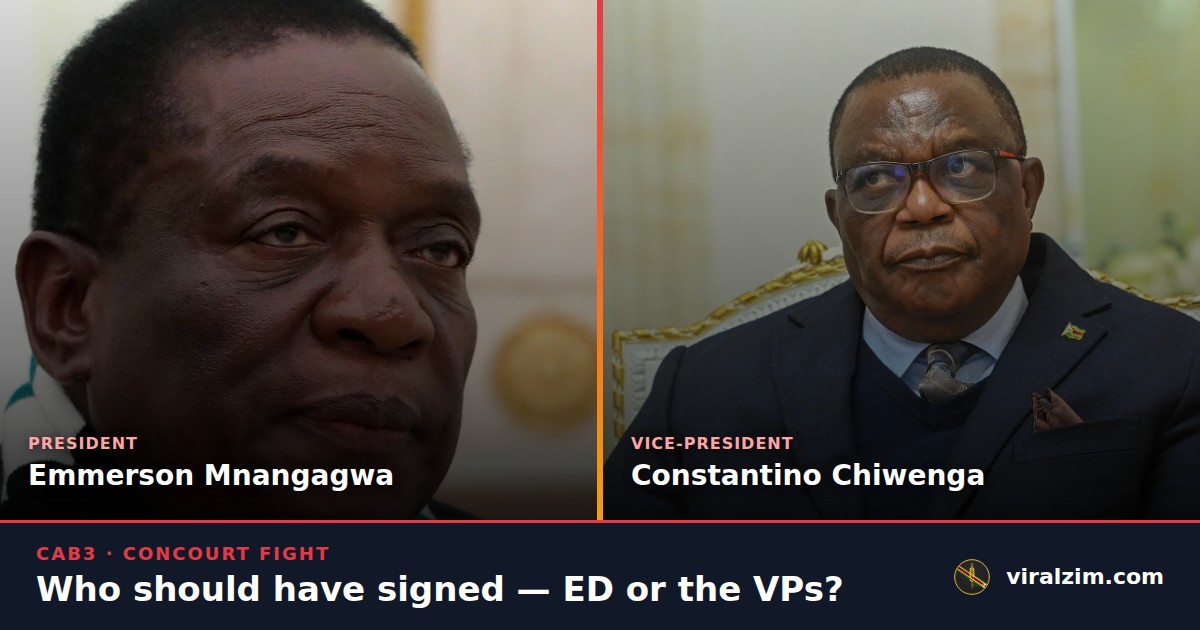
The ruling Zanu PF party is facing its gravest internal crisis in years after Vice Presidents Constantino Chiwenga and Kembo Mohadi failed to attend a key Politburo meeting on Wednesday, multiple party insiders have confirmed. The boycott – which left empty seats at the highest decision-making table – is being interpreted as a direct challenge to President Emmerson Mnangagwa’s grip on the party ahead of the 2028 succession battle.
The Boycott That Signals a Deeper Rift
“This was not a mere scheduling conflict. It was a deliberate show of force,” said a Harare-based political analyst who has advised party factions in the past. “Chiwenga’s military-backed faction and Mohadi’s traditionalist wing have long chafed under Mnangagwa’s style of leadership. By staying away, they are sending a message that they will not rubber-stamp decisions that marginalise them.”
Chiwenga, the former army general who helped bring Mnangagwa to power in the 2017 coup, has been steadily building his own power base. Mohadi, a veteran of the liberation struggle, commands loyalty among older party cadres. Their joint absence is unprecedented in recent memory and suggests that the two vice presidents have coordinated their opposition.
Repeated calls to the official spokespersons for Zanu PF and the Office of the Vice President went unanswered. The party’s Twitter account posted a routine summary of the meeting minutes that omitted any mention of boycotts. State-owned media, which normally reports extensively on Politburo events, carried only a brief line noting that the meeting had taken place.
The crack in the party’s public unity comes at a dangerous moment. Zimbabwe is grappling with hyperinflation – official figures put annual inflation at 175% in February, though independent economists estimate it is above 300% – and the government is borrowing heavily from the central bank to pay civil servants. The International Monetary Fund has suspended staff-level talks over governance concerns, and the United States extended its targeted sanctions on senior officials in March.
Geopolitical Fallout for Southern Africa
Zimbabwe’s instability is never contained within its borders. The Southern African Development Community (SADC), already stretched by crises in Mozambique’s Cabo Delgado province and the political standoff in Madagascar, views Zimbabwe as a lynchpin of the region’s security architecture. Any escalation in Harare could destabilise the entire bloc.
“If Mnangagwa loses control of Zanu PF, there is a real risk of state paralysis,” said Dr. Nomsa Sibanda, a senior researcher at the Institute for Security Studies in Pretoria. “That would create a vacuum that organised crime networks, already operating from Zimbabwe’s border regions, would exploit. South Africa and Botswana would face a surge in smuggling, illegal migration, and arms trafficking.”
The boycott also threatens SADC’s mediation efforts in eastern Democratic Republic of Congo, where Zimbabwe contributes troops to a regional force. If Harare’s political crisis deepens, those deployments could be pulled, weakening the mission against the M23 rebels.
Inside Zimbabwe, the opposition Citizens Coalition for Change (CCC) has called for an independent investigation into the Politburo rift, though the party itself is fractured and unable to mount a coherent challenge. “The regime is eating itself,” said a CCC spokesperson. “We are watching, but we are not in a position to stop the bleeding.”
Analysts caution that the boycott does not necessarily mean an immediate coup or resignation. Mnangagwa still controls the security apparatus and the levers of patronage. But the fact that Chiwenga and Mohadi were willing to publicly defy him suggests that internal negotiations have broken down.
“Mnangagwa has a history of outmanoeuvring rivals,” said the Harare-based analyst. “But he is 81 years old. He cannot outrun the succession question. The vice presidents know this, and they are positioning themselves for the endgame.”
The coming weeks will be decisive. If Chiwenga and Mohadi continue to skip meetings and rally their factions, Zanu PF may descend into an open war of attrition. For the people of Zimbabwe – already battered by economic collapse and a healthcare system in ruins – that prospect is terrifying. For Southern Africa, it is a warning that the continent’s next crisis may be triggered not by a border clash or a disputed election, but by a boycott in a smoke-filled room in Harare.