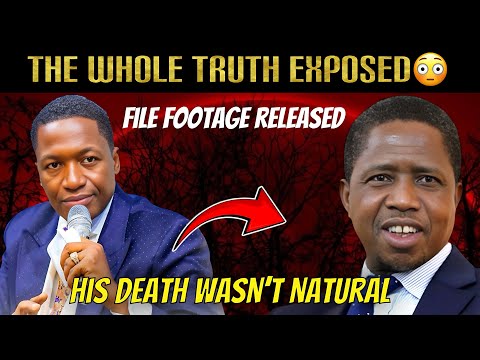
Prophet Uebert Angel, a prominent figure in Southern Africa's religious landscape, has publicly claimed that his prophetic interventions were directly responsible for the political demise and eventual death of former Zambian President Edgar Lungu. In a recent address, Angel asserted that he had "numbered the days" of the former leader, framing the event as a manifestation of divine judgment against those who opposed his ministry.
Lungu, who served as the sixth president of Zambia, died at the age of 68. His passing has sparked significant discourse across the SADC region, with Angel’s bold declarations adding a layer of religious controversy to the political narrative. Angel alleged that Lungu had previously blocked him from entering Zambia and that he had subsequently declared on television that the former president would face electoral defeat, a prediction he claims came to pass.
The Intersection of Faith and Politics in Southern Africa
The influence of charismatic religious figures on political leaders in Southern Africa has become a subject of increasing scrutiny. Critics argue that such claims of divine political influence undermine democratic processes and the secular nature of governance. Angel’s assertion that he possesses the power to "remove people from power" reflects a growing trend where religious leaders position themselves as kingmakers or spiritual arbiters of state affairs. This dynamic is particularly sensitive in countries like Zimbabwe, where the lines between political patronage and religious endorsement are often blurred.
“The prophetic voice is frequently used to legitimize or delegitimize political actors,” says Dr. Tendai Mashingaidze, a researcher specializing in religion and politics in the region. “When a leader claims to have caused the death or downfall of a head of state, it transcends mere religious rhetoric and enters the realm of political intimidation. It forces the public to view political outcomes through a supernatural lens, which can be both stabilizing and destabilizing for national discourse.”
Regional Implications and Public Reaction
The incident highlights the broader geopolitical tensions within the SADC region, where political leaders often seek the counsel—or the endorsement—of high-profile prophets. For many in Zimbabwe and neighboring states, the intersection of these spheres is a source of both hope and deep skepticism. The use of such platforms to address the death of a former head of state raises ethical questions regarding the responsibility of religious leaders in public life.
As the region continues to navigate complex political transitions, the role of these influential figures remains a point of contention. While supporters view Angel's words as evidence of his spiritual authority, detractors see them as an opportunistic exploitation of a sensitive political death. The incident serves as a stark reminder of the unique and often volatile relationship between faith-based influence and political power in contemporary Southern Africa.