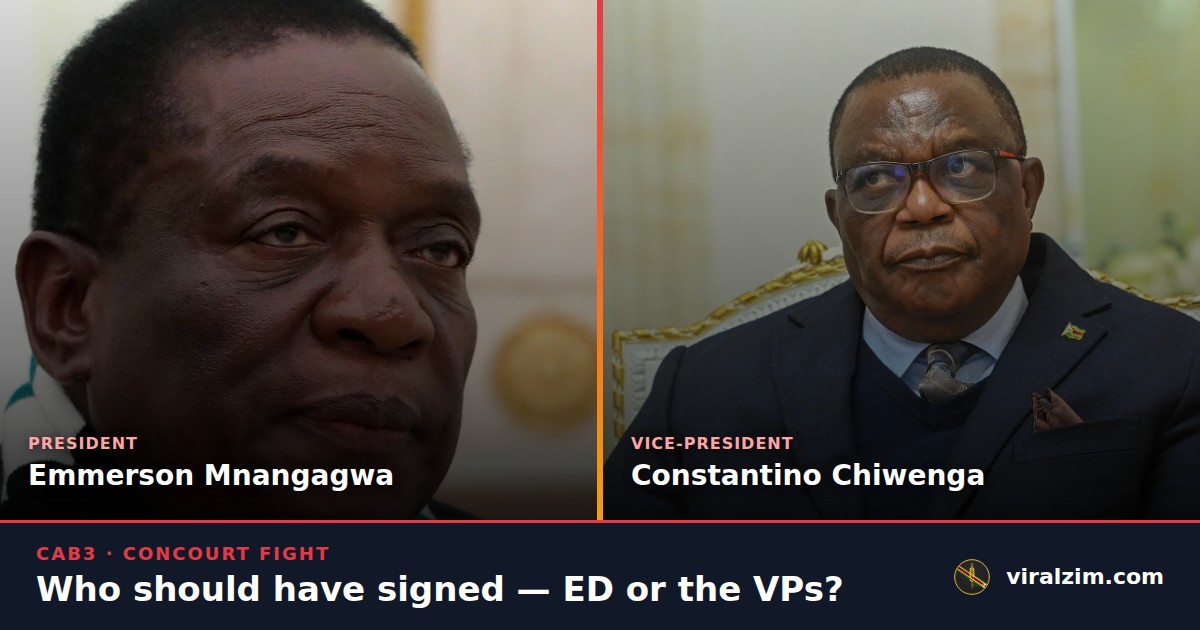
The claim, first aired during a live broadcast by a Harare-based media outlet, alleges that a coordinated plan involving state security agencies was set in motion to detain Chiwenga on criminal charges shortly after his return from a diplomatic visit to Kampala. Neither the Vice President's office nor the Zimbabwean government has officially commented on the report, but independent analysts warn that even the unsubstantiated rumor reflects a dangerous breakdown in the country's already fragile political truce.
The Alleged Plot and Its Backdrop
Chiwenga, a former army general who orchestrated the 2017 military intervention that ousted Robert Mugabe, has been locked in an increasingly public rivalry with President Mnangagwa. The two men were once allies in the post-Mugabe transition, but a series of cabinet reshuffles and corruption investigations have been widely interpreted as an attempt by Mnangagwa to sideline his deputy. In 2019, Chiwenga survived an assassination attempt in the form of a suspicious food poisoning incident while on a trip to China, and in 2021 he underwent months of medical treatment abroad, fueling speculation about his political future.
'This is not just a rumor; it is a sign that the internal power struggle is moving from the boardroom to the barracks,' said a Harare-based political analyst who requested anonymity due to the sensitivity of the matter. 'If true, the arrest of a sitting vice president would be unprecedented in Zimbabwe's history. It would fracture the military, split the party, and send a signal to the region that the state itself is being weaponized.'
Zimbabwe's security apparatus has long been a double-edged sword. The Zimbabwe Defense Forces, which Chiwenga once commanded, remain deeply factionalized. Mnangagwa, a former state security chief under Mugabe, has consolidated his grip on the police and intelligence services, but the military's loyalty is uncertain. 'The army is not a monolith,' added the analyst. 'Any move against Chiwenga would risk a split that could trigger a violent confrontation.'
Geopolitical and Regional Fallout
The implications extend far beyond Zimbabwe's borders. The Southern African Development Community (SADC) has watched Harare's internal instability with growing alarm. Mnangagwa's government, already crippled by hyperinflation, a collapsing currency, and international sanctions, relies heavily on regional goodwill and Chinese investment. A naked power grab against Chiwenga would undermine the veneer of constitutional order that Mnangagwa has tried to project to attract foreign capital.
Uganda, where Chiwenga was visiting, is a key SADC partner. President Yoweri Museveni has historically maintained close ties with both Mnangagwa and Chiwenga. The arrest of a vice president on his return from Ugandan soil would be seen as a diplomatic affront to Kampala and could complicate bilateral relations. 'This is a test for SADC,' said a regional security expert based in Pretoria. 'If Zimbabwe descends into open political warfare, the entire region will feel it — from trade routes to refugee flows.'
China, Zimbabwe's largest foreign creditor and a key arms supplier, has remained publicly neutral but has a clear interest in stability. Beijing has backed Mnangagwa but also maintains ties with Chiwenga's faction. Any disruption could jeopardize billions of dollars in mining and infrastructure deals. 'The Chinese do not take sides, but they abhor chaos,' noted a diplomat familiar with Beijing's Africa policy. 'They will pressure both camps to avoid a full-blown crisis.'
The arrest plot, if verified, would also highlight the fragility of Zimbabwe's post-2017 'transition.' Mnangagwa promised democratic reforms but has instead consolidated autocratic rule. The opposition, led by Nelson Chamisa, remains marginalized. A Chiwenga arrest could galvanize anti-Mnangagwa forces, including disgruntled war veterans and elements within the military. 'This is the kind of spark that lights a powder keg,' warned the Harare analyst.
As of press time, Chiwenga has not been publicly seen since his return, and the government has not issued a statement. The absence of official confirmation fuels speculation. Opposition lawmakers have called for an emergency session of Parliament to address the allegations. Meanwhile, social media in Zimbabwe is ablaze with conflicting narratives, with some pro-Mnangagwa accounts dismissing the report as 'fake news' while others demand a full investigation.
What is clear is that Zimbabwe's political stability — already hanging by a thread — is facing its gravest test since the 2017 coup. For the people of Zimbabwe, who endure daily power cuts, soaring inflation, and unemployment above 80 percent, the prospect of another elite power struggle only deepens their despair. For Southern Africa, a region still recovering from the shocks of COVID-19 and a war in Mozambique, another crisis on the Limpopo is the last thing needed.
The coming hours and days will reveal whether the alleged plot is real or a political weapon designed to test loyalties. Either way, the damage to Zimbabwe’s already tarnished reputation is done. The world is watching — and so are the generals.