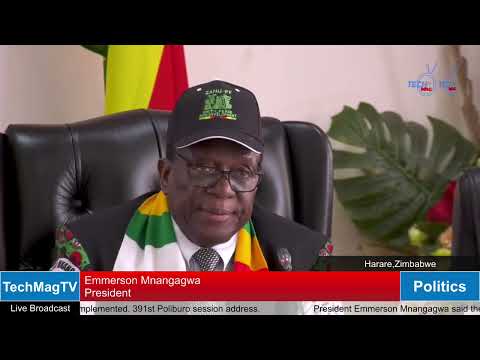
In a decisive move that signals a tightening of internal party discipline, President Mnangagwa has officially tasked the Politburo with the full and swift implementation of all party resolutions. The directive, broadcast via TechMag TV, underscores a strategic push to ensure that the party’s legislative and policy agenda moves from the planning stage to concrete action without further delay. This mandate serves as a clear signal to the party leadership that the time for deliberation has concluded, and the era of execution has begun.
The Strategic Mandate
The background of this directive lies in the necessity for organizational cohesion and the realization of long-term party objectives. By focusing on the Politburo—the central executive body—Mnangagwa is leveraging the highest level of party governance to drive his agenda forward. The move is designed to eliminate bureaucratic inertia that has historically hindered the transition from policy adoption to actual, on-the-ground implementation. This push for efficiency is aimed at solidifying the party's grip on its stated goals and ensuring that every resolution passed is treated as a binding, time-sensitive requirement.
Analyzing the Directive
From an analytical perspective, this development represents a significant shift in political management. By demanding 'swift' implementation, Mnangagwa is effectively placing the Politburo under a microscope, making them directly accountable for the success or failure of party policies. This is not merely an administrative instruction; it is a political recalibration. The focus on 'all' resolutions implies a comprehensive audit of the party's agenda, leaving no room for selective execution or the shelving of complex mandates. The urgency conveyed in the directive suggests that the leadership is seeking to project an image of absolute control and operational readiness.
Impact on Governance
The real-world significance of this directive is profound, as it directly dictates how the party will function in the coming months. If the Politburo succeeds in rapidly implementing these resolutions, it could lead to a more streamlined and responsive political environment. However, the pressure to act 'swiftly' carries inherent risks, including the potential for oversight or the marginalization of dissenting voices within the party structure. The impact will be felt primarily in the speed at which internal policy is translated into public-facing action, potentially altering the political landscape of Zimbabwe as the party seeks to consolidate its influence through efficient governance.
Stakeholder Reactions
The reaction from party stakeholders and observers has been one of intense scrutiny. The directive has effectively set a benchmark for performance that the Politburo must now meet. Within the party, this is being interpreted as a call to arms for officials to align their activities with the President’s vision. Outside observers are watching closely to see if the Politburo can actually meet these high expectations or if the directive will lead to internal friction. The emphasis on 'full' implementation suggests that the leadership is unwilling to accept partial results, placing significant pressure on those tasked with executing the party’s will.
What Happens Next
Moving forward, the primary metric for success will be the tangible progress made on the specific resolutions mentioned in the directive. Observers should watch for subsequent reports or meetings where the Politburo is expected to present updates on their implementation progress. The speed and quality of these updates will serve as a litmus test for the effectiveness of Mnangagwa’s leadership style and the responsiveness of the party’s top brass. Whether this directive leads to a period of accelerated development or increased political tension remains the central question for the coming cycle.