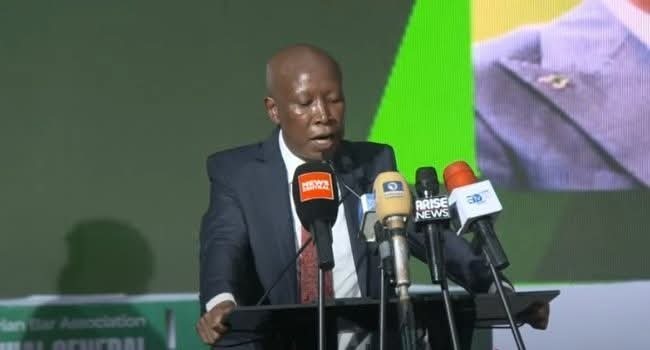
Julius Malema’s call for a single African presidency and a common currency is not a ceremonial pan-African slogan—it is a direct attempt to redraw the constitutional architecture of sovereignty across the continent. Speaking at the Nigerian Bar Association (NBA) Annual General Conference in Enugu, he demanded a borderless Africa where Africans can move freely, where money is governed collectively, and where security decisions are centralised rather than fragmented by national borders.
Malema’s intervention landed in a legal setting that matters: the NBA conference is a platform where rules, enforcement and institutional design are debated. His message was blunt—Africa cannot industrialise, defend itself, or negotiate with global powers from a position of strength while Africans remain trapped inside colonial-era boundaries that shape citizenship, policing, trade and migration.
He argued that the continent must “speak with one voice” through a package of structural changes: one presidency, one currency, one parliament, and one military command. The proposal challenges the post-independence settlement that left borders intact while governments inherited separate legal systems, separate monetary regimes and separate security chains of command.
In Enugu, Malema framed integration as a power shift. The core issue, he said, is not identity—it is control: who sets the rules, who manages money, who commands security, and who adjudicates disputes. That is why his agenda is inseparable from governance. A borderless Africa without enforceable rights would not liberate people; it would simply relocate coercion into new forms.
Legal forum turns pan-Africanism into a governance blueprint
Malema delivered the keynote address at the NBA’s 2025 Annual General Conference at the International Conference Centre in Enugu on Sunday, August 24, 2025. His argument was anchored in the idea that the legal profession has a role in decolonising systems—removing barriers that restrict movement and economic development across Africa.
He urged leaders to discard “colonial” boundaries and replace fragmentation with integration. The demand for a unified military command and a single presidency goes beyond symbolism. It implies a transfer of authority away from national governments—especially over internal security, border enforcement and crisis decision-making.
That is where the political shock lies. Centralising security and citizenship would force governments to surrender parts of their sovereignty at the exact moment many states are already struggling with legitimacy, corruption and capacity constraints. In practice, the hardest question is not whether integration is desirable; it is whether institutions can protect rights when authority is pooled.
Malema’s call also intersects with the NBA’s emphasis on removing intra-African barriers and enabling visa-free movement as a foundation for economic development and trust. The legal framing matters because movement is not only about travel—it is about work permits, residency rights, labour protections, access to courts and the ability to challenge abuse.
Without harmonised legal standards, visa-free travel can become a trap: migrants may move more easily, but they can still be denied due process, exploited through informal labour markets, or targeted through selective policing. Malema’s agenda therefore creates a high-stakes test for African leaders—whether they can build enforceable rights into integration, not just announce them.
Southern Africa’s fault lines: mobility, xenophobia and the cost of fragmentation
For Zimbabwe and the wider Southern African region, Malema’s proposal is not abstract. Southern Africa already lives with the consequences of porous borders, uneven enforcement and recurring violence against migrants—especially in South Africa, where economic stress and political contestation can quickly turn into collective punishment of foreign nationals.
A borderless Africa could reduce the conditions that allow scapegoating and exploitation to thrive—if integration is paired with credible citizenship rights, common standards and accountable institutions. But if integration is pursued without safeguards, it could intensify conflict by increasing the number of people exposed to abuse while leaving enforcement mechanisms fragmented and biased.
Malema’s insistence on a unified military command is also inseparable from regional security debates. The African Union has repeatedly struggled to translate continental commitments into rapid, credible action when crises erupt. A single security command would attempt to solve that by centralising decision-making. Yet centralisation would also trigger resistance from leaders who fear losing control over internal security and border management.
That tension is already visible across the region: states want cooperation, but they also want the ability to act unilaterally when domestic politics demand it. Integration would force a choice—either accept shared authority during crises or continue paying the price of fragmentation.
The most disruptive element is the demand for one currency. Currency unions are not just about exchange rates; they require fiscal coordination, banking supervision, and political consensus on taxation and spending. Africa’s monetary landscape remains fragmented, with different exchange-rate regimes, debt structures and inflation dynamics.
For Zimbabwe, monetary stability has been a defining political and economic struggle. Any movement toward a common currency immediately raises hard questions: who sets monetary policy, how shocks are absorbed, what happens when one member state faces a severe balance-of-payments crisis, and how debt is restructured or pooled. Without credible mechanisms, a common currency can become a vehicle for transferring risk from the weakest economies to the most vulnerable populations.
Malema’s political logic is that currency fragmentation keeps Africa dependent—especially in negotiations where the dollar dominates trade invoicing, debt servicing and global finance. A continent that negotiates as one bloc could be harder to divide and better positioned to resist external pressure tied to loans, sanctions and conditionalities.
But the Zimbabwean and Southern African reality is that ordinary people experience monetary policy through prices, wages and jobs. Integration that ignores social protection and transition planning risks turning a grand bargain into a new source of instability.
Malema’s speech also carries a geopolitical warning: integration is leverage. A continent that can coordinate on trade, industrial policy and security would reduce the ability of external actors to exploit divisions. That matters for Southern Africa because regional economies are deeply connected to global markets—through commodity exports, remittances, and cross-border labour flows.
The NBA’s emphasis on removing intra-African barriers points to the practical work ahead: harmonising labour laws, strengthening anti-trafficking enforcement, and building dispute-resolution mechanisms that migrants can access. The legal profession’s role becomes central because implementation will depend on courts, legal aid, regulatory compliance and enforceable standards.
There is also a hard warning embedded in Malema’s own framing. Integration without rights protection can turn migrants into targets. Integration without credible enforcement can make borders reappear in different forms—through paperwork barriers, corruption at border posts, private militias, and selective policing.
For Zimbabwe and Southern Africa, the immediate impact is political pressure. Malema has forced the integration agenda back into the open—at the level of presidency, currency, military command and citizenship. The region now faces a choice: support a long-term roadmap toward integration, or demand enforceable safeguards first.
Either way, the debate is no longer confined to academic circles. It is being demanded from a public stage where lawyers, policymakers and political leaders are listening—and where the consequences will be measured in security outcomes, economic access and the safety of people on the move.
Click to act: