
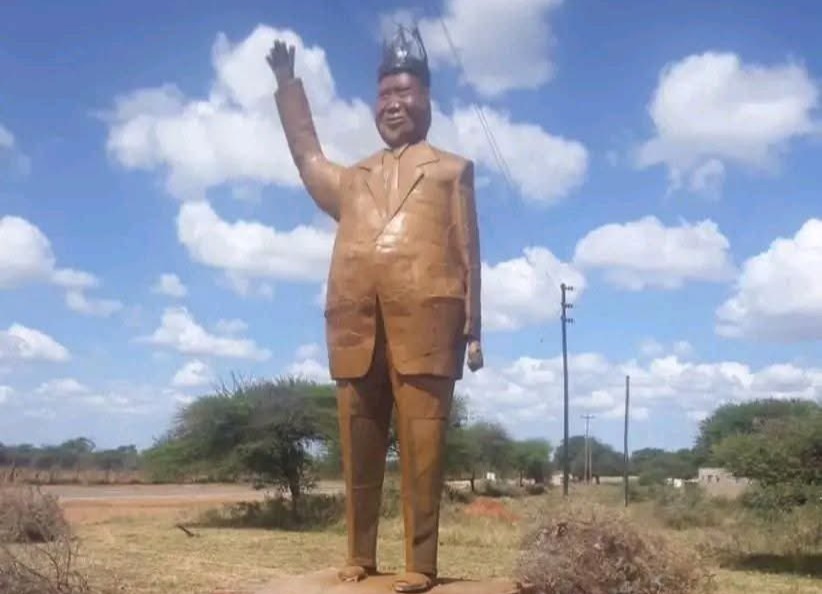
MAPHISA, Matabeleland South — A new statue of liberation hero Joshua Mqabuko Nyongolo Nkomo has been installed in Maphisa ahead of Zimbabwe’s Independence Day celebrations tomorrow, as the country marks 46 years since independence.
The timing is not incidental. The main national celebrations are being held in Maphisa, and the statue is now positioned as part of the public-facing landscape that will host state delegations, school children, veterans and thousands of residents expected to converge on the town for Zim@46.
But the installation has reopened a question Zimbabweans ask every time public monuments rise: what did it cost, who paid, and where is the accountability for taxpayers’ money—especially in a country where basic services remain under pressure and households are already stretched by the cost of living.
Symbol in stone, scrutiny in the streets
Joshua Nkomo is not a peripheral figure in Zimbabwe’s national story. He is widely regarded as a central architect of the unity that followed years of conflict. Known as ‘Father Zimbabwe’, Nkomo served as Vice-President from 1990 until his death in 1999. His legacy is deeply embedded in the liberation narrative and in the political settlement that shaped the post-independence state.
That is why the decision to place a new Nkomo statue in Maphisa—Nkomo’s home area and the venue for the main Independence Day celebrations—carries symbolic weight beyond commemoration. It is intended to anchor the state’s message of unity and development in a region with a painful history, including the mass violence of the 1980s that devastated parts of Matabeleland.
Zimbabwe’s government has linked the choice of Maphisa to historic resonance and national narrative-building. Cabinet has also confirmed that the 46th Independence Celebrations and the 2026 Children’s Party will be held at Maphisa Growth Point in Matobo District under the theme ‘Zim@46-Unity and Development Towards Vision 2030’.
Yet symbolism does not settle budgets. When monuments are unveiled, the public is often left without the full financial ledger: the contract value, the procurement route, the materials used, the contractor’s identity, and whether the project met cost and quality standards. In Zimbabwe, that transparency gap is where public anger grows.
There is also a history of controversy around Nkomo statues—particularly over consultation, design standards and the involvement of foreign sculptors. Disputes in the past over the Bulawayo statue included objections to elements of the pedestal and broader concerns about how the project was handled. That history matters now because it shapes how residents interpret new installations: as remembrance, yes—but also as political theatre if the spending is not explained in a way ordinary people can verify.
In Maphisa, the question is blunt and immediate: how much did this statue cost? The figure has not been publicly confirmed in the information available to the public, and without a transparent breakdown, Zimbabweans are left to guess. Guessing is not accountability; it is fuel for suspicion.
“Monuments are not neutral,” said Pathisa Nyathi, a Bulawayo-based historian, in earlier commentary on the quality and implications of the Nkomo statue project. Nyathi argued that the statue’s design and context raised questions about standards and representation.
That critique lands with renewed force in the current moment. Zimbabwe is not only building stone figures; it is building legitimacy—through how it spends, how it consults, and how it explains.
Independence Day spectacle meets the politics of spending
Tomorrow’s Independence Day celebrations will therefore test more than choreography and speeches. They will test whether the state can pair unity messaging with financial transparency and regional sensitivity.
In Matabeleland South, the symbolism is especially charged. The region is being asked to host the national event, and that can be a genuine honour. But hosting also places the spotlight on whether commemoration is matched by tangible improvements—roads, water systems, health facilities and local economic opportunities—rather than relying on spectacle alone.
Preparations are already underway. Public communications around the celebrations have emphasized progress on infrastructure and legacy projects tied to the host district, with plans extending beyond the day itself. Still, the statue is the most visible object in the immediate countdown, and visibility is where scrutiny concentrates.
That scrutiny is not only domestic. In Southern Africa, Zimbabwe’s political choices reverberate. When Zimbabwe invests in liberation iconography, it signals how the region should interpret its own liberation histories, governance models and reconciliation narratives. In that environment, the cost and procurement details become more than local administrative matters—they affect how partners, investors and neighbouring governments read Zimbabwe’s priorities.
Across the continent, public procurement scandals have repeatedly shown how quickly financial opacity can become a diplomatic and economic liability. Transparency is therefore not just a moral requirement; it is a strategic asset. When governments cannot clearly account for public spending, they weaken trust at home and credibility abroad.
Zimbabwe’s Independence Day is also watched beyond the region. Liberation leaders and monuments are part of a wider African contest over memory: whose suffering is recognized, whose contributions are centred, and whose reconciliation is treated as complete. In that contest, monuments are never only about the past. They are about the present—and about what the state is willing to justify.
As the national anthem is expected to be sung in Maphisa tomorrow, the statue will stand as a message of remembrance. But for many residents, the real test will be whether the state answers the hard question behind the ceremony: what did it cost, and who is accountable?
Until procurement records, contract amounts and responsible officials are made clear and verifiable, the stone will remain both symbol and unanswered bill.