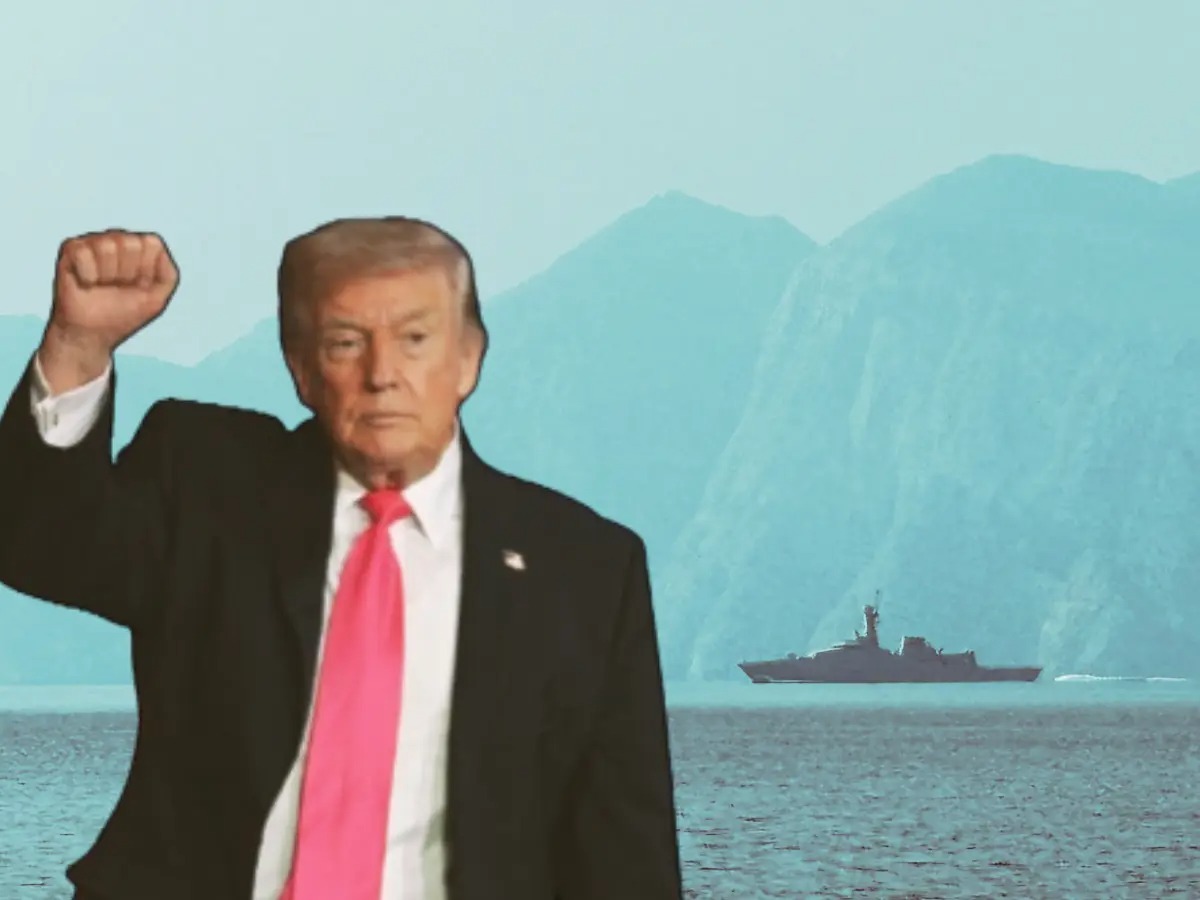
The most dangerous part of the U.S.-Iran confrontation is no longer confined to the air. It is the sea lanes—where a single boarding, a single disabled engine, or a single drone strike can cascade into a wider regional war. On Sunday, the United States seized the Iranian-flagged cargo ship Touska near the Strait of Hormuz after a U.S. guided-missile destroyer issued repeated warnings over several hours and disabled the vessel. Iran’s joint military command said the seizure would be met with a ‘swift response’—turning a maritime enforcement action into a potential trigger for retaliation.
President Donald Trump said the destroyer ‘stopped them right in their tracks’ by blowing a hole in the engine room and that U.S. Marines were ‘seeing what’s on board.’ The U.S. framed the operation as enforcement of a naval blockade that began last week—its first interception since the blockade of Iranian ports started. The message was clear: Washington is not only watching Iranian-linked activity; it is actively disabling and seizing ships it deems connected to Tehran’s strategic aims.
Drone pressure meets blockade enforcement
The seizure did not happen in isolation. It landed in the middle of a widening campaign in which Iran has increasingly leaned on unmanned systems—drones and other low-cost platforms—to pressure U.S. and allied forces without matching conventional military firepower. That shift matters because drones are designed to overwhelm defenses, complicate identification, and create constant friction at sea and in the air. When unmanned attacks and maritime interdictions are treated as one integrated threat, the operational logic becomes saturation and disruption: deny freedom of navigation, force rerouting, and raise the cost of operating near Iranian waters.
In Washington, the posture has moved beyond simply holding the line at Iranian ports. The U.S. has widened enforcement efforts to stop ships tied to Tehran or suspected of carrying supplies that could support Iran’s military capabilities—ranging from weapons-related materials to oil, metals, and electronics. The goal is to tighten the economic and logistical pipeline that sustains Iran’s regional leverage. The U.S. has also signaled that it expects to enforce control even when ships attempt to route around restrictions—an approach that assumes the U.S. can manage dense global shipping traffic while still applying pressure.
Chairman of the Joint Chiefs of Staff Gen. Dan Caine described the challenge in blunt terms: enforcing control while navigating crowded shipping lanes is like ‘driving a sports car through a supermarket parking lot on a payday weekend.’ The metaphor captures the core risk. The U.S. believes it can keep control; Iran believes enforcement is an act of aggression. When both sides interpret the same actions through incompatible lenses, the chance of miscalculation rises sharply.
Ceasefire uncertainty and the risk of escalation
Sunday’s seizure also arrived amid fragile political timing. A ceasefire deadline was looming, and uncertainty surrounded whether new talks would proceed as planned. Iran’s chief negotiator and senior parliamentary leadership insisted there would be ‘no retreat in the field of diplomacy,’ while acknowledging that gaps remained. But diplomacy cannot survive if each side treats the other’s moves as proof of an imminent ‘decisive’ strike.
Iran’s joint military command called the seizure a ceasefire violation. The United States treated it as enforcement of blockade rules. That mismatch is not a semantic dispute—it is a direct escalation pathway. A disabled engine, a boarding, or a warning shot can be interpreted as a deliberate breach rather than a controlled enforcement step. In such an environment, retaliation becomes more likely, and retaliation becomes harder to contain.
Compounding the danger is the U.S. operational expansion. The U.S. has broadened its approach beyond a narrow blockade perimeter, signaling it would actively pursue Iranian-flagged vessels and ships providing material support to Iran. The practical effect is a wider footprint: more interdictions, more confrontations at sea, and more opportunities for drones and naval assets to collide in the fog of war.
For Iran, drones offer a way to strike without exposing high-value platforms. For the U.S., interdiction and enforcement offer a way to disrupt supply chains and deter future attacks. But the combination—unmanned strikes plus aggressive maritime seizures—creates a feedback loop. Each side responds to the other’s pressure with tactics designed to reduce the opponent’s room to maneuver. That is how localized incidents become regional crises.
What happens next will not hinge on a single ship. It will hinge on whether Washington treats the Touska seizure as a contained enforcement action and whether Tehran treats it as a provocation requiring immediate, visible retaliation. Iran has already signaled it will respond. The United States has already signaled it is widening the scope of what it will seize and where. In a standoff defined by drones, interdictions, and contested interpretations of ceasefire rules, the next move could come faster than diplomacy can absorb.