
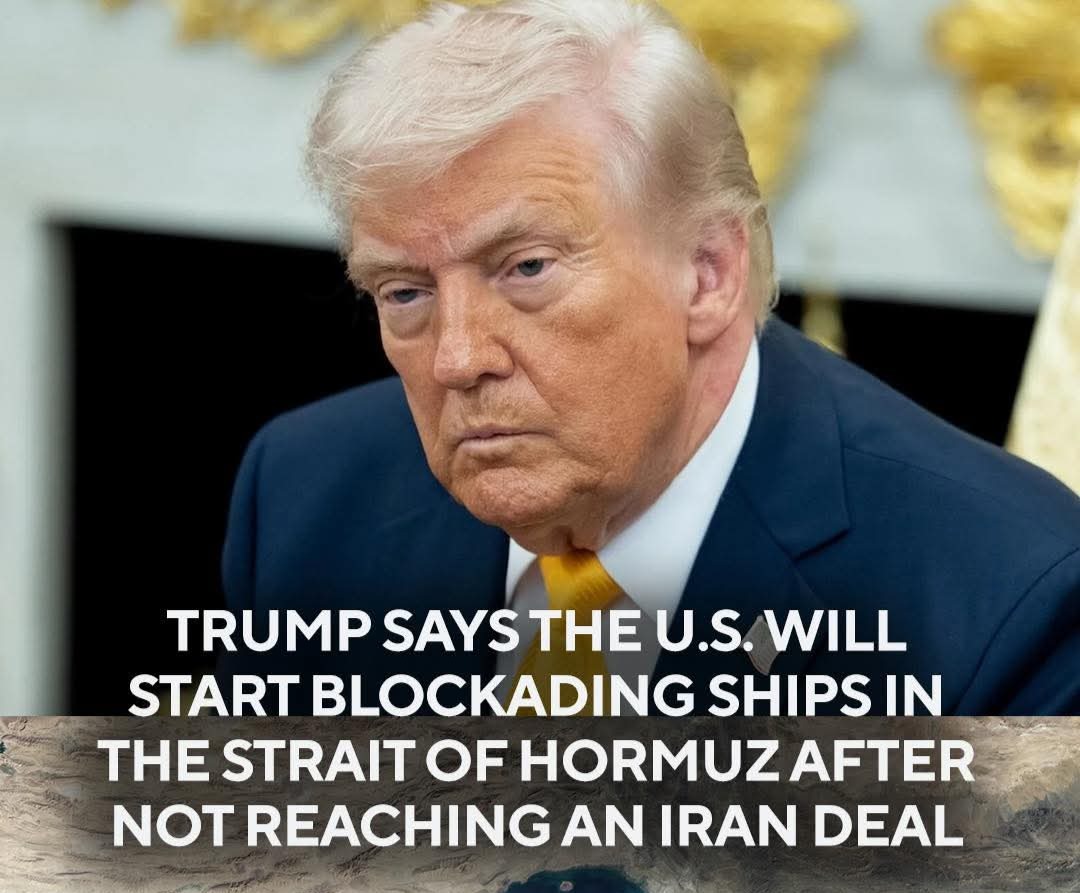
President Donald Trump announced Sunday that the U.S. Navy will begin a blockade of the Strait of Hormuz, warning that it will stop any ship trying to enter or leave the world’s most critical oil chokepoint and will interdict vessels that have paid tolls to Iran. The move, he said, takes effect immediately—turning a diplomatic effort into an operational confrontation at sea.
In a post on Truth Social, Trump wrote that “Effective immediately, the United States Navy, the Finest in the World, will begin the process of BLOCKADING any and all Ships trying to enter, or leave, the Strait of Hormuz,” and that he had instructed the Navy to “seek and interdict every vessel in International Waters that has paid a toll to Iran.” The language is unambiguous: this is not a warning of possible future action. It is a directive to act now.
The announcement follows marathon U.S.-Iran ceasefire talks mediated in Pakistan that ended without an agreement to end the wider war or reopen the strait. With diplomacy failing to produce a settlement, Washington is shifting from negotiation to enforcement—using naval power to control access to the corridor that underpins global energy markets.
Blockade and interdiction: a direct threat to global shipping
A blockade is designed to prevent commercial traffic from moving through a chokepoint, not simply to deter it. That distinction matters because markets react to disruption risk even before ships are physically stopped. Shipping insurers, freight operators, and energy traders price uncertainty in real time—often within hours—through higher premiums, revised routing, and contract renegotiations.
Trump’s second instruction—interdicting “every vessel” that has paid Iran tolls—adds a targeted enforcement mechanism. Iran has used toll collection as a way to assert leverage over passage and to frame reopening as conditional on compliance. By treating toll-paying as a disqualifying act, the U.S. is signaling that it will not recognize Iran’s toll regime as legitimate for safe passage.
That approach raises the stakes for civilian shipping. Interdiction in international waters can be interpreted as an escalation step by Iran, particularly if Iranian authorities or proxies treat toll enforcement as sovereign control. The risk is miscalculation: a civilian vessel could be caught between competing claims of authority, and a routine maritime inspection could spiral into a confrontation.
Even a partial disruption can trigger cascading effects. Maritime traffic does not need to stop completely for costs to rise. Reduced throughput, longer transit times, and heightened security procedures can tighten supply and lift prices. In energy markets, the Strait of Hormuz is not just a route; it is a pricing reference point. When the corridor is threatened, crude oil and refined products reprice immediately, and downstream costs follow.
For shipping companies, the operational question becomes whether transiting vessels can comply with U.S. directives without triggering Iranian retaliation. For insurers, the question becomes whether the risk profile has changed enough to justify new premiums or exclusions. For traders, the question becomes how long the disruption could last and whether it will spread beyond the strait.
Why this matters for Zimbabwe and Southern Africa: price shocks arrive fast
The Strait of Hormuz carries roughly one-fifth of global oil shipments and a comparable share of global LNG flows. That concentration means any threat to passage quickly becomes a global supply risk. When supply risk rises, oil prices typically move first, before diplomats can salvage a deal and before companies can adjust procurement plans.
In practical terms, a blockade threat can raise the cost of diesel and petrol used by freight operators, mining logistics, and agricultural supply chains. It can also increase the cost of industrial feedstocks and the price of goods transported across the region. Those effects do not require a full closure of the strait; they require only sustained uncertainty that keeps risk premiums high.
There is also a geopolitical dimension that can worsen the economic impact. A blockade and interdiction campaign increases the probability of escalation—especially if Iran responds by tightening its own enforcement or by targeting shipping linked to U.S. interests. If the confrontation expands, the strait could become less predictable, and markets will price that unpredictability as a structural risk rather than a temporary disturbance.
The immediate question now is whether the U.S. will operationalize the blockade through inspections, rerouting, or physical interdictions—and how Iran will respond to toll enforcement being treated as a hostile act. The longer the standoff persists, the more likely it becomes that the economic shock will outlast the diplomatic process that failed in Pakistan.