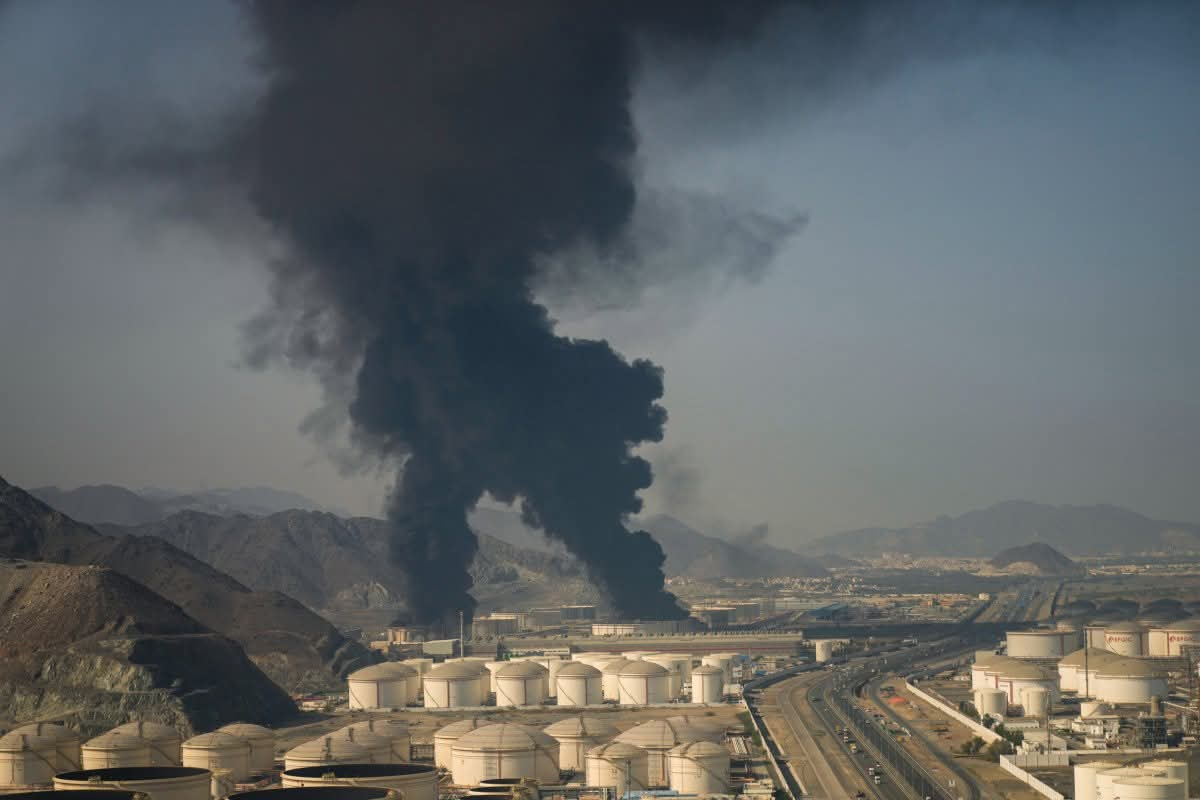
A coordinated drone strike has ignited a massive blaze at a critical United Arab Emirates oil facility, marking a violent expansion of the shadow war between Iran and the Gulf states. The attack, which hit the heart of Abu Dhabi’s industrial infrastructure, has sent crude oil prices soaring, immediately destabilizing energy markets that sustain the global economy. For Zimbabwe and the Southern African Development Community (SADC), this act of aggression is not a distant Middle Eastern skirmish; it is a direct threat to the region's already precarious fuel security and economic survival.
The Architecture of Escalation
The strike follows a pattern of heightened regional tensions that have simmered since the 2019 Abqaiq–Khurais attack in Saudi Arabia. Intelligence reports identify the weaponry as sophisticated loitering munitions, likely supplied by Iranian proxies, aimed at crippling Gulf logistics. The UAE, a key OPEC producer, has seen its strategic neutrality tested as Iranian-backed Houthi forces in Yemen expand their targeting envelope. With over 30% of the world’s seaborne oil passing through the Strait of Hormuz, these attacks are deliberate attempts to weaponize the global supply chain, turning the Gulf into a flashpoint that dictates the price of a liter of petrol in Harare or Lusaka.
Geopolitical Shockwaves in Southern Africa
For Zimbabwe, a nation already grappling with chronic fuel shortages and a heavy reliance on imported refined products, the UAE strike is catastrophic. As global oil prices spike, the landed cost of fuel in Southern Africa climbs, putting immense pressure on foreign currency reserves. Dr. Tapiwa Muchena, a regional energy economist, notes, 'Zimbabwe imports its fuel via the Beira corridor, which is directly indexed to international benchmarks. When the Gulf burns, the pump price in Harare hits the ceiling within weeks, triggering inflation that wipes out the purchasing power of the average citizen.' The ripple effect extends to transport costs, food prices, and the operational viability of the mining sector, the backbone of the Zimbabwean economy.
The Real-World Economic Toll
Data from the International Energy Agency (IEA) suggests that sustained disruptions in UAE output could tighten global supply by up to 2 million barrels per day. For landlocked nations like Zimbabwe, Zambia, and Botswana, this means an immediate supply crunch. Unlike larger economies, these countries lack the strategic petroleum reserves to buffer against a prolonged conflict. 'We are looking at a scenario where supply chains are not just expensive, but potentially volatile,' says Sarah Jenkins, a senior energy analyst. 'If the UAE’s infrastructure remains a target, the premium on African oil imports will become unsustainable, forcing governments to choose between subsidizing fuel or funding basic social services.'
Diplomatic and Institutional Reactions
The international community has condemned the attack, with the UN calling for immediate de-escalation to avoid a regional conflagration. However, the Gulf states are signaling a hardened stance. 'We will not stand by as our sovereignty and economic infrastructure are targeted by state-sponsored proxies,' a UAE diplomat stated in an emergency briefing. In Southern Africa, the response has been more guarded. SADC officials are watching the situation with mounting anxiety, fearing that if the U.S. or its allies respond militarily against Iranian assets, the resulting chaos in the shipping lanes will lead to a total logistical blockade, leaving the region starved of energy.
The Future of Regional Energy Security
The path forward is grim. As long as the proxy war between Iran and the Gulf continues, the risk to maritime security and energy infrastructure remains existential. For Zimbabwe and its neighbors, the imperative is clear: the energy transition must accelerate. Dependence on imported fossil fuels from a volatile Middle East is a strategic failure that can no longer be ignored. Future stability requires diversifying supply routes and investing in local renewable alternatives. Until then, every drone strike in the Gulf is a direct hit to the prosperity of Southern Africa, reminding leaders that their economic stability is tethered to a region thousands of miles away, currently engulfed in flames.