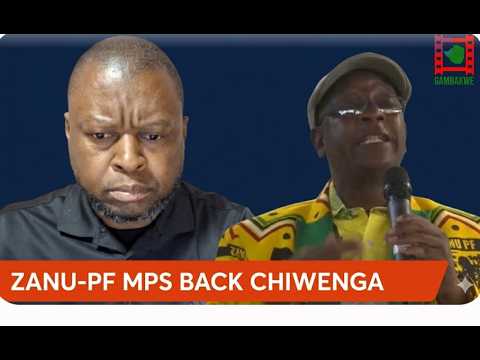
HARARE, Zimbabwe – Zimbabwe’s ruling Zanu-PF party has finally addressed the conspicuous absence of both Vice Presidents, Constantino Chiwenga and Kembo Mohadi, from a critical Politburo meeting held last week – but the official explanation is doing little to calm mounting speculation about a deepening internal power struggle.
In a rare public statement, Zanu-PF spokesperson Christopher Mutsvangwa said the two vice presidents were absent from the February 20 Politburo session due to ‘previously scheduled engagements’ and dismissed rumours of a rift. However, multiple party insiders and political analysts say the absence of the country’s two most senior officials from a meeting that discussed the party’s candidate selection process ahead of the 2028 elections is highly unusual and points to intensifying factional battles at the top of the party.
A Party in Two Camps
The Politburo meeting was convened to finalise the party’s electoral strategy, including the controversial ‘no primary elections’ resolution that would allow President Emmerson Mnangagwa to hand-pick candidates. Both Chiwenga and Mohadi are seen as leaders of competing factions within the party, with Chiwenga – a former army general who led the 2017 coup that ousted Robert Mugabe – widely considered the frontrunner to succeed Mnangagwa. Mohadi, a former State Security minister, commands a smaller but loyalist faction that has traditionally supported Mnangagwa.
‘The absence of both vice presidents from a meeting where such a contentious issue was under discussion is not a coincidence,’ said a Zimbabwe-based political analyst who spoke on condition of anonymity due to the sensitivity of the matter. ‘It indicates that the succession battle within Zanu-PF is no longer a hidden debate; it is now playing out in real time through attendance and non-attendance at party structures.’
Geopolitical Stakes for Southern Africa
The internal machinations in Zanu-PF extend far beyond party politics. Zimbabwe remains a pivotal player in the Southern African Development Community (SADC), especially as the region grapples with the fallout from Mozambique’s Cabo Delgado insurgency, the crisis in the Democratic Republic of Congo, and an ailing South African economy. A chaotic succession in Zimbabwe would destabilise the entire region.
Zimbabwe also sits on some of the world’s largest untapped lithium deposits, making it a critical node in the global green energy transition. Chinese and Russian mining giants have poured billions of dollars into the country’s mining sector. Any political vacuum or outbreak of factional violence could jeopardise those investments, sending shockwaves through the Johannesburg Stock Exchange and commodity markets.
‘Investors are watching this very closely,’ said a Harare-based economist who requested anonymity. ‘The absence of Chiwenga and Mohadi from the Politburo is being interpreted as a sign that President Mnangagwa may be trying to sideline his rivals ahead of a possible third-term bid. If the succession battle turns violent, we could see capital flight and a further decline in the Zimbabwean dollar.’
Chiwenga and Mohadi have both been noticeably absent from public events in recent weeks. Chiwenga missed the SADC Extraordinary Summit in Harare earlier this month, while Mohadi canceled a scheduled tour of the border town of Beitbridge. The party has offered no medical or personal explanation for either absence.
What the Party Says – and Doesn’t Say
In his statement, Mutsvangwa attempted to project unity, insisting that the party ‘remains solidly behind President Mnangagwa’ and that the vice presidents are ‘fully engaged in their constitutional duties’. But the statement did not specify what those ‘engagements’ were, nor did it explain why both vice presidents could not be present at a meeting that lasted only four hours.
‘The party is trying to control the narrative, but the narrative has already escaped their grasp,’ said Masunungure. ‘The public and the international community see two powerful men who were not in the room when crucial decisions were made. That is not a sign of a healthy ruling party.’
The episode also raises questions about President Mnangagwa’s own grip on power. Now 81, Mnangagwa has not explicitly ruled out seeking a third term in 2028, despite Zimbabwe’s constitution limiting a president to two five-year terms. Amendments to the constitution would require a two-thirds parliamentary majority, which Zanu-PF possesses. Analysts say the current factional posturing is a direct result of the uncertainty over whether Mnangagwa will step down or attempt to stay on.
‘The succession question is the single biggest source of instability in Zimbabwe right now,’ said the political analyst. ‘Chiwenga and Mohadi both believe they have a claim to the presidency. If Mnangagwa tries to extend his rule, he could face a revolt from within his own party – as he did against Mugabe.’
Regional Reaction and the Road Ahead
SADC’s principle of non-interference in member states’ internal affairs has largely kept the regional bloc silent, but a full-blown crisis in Harare would force the organisation to act. Already, SADC’s mediation efforts in Mozambique and Lesotho have been complicated by Zimbabwe’s political uncertainty.
The coming weeks will be critical. Zanu-PF is expected to hold its annual conference in December, where the succession issue will almost certainly dominate. For now, the party line is that all is well. But the empty seats at the Politburo table tell a different story – one of a party on the verge of a historic fracture with consequences that will be felt far beyond Zimbabwe’s borders.