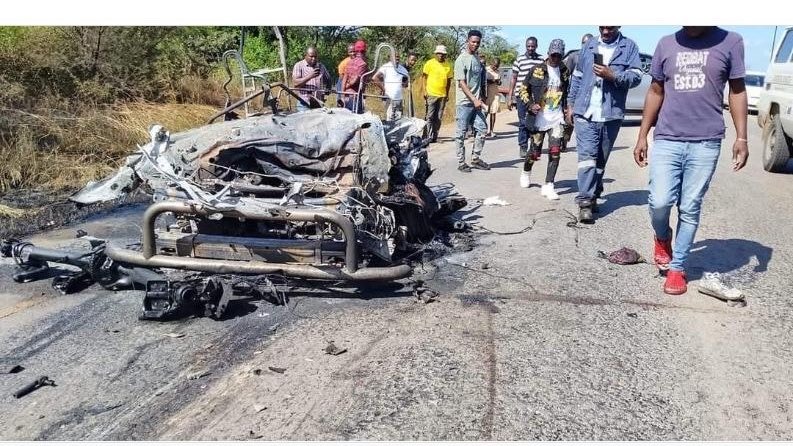
Zimbabwe Republic Police has confirmed the deaths of about 18 people after a kombi exploded into fire on the Bulawayo–Beitbridge Road between Chipangali and the Gwanda tollgate. The incident occurred between 1300 hours and 1400 hours today, turning a routine commuter journey into a mass-casualty disaster on one of the country’s most heavily used corridors.
The location is not incidental. The Bulawayo–Beitbridge Road is the main overland artery linking Zimbabwe’s interior to the Beitbridge border post, where cross-border movement of passengers and freight feeds into regional trade flows. In Matabeleland South, the corridor is also a daily lifeline: kombis, buses, and haulage trucks move people to work, learners to schools, and families to markets and clinics. When fire erupts on a packed highway route, the consequences spread instantly—beyond the crash site and into households that depend on that transport every day.
Fire on a packed highway corridor turns minutes into tragedy
Highway fires are uniquely lethal because they compress time. A kombi carrying passengers can become a moving inferno within minutes, especially where vehicles are overloaded, exits are limited, and passengers have little time to escape. Even when emergency services are dispatched quickly, the first minutes determine survival—how fast people can get out, whether the fire is contained, and whether rescue teams can access the scene safely.
ZRP has not yet released the full details of what caused the explosion or the identities of the victims. The police said more information will be provided in due course, including the passenger manifest and the circumstances leading to the fire. That gap matters. Public demand will focus on whether the vehicle was mechanically sound, whether it was carrying passengers beyond safe capacity, and whether any fuel or gas-related failure triggered the blaze.
Road safety specialists have long warned that preventable factors—vehicle roadworthiness, speed, overcrowding, and inconsistent enforcement—raise the risk of catastrophic outcomes. When those risks combine with delayed or constrained emergency response capacity, the result is a death toll that is far higher than the public expects from a single crash.
For families along the corridor, the impact will be immediate and brutal. Loss of income, funeral costs, and medical expenses often arrive at the same time, forcing households to pull children out of school or delay treatment. Communities also face a second wave of harm: the psychological shock of sudden death on a route people use daily, and the anger that follows when accountability is slow or incomplete.
Beitbridge corridor stakes: border trade, logistics costs, and regional confidence
Every major incident on the Bulawayo–Beitbridge Road carries geopolitical weight because the corridor is tied to regional movement of people and goods. Beitbridge is one of Southern Africa’s key border nodes, connecting Zimbabwe to South Africa’s economic hubs and forming part of the wider movement of freight and services across the region. When accidents occur on approach roads, the effects are not confined to local commuters.
Disruptions can delay deliveries, increase transport insurance and operating costs, and reduce labour availability when travel becomes unreliable. In an environment where economies are already under pressure from inflation and constrained public resources, repeated safety failures undermine confidence in cross-border travel systems and add friction to trade.
For Zimbabwe, the state faces a dual challenge: managing emergency response and bereavement support while also demonstrating credible prevention measures. The political and administrative pressure will be intense—because the corridor is a national economic channel, and because the public expects enforcement to match the scale of the risk.
Zimbabwe has repeatedly signalled road rehabilitation and corridor improvements. But rehabilitation alone does not prevent fires. Prevention requires strict compliance checks, consistent enforcement against overcrowding and unsafe vehicles, and rapid, well-resourced emergency response along high-risk routes. Today’s deaths will intensify scrutiny of whether those systems performed adequately in the critical early minutes after the kombi caught fire.
ZRP’s promise of further details will be tested by the public’s demand for answers: What exactly caused the explosion? Was there a mechanical failure? Was the vehicle overloaded? Were there fuel or gas-related issues? Did passengers have time and access to escape? And were fire suppression and extraction efforts initiated immediately and effectively?
As investigations begin, Zimbabwe will also watch for operational follow-through—whether the crash report is published, whether any regulatory breaches are identified, and whether survivors and families receive timely support. The immediate facts remain stark: about 18 people are dead; the incident occurred between 1300 and 1400 hours; and the explosion happened between Chipangali and the Gwanda tollgate on the Bulawayo–Beitbridge Road.
The corridor that connects Zimbabwe to the region will not forget this toll.