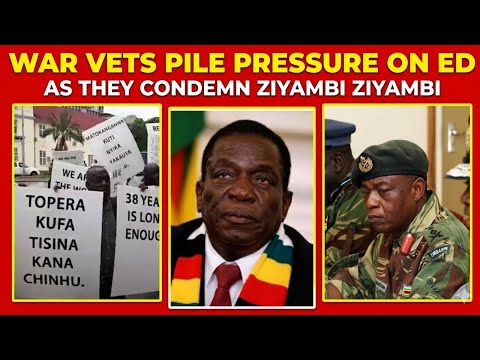
In a significant escalation of internal political friction, war veterans have publicly turned on President Emmerson Mnangagwa, issuing an urgent demand for the immediate firing of Ziyambi Ziyambi. The ultimatum, which has sent shockwaves through the political establishment, marks a volatile shift in the relationship between the governing party’s traditional power base and the current leadership. This development, broadcast via Mbire TV, signals a deepening crisis within the hierarchy as veterans of the liberation struggle openly break ranks with the head of state.
The Fracture in the Liberation Narrative
The demand for Ziyambi Ziyambi’s removal stems from mounting grievances within the war veteran community, a group that has historically served as the bedrock of the ruling party’s legitimacy. By targeting a key cabinet member, the veterans are effectively challenging the administrative competence and the political direction of the Mnangagwa presidency. This public confrontation reflects a growing disillusionment among those who view themselves as the custodians of the nation's revolutionary legacy, suggesting that the current governance trajectory is no longer aligned with their expectations or the party's foundational principles.
Analyzing the Political Brinkmanship
From an analytical perspective, this move is more than a mere cabinet reshuffle demand; it is a calculated act of political brinkmanship. By calling for the ouster of a high-ranking official like Ziyambi, the veterans are testing the limits of the President's authority and his ability to manage internal dissent. The timing of this demand, captured by Mbire TV, suggests that the veterans are leveraging their historical influence to force a course correction. This internal pressure creates a precarious environment where the administration must choose between appeasing its most loyal traditional base or maintaining the integrity of its current cabinet appointments.
The Strategic Consequences of Internal Dissent
The real-world significance of this standoff cannot be overstated. When the liberation war veterans—a group deeply embedded in the state's security and political apparatus—publicly demand the firing of a cabinet minister, it destabilizes the perception of unity within the party. For the broader public, this highlights a widening rift that could impact governance, policy implementation, and the overall stability of the state. The demand serves as a litmus test for the administration's resilience and its capacity to navigate dissent within its own ranks without triggering a broader collapse of institutional cohesion.
Public and Stakeholder Response
The reaction to this ultimatum has been swift and polarized, as evidenced by the intense social media discourse surrounding the Mbire TV report. Various stakeholders, ranging from political analysts to the general public, are scrutinizing the veterans' motives and the potential for a wider purge. The digital conversation, fueled by hashtags like #NoTo2030 and #ZanuPFParty, underscores a high level of public engagement with the conflict. There is palpable tension among citizens who are watching to see if the President will bow to these demands or if he will double down, potentially alienating a critical segment of his support base.
The Path Toward Political Uncertainty
Looking ahead, the primary focus will be on the President's response to the veterans' ultimatum. Will there be a strategic firing of Ziyambi Ziyambi to pacify the veterans, or will the administration attempt to marginalize the dissenters? The situation remains fluid, and observers are closely monitoring whether this demand is an isolated incident or the beginning of a broader campaign to reshape the current cabinet. As the political landscape shifts, the ability of the leadership to reconcile these competing interests will determine the stability of the administration in the coming months.