Power always offers two roads. One is wide, smooth, and paved with corruption, patronage, and personal gain. The other is narrow, steep, and built on principle—where the cost is immediate and the reward, if it comes, arrives late and only if the state can enforce it.
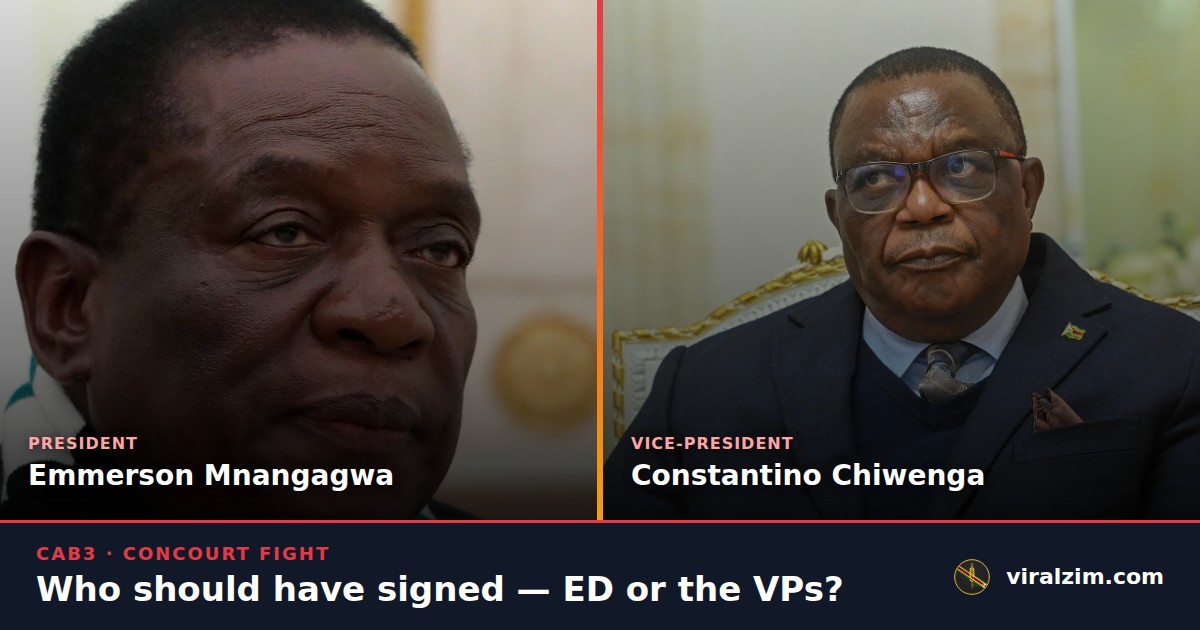
In Zimbabwe, that test is no longer abstract. It is played out in procurement decisions treated like currency, in party structures where “loyalty” is measured by who benefits, and in state-linked deals where public resources are quietly re-routed into private hands. In that environment, Vice President (Rtd) General Constantino Chiwenga’s political standing is being defined by a single claim: that he has refused to sell out when corruption and self-interest would have been easier.
That is why this moment matters. Zimbabwe does not need more speeches about integrity. It needs proof that leaders can resist the patronage machine—and survive the backlash that follows when entrenched networks feel threatened.
Corruption pressure meets liberation-era legitimacy
Zimbabwe’s political culture is saturated with liberation-era language. It is sometimes used as moral cover. It is sometimes used as a genuine benchmark. Either way, it creates an expectation: that the sacrifices of the bush war were not made so that tenders could be looted from air-conditioned offices while ordinary people endure shortages, unemployment, and rising costs.
But accountability is not measured by rhetoric. It is measured by outcomes: who gets investigated, who gets protected, whether public institutions are allowed to function without political interference, and whether the rules apply consistently across factions.
Inside the ruling party ecosystem, the debate around Chiwenga’s anti-corruption posture has become a flashpoint. The argument is not simply about whether corruption exists. Corruption is not a mystery in Zimbabwe—it is a system. The real question is whether the system can be confronted without selectively targeting rivals while shielding allies.
That is the core of the internal dispute. One side argues that corruption must not be “hijacked” for narrow political advantage and that unity cannot be sacrificed to factional calculations. The other side insists the problem is corruption itself—not the people raising alarms—and that focusing on the “problem” rather than attacking whistleblowers is the only way to break the cycle.
Zimbabweans should treat this as more than party drama. Corruption is not only an economic crime. It is a political weapon. When a leader becomes associated with challenging patronage networks, he becomes a target—not just for opponents outside the party, but for insiders who benefit from the status quo.
That is the hard path: not merely condemning corruption, but enduring the political cost of confronting it.
And here is the investigative standard Zimbabwe must demand: what specific actions were taken, what specific deals were stopped, what specific individuals were held accountable, and what measurable governance improvements followed. Without evidence, “principle” becomes a slogan. With evidence, it becomes a benchmark.
Zimbabweans are not asking for loyalty to a person. They are asking for loyalty to the public interest.
Southern Africa’s geopolitical reality: credibility travels
Zimbabwe does not operate in isolation. Southern Africa is a region where legitimacy is tested through economic performance, governance credibility, and the reliability of state institutions. When corruption deepens, it does not only drain budgets. It distorts investment decisions, undermines confidence in cross-border trade, and weakens governments’ bargaining positions with global lenders and strategic partners.
For Zimbabwe, the consequences are immediate and visible. When procurement is compromised, infrastructure suffers first—roads, power, water systems, and public services. When mining and value-addition policies are captured by rent-seekers, the country loses leverage in commodity negotiations and forfeits employment creation. When factionalism becomes the mechanism for distributing state resources, policy becomes unstable, scaring local entrepreneurs and foreign investors who require predictable rules.
That is why the “hard path” narrative is not only moral theatre. It is a governance thesis: principle is not a luxury. It is a strategy for protecting national capacity.
There is also a geopolitical layer. Zimbabwe’s governance choices shape how regional partners assess risk. In a tightly interlinked region, credibility deficits in one capital can ripple outward—affecting trade routes, regional investment sentiment, and the willingness of external actors to commit to long-term projects.
When leaders are seen to tolerate corruption, the region learns a dangerous lesson quickly: rules can be bent, enforcement can be selective, and accountability can be negotiated. When leaders are seen to confront corruption networks, the region learns something else: the state can act as a referee rather than a participant in the game.
In that context, Chiwenga’s position—whether one agrees with it or not—has become part of a larger regional question: will Zimbabwe’s security-state legacy be used to stabilize governance through discipline, or will it be used to entrench patronage through intimidation?
Zimbabweans deserve direct answers, not insinuations. The country needs a clear record of whether anti-corruption actions are consistent, whether they protect institutions or weaken them, and whether they reduce the incentives for rent-seeking.
Power will always offer the easy road. The question is whether Zimbabwe will produce leaders who can refuse it—and whether the refusal becomes a pattern rather than a performance.
Chiwenga’s supporters say he has taken the hard path. Zimbabwe will know whether that claim is true when principle stops being a slogan and starts showing up as measurable governance change: fewer opportunities for looting, stronger enforcement, and public resources that reach the people they are meant to serve.
Click to follow the investigation and demand accountability.