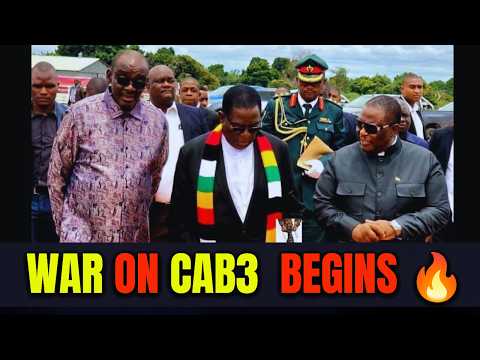
In a rare and significant public rebuke, Vice President and former Commander of the Zimbabwe Defence Forces General (Rtd) Constantine Chiwenga has broken his silence on the controversial Constitutional Amendment Bill No. 3 (CAB3), warning that the proposed legislation threatens the very foundation of the nation’s liberation heritage.
Chiwenga’s Objection
Speaking in an unprecedented public address, Chiwenga argued that CAB3 “undermines the sacrifices made during the nation’s struggle for independence.” The 69-year-old Vice President, who led the 2017 military intervention that removed Robert Mugabe from power, questioned “why the masses, who suffered during the liberation struggle, should now be denied their right to vote.”
CAB3, formally gazetted on 16 February 2026 as H.B. 1 of 2026, proposes sweeping constitutional changes including:
- Extending presidential and parliamentary terms from 5 to 7 years
- Abolishing direct presidential elections in favour of selection by a joint sitting of Parliament
- Allowing the President to appoint 10 additional Senators
- Stripping the Defence Forces of their constitutional mandate to uphold the Constitution
- Removing public interviews for judges
- Repealing the Zimbabwe Gender Commission and National Peace and Reconciliation Commission
Retired Generals Join the Fray
Chiwenga’s position has been reinforced by a group of retired military generals led by Vice Air-Marshal (Rtd) Henry Muchena, who issued a scathing statement against the bill last month.
“We state without equivocation that the said process was choreographed, imposed upon the people, and its outcomes do not in any manner reflect the genuine will of the people of Zimbabwe,” Muchena declared.
The retired generals further alleged that provincial party chairpersons were “induced with motor vehicles and payments of US$100,000 each to support CAB3” and that “US$31 million has been set aside to buy MP votes.”
Parliamentary Debate Intensifies
The National Assembly opened debate on CAB3 on 4 June 2026, but the session was cut short after MPs reported receiving death threats and security concerns. CCC MP Thomas Muwodzeri delivered a stinging critique of Clause 16, which seeks to amend Section 212 of the Constitution concerning the Defence Forces.
“A government that disempowers its own military from the constitutional obligation to defend the Constitution is a government that has something to fear from a constitutionally faithful military,” Muwodzeri told Parliament. “And a government that fears a constitutionally faithful military is a government that intends to act unconstitutionally.”
“Old Fault Lines Re-Emerging”
Analysts say the CAB3 debate has reopened old factional wounds within ZANU-PF, with supporters of President Emmerson Mnangagwa pushing for term extension while a rival faction widely seen as aligned with Chiwenga mounts resistance.
Justice Minister Ziyambi Ziyambi, defending the bill, praised the mobilisation effort: “Mashonaland West, you made us proud. You provided the highest number of written submissions. The mobilisation we did within our party structures was very excellent.”
Parliament claims 537,102 submissions in favour of CAB3 versus just 2,935 against — figures that civil society organisations have dismissed as “ghost stats” and “a gross distortion.”
Civil Society Rejects CAB3
At a People’s Summit held in Harare on 7 June 2026, civic organisations issued a joint communiqué declaring: “We, the people, reject CAB3 in its current form because it threatens constitutional democracy, accountable governance, the separation of powers, gender equality, and the democratic gains secured through decades of struggle and sacrifice.”
Opposition leader Nelson Chamisa has adopted a strategic approach, stating: “What Mnangagwa is doing is going to be a catalyst for change. At times you do not need to stop someone who is determined to commit suicide. You let them commit suicide and celebrate their demise.”
Chiwenga’s silence since his initial remarks has been described by political analysts as “quite telling,” with his faction’s opposition remaining active through proxy voices in the retired military and civil society.
The bill requires a two-thirds parliamentary majority to pass, with certain clauses potentially requiring a national referendum under Section 328 of the Constitution.