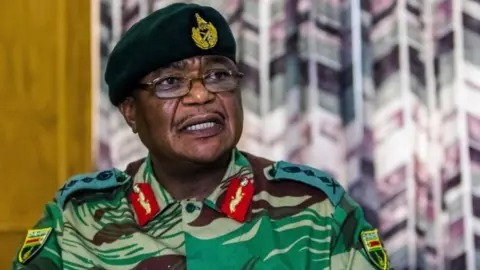
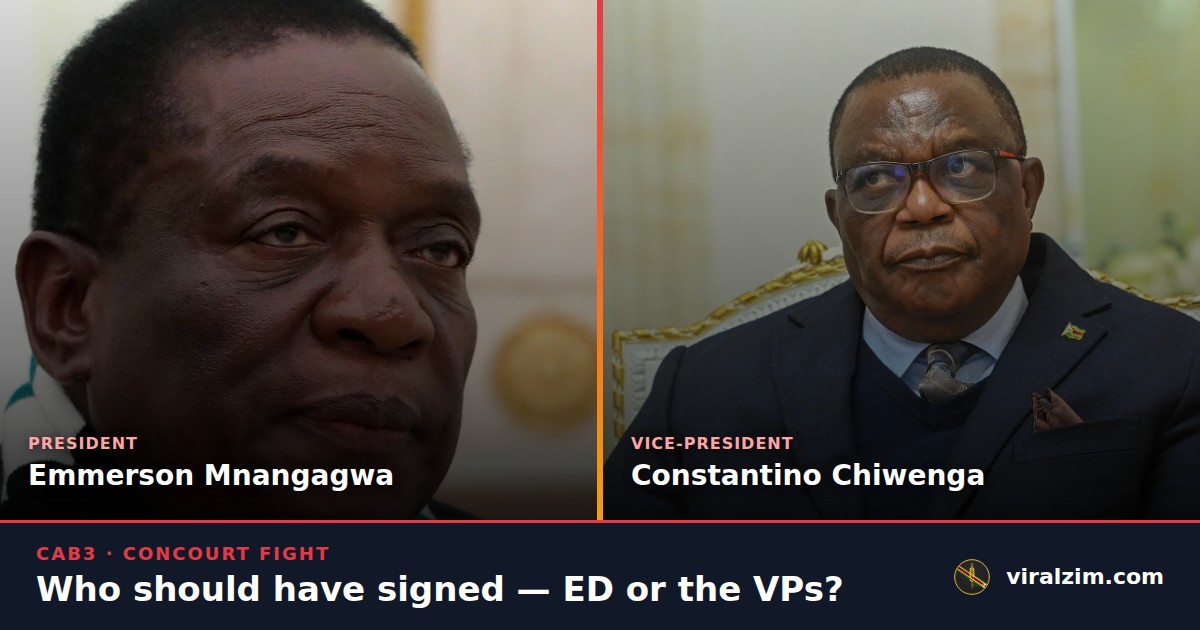
The most explosive claim in Zimbabwe’s ruling-party politics is not about policy—it is about power removal. Team Pachedu alleges that a coalition of influential political figures is pushing for the removal of Vice President Constantino Chiwenga. If the effort succeeds, the group says businessman Kudakwashe Tagwirei could be positioned to become Zimbabwe’s next Vice President.
This is being framed as a succession manoeuvre inside ZANU–PF, not a public dispute. The allegation lands in the middle of an intensifying factional contest—one that has already moved from rhetoric into party discipline battles, organisational pressure, and the mobilisation of provincial influence networks.
In Zimbabwe’s political architecture, the vice presidency is not ceremonial. It sits at the intersection of the ruling party’s internal legitimacy and the security establishment’s coercive capacity. That is why the claim matters beyond personalities: it suggests an attempt to rebalance the security-political interface at the exact moment Chiwenga is portrayed as politically vulnerable.
Alleged “weakest” moment and the provincial mobilisation claim
Team Pachedu’s central argument is that Chiwenga is currently at his weakest politically. The group claims his support base is narrow—described as being anchored by Sanyatwa—while other networks are being activated to engineer his exit.
What makes the allegation particularly dangerous is the method described: mobilisation of ZANU–PF provincial structures. In Zimbabwe, provincial structures are not merely administrative. They are power pipelines—channels through which loyalty is organised, messaging is enforced, and internal pressure is converted into votes, endorsements, and disciplinary outcomes.
That is why the claim, if it gains traction, would represent more than a personal attack. It would signal that the internal machinery of the ruling party is being prepared to translate factional alignment into formal political outcomes.
Zimbabwe’s ruling party has repeatedly emphasised that it operates through structured support-building from the ground up, including cell and village levels up to provincial structures. The party’s public posture is that it will not tolerate destabilisation that disturbs security and peace.
But the alleged provincial mobilisation—if accurate—would expose a contradiction: the language of stability can be used to mask internal power contestation. In practice, factional warfare often hides behind procedural claims, organisational “realignment,” and discipline narratives, while the real objective is to remove a rival who can disrupt the balance of power.
For Chiwenga, the alleged isolation is the critical vulnerability. A vice president who loses provincial traction becomes easier to contain. A vice president who cannot rely on party structures to defend his position faces a narrowing corridor of influence—especially when the contest is being driven by networks that can operate through party committees rather than public confrontation.
Team Pachedu’s allegation therefore points to a specific political strategy: weaken the vice president’s organisational base first, then move toward formal outcomes. In Zimbabwe’s system, that sequence is often decisive.
Tagwirei as the alleged replacement—and why it changes the stakes
The most consequential part of the claim is the alleged succession path. Team Pachedu says businessman Kudakwashe Tagwirei could be positioned to replace Chiwenga if the removal succeeds.
Tagwirei is not being presented as a neutral technocrat. The allegation places him at the centre of a power shift that would connect business influence, party patronage, and the security-political balance. In Zimbabwe, business networks have long been intertwined with state contracting and patronage ecosystems, and critics argue that this relationship can be converted into political leverage.
Chiwenga’s public posture has included sharp criticism of questionable business practices and “phantom entrepreneurship,” language that has been interpreted by political observers as targeting networks tied to powerful economic actors. That public stance has contributed to a perception that Chiwenga’s position is not only political but also adversarial toward certain business-linked influence networks.
At the same time, Tagwirei’s political footprint is described by critics as extending beyond commerce into party-linked support and high-visibility patronage. In a factional environment, that kind of influence can become a substitute for formal authority—funding logistics, strengthening loyalty, and enabling provincial mobilisation.
If Tagwirei is indeed being positioned as a replacement, the implications are immediate. A vice presidency appointment in Zimbabwe can reshape how the state manages internal discipline, how security actors coordinate with party structures, and how patronage networks align with the ruling party’s leadership priorities.
That is why the allegation is being treated as a succession threat rather than a rumour. It suggests a deliberate attempt to replace a security-linked political figure with someone whose influence is rooted in business patronage and party support networks.
For Southern Africa, the regional impact is not abstract. Zimbabwe’s internal leadership balance affects how the state approaches external engagement—particularly where sanctions risk, debt negotiations, and governance reform commitments intersect with security and political stability. When leadership contests escalate, external partners often reassess timelines, risk exposure, and the credibility of commitments.
Regional confidence also matters for trade and investment. Zimbabwe’s political stability influences cross-border business decisions, migration pressures, and the willingness of regional institutions to treat Zimbabwe’s commitments as dependable. A credible attempt to remove a vice president can trigger anxiety among diplomatic and commercial actors who rely on predictable governance and stable security coordination.
In short: if the alleged plot is real and moves toward execution, it would not remain a domestic story. It would become a regional signal about who controls Zimbabwe’s levers of state capacity.
Team Pachedu’s claims are high-voltage because they point to a mechanism—provincial mobilisation—that can convert factional alignment into organisational outcomes. In Zimbabwe, claims do not stay claims for long when the stakes are succession and the tools are party structures.
What to watch next
First, look for formal party actions that move beyond rhetoric: provincial committee statements, disciplinary proceedings, or central committee agenda items that directly affect Chiwenga’s position.
Second, monitor whether Tagwirei’s influence expands from business patronage into explicit party authority—especially through endorsements, appointments, and organisational support that can be traced to party decision-making channels.
Third, track whether Mnangagwa’s inner circle tightens control over the security-political interface by elevating alternative influence networks that can counterbalance Chiwenga’s alleged provincial weakness.
Until those indicators appear, the allegation remains unverified. But in Zimbabwe’s political system, the difference between a factional narrative and a succession outcome is often measured in provincial mobilisation—and that is exactly what Team Pachedu is alleging.