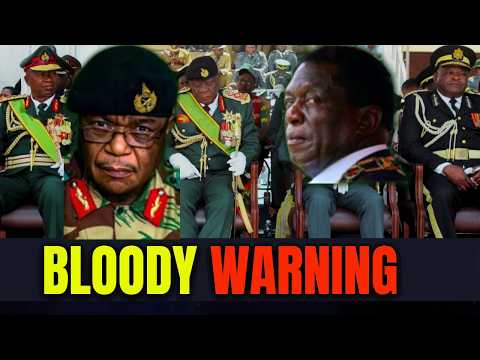
JOHANNESBURG – When South African President Cyril Ramaphosa landed in Harare in mid-April, the official narrative from Zimbabwe’s state media was predictable: the acting SADC chairperson had come to assure President Emmerson Mnangagwa that no coup would topple him. That story, fed to a compliant press, turned out to be a carefully crafted cover—one orchestrated by a cabal of businessmen and political operatives who now effectively control the aging president.
The generals implored Chapo to convey their concerns to Ramaphosa, who as SADC chairperson held the diplomatic weight to act. Chapo agreed, marking the real purpose of Ramaphosa’s hastily arranged trip to Harare. The message was blunt: the unconstitutional activities surrounding the proposed Constitutional Amendment Number 3 (CAB3)—which would extend presidential term limits or allow Mnangagwa to stay beyond 2028—and the systematic looting of state contracts by figures such as Wicknell Chivhayo, Kudakwashe Tagwirei, and Tempter Tungwarara had crossed a red line. The generals are watching with growing alarm as the country slides toward what a retired diplomat called ‘a slow-motion implosion’.
The Message from Maputo
The role of President Chapo is critical to understanding the diplomatic chain reaction. Mozambique’s leadership has long viewed Zimbabwe’s stability as a direct security concern—shared borders, trade corridors, and the memory of past regional conflicts weigh heavily on Maputo’s calculus. When the Zimbabwean generals approached Chapo, they did so as men who had served under Robert Mugabe and witnessed the 2017 military intervention. They feared history was repeating itself in a more insidious form.
Ramaphosa carried a message that the generals wanted delivered without them having to take matters into their own hands. The fact that they went through Mozambique’s president shows how desperate they were to avoid a direct military confrontation. The generals’ concerns center on CAB3, a constitutional amendment designed to allow Mnangagwa to remain in power beyond his current term, which ends in 2028. The amendment has been stalled in parliament amid growing public opposition, but the Zvigananda cabal—the tight circle around the president—has been pushing aggressively to have it passed. The group includes Chivhayo, a flamboyant businessman known for securing lucrative energy contracts; Tagwirei, a fuel magnate under U.S. sanctions; and Tungwarara, a political fixer with deep ties to the security apparatus.
These three men have turned President Mnangagwa’s private residence in Borrowdale into a de facto command center. A team of apostolic sect members—vapostori—has been installed there under the guise of praying for the president’s health. In reality, they monitor all visitors and report on Mnangagwa’s mental state. The president’s cognitive faculties have deteriorated markedly in recent months, a condition the cabal exploits to push through contracts and personnel changes. They wait until he is at his weakest—moments when his dementia is most pronounced—and then have him sign approvals or fire officials they do not like.
The Cabal and the President’s Health
The manipulation of Mnangagwa’s health has become a central feature of state capture in Zimbabwe. Those close to the president describe a pattern: the cabal controls access to him, isolates him from dissenting voices, and exploits his diminished capacity to make decisions. Mnangagwa is a hostage in his own house, surrounded by people who have mastered how to use his condition to their advantage. They record every conversation, monitor every visitor, and decide what he hears.
Recordings are a key weapon. The cabal routinely tapes conversations between the president and other officials, then uses those recordings to blackmail or to present selective evidence at opportune moments. One audio snippet, played for Mnangagwa in the midst of a cognitive low, was enough to turn him against former CIO Director General Fulton Mangwanya. Mangwanya was fired after a recorded conversation in which he told Tagwirei that CAB3 was so unpopular it could destabilize the country. Similar tactics have been used to sideline other senior officials who questioned the direction of the state. Even the current CIO Director General has been recorded telling subordinates to tell the president ‘what he wants to hear, not the truth from the ground’.
The geopolitical stakes are immense. Zimbabwe sits at the heart of southern Africa’s trade and transport networks. A collapse of the state or a violent power struggle would send shockwaves through the region. South Africa, already struggling with its own economic woes, cannot afford a refugee crisis or a failed state on its border. Mozambique, battling an Islamist insurgency in Cabo Delgado, needs a stable partner on its western flank. SADC, meanwhile, has been notably quiet on Zimbabwe’s internal affairs, a silence that diplomats say is becoming untenable.
SADC has been briefed in detail. If it does not act, the generals will. That is the message that was delivered to Ramaphosa, and that is the message he carried back to the SADC summit. The clock is ticking.
The implications for ordinary Zimbabweans are dire. The economy continues to spiral—inflation is above 55%, the parallel market exchange rate is volatile, and basic commodities are increasingly out of reach for millions. The cabal’s looting has hollowed out state coffers. Contracts awarded to Chivhayo’s companies, including a $5 billion energy deal that has delivered little, have drained resources. The Zvigananda network has enriched itself while the country sinks deeper into poverty.
In the corridors of power, fear is palpable. Even loyalists within ZANU-PF are said to be nervous. The recording culture has created a climate of paranoia. No one knows who is wearing a wire. The Zvigananda cabal has mastered the art of information warfare, using paid media mouthpieces like Daddy Hope—a controversial online commentator whom Chivhayo boasts is ‘in his pocket’—to shape the narrative. The leak about Ramaphosa’s visit being a ‘coup reassurance’ mission was manufactured by Chivhayo himself to distract from the real purpose.
For Zimbabweans who have endured decades of political repression and economic decline, the latest revelations may feel like yet another chapter in a grim saga. But there is a growing sense that the endgame is approaching. The generals who served under Mugabe and who moved against him in 2017 are now watching another leader they helped install. They have made their move diplomatically. If that fails, the next move may be less subtle.
The military will not sit by while the country is destroyed by a handful of criminals. They have done it before. They will do it again if they have to. This time, the people are with them.