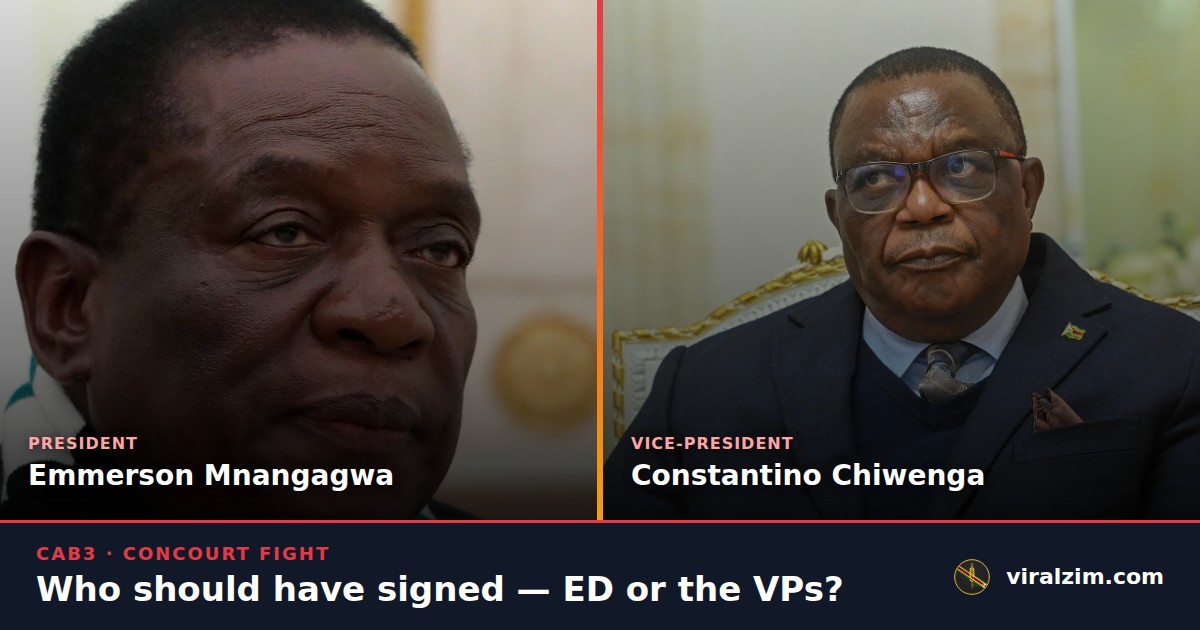
Harare, Zimbabwe – Zimbabwe’s Vice President Constantino Chiwenga has issued a stark warning over what he describes as an orchestrated attempt to ‘capture the state’, a direct response to the revelation of a secret dinner between two of the country’s most controversial businessmen – Wicknell Chivayo and Kudakwashe Tagwirei – and South African President Cyril Ramaphosa. The meeting, which took place at a private farm outside Pretoria, has ignited a political firestorm in Harare and raised serious questions about cross-border influence, sovereignty, and the integrity of Zimbabwe’s fragile coalition government.
The Secret Dinner at a Private Farm
Ramaphosa’s office confirmed the dinner but characterized it as a ‘private social engagement’. ‘President Ramaphosa meets regularly with business leaders from across the continent to discuss investment opportunities,’ a spokesperson said in a statement. ‘No government decisions were made, and no commitments were given.’ However, critics point out that Ramaphosa’s presence – the first such meeting with Chivayo and Tagwirei on record – elevates the businessmen’s status and gives them a degree of political cover that they lack in Zimbabwe, where both face ongoing investigations and public scrutiny.
Chiwenga’s Warning: ‘State Capture’ Allegations
Chiwenga’s language – ‘state capture’ – is a loaded term in Southern African political discourse, most famously used to describe the looting of South African state institutions under former President Jacob Zuma. By invoking it, Chiwenga is directly accusing the dinner participants of attempting to replicate that dynamic in Zimbabwe. Political analysts in Harare say the Vice President’s outburst reflects deep tensions within the ruling ZANU-PF party between a faction loyal to Mnangagwa – who has long relied on Tagwirei and, to a lesser extent, Chivayo for campaign financing and business patronage – and a reformist wing led by Chiwenga that wants to distance the party from corrupt practices ahead of the 2028 elections.
‘Chiwenga is drawing a line in the sand,’ said Dr. Pedzisayi Ruhanya, a political analyst at the University of Zimbabwe. ‘He is signalling that the era of unchecked influence by a few businessmen is over. But the question is whether he has the institutional power to back that up, or whether this is a last-ditch protection of his own faction’s interests.’
The timing is critical. Zimbabwe is grappling with a deepening economic crisis – inflation above 50%, chronic fuel shortages, and a collapsing currency. The government has been unable to attract meaningful foreign direct investment, in part because of the very sanctions that target Tagwirei. A meeting between Ramaphosa, a respected continental statesman, and the sanctioned businessman threatens to undermine the African Union’s own anti-corruption frameworks and could reopen old wounds between Harare and Pretoria.
The Men at the Centre: Chivayo and Tagwirei
Wicknell Chivayo, often referred to by his alias ‘Sir Wicknell’, rose to prominence through a series of opaque energy contracts with the Zimbabwe Electricity Supply Authority (ZESA). In 2016, he was awarded a $533 million tender to build a solar plant that remains unbuilt. Despite multiple court cases and public protests, Chivayo has maintained his access to the highest levels of government, including direct lines to Mnangagwa. Kudakwashe Tagwirei, the head of the Sakunda Holdings conglomerate, is even more powerful. He controls fuel imports, agribusiness, and mining interests and is widely seen as the financial backbone of Mnangagwa’s political machinery. Both men deny any wrongdoing and have never been convicted of a crime.
Their presence at a private dinner with Ramaphosa, however, has triggered alarm in diplomatic circles. ‘This is not a routine business meeting,’ said a senior Western diplomat based in Harare who spoke on condition of anonymity. ‘Tagwirei is under U.S. sanctions for facilitating corruption. A meeting with a sitting president – even off the record – sends a signal that sanctions can be circumvented with the right connections. It weakens the entire regional anti-graft architecture.’
Geopolitical Fallout for Southern Africa
The implications extend well beyond Zimbabwe’s borders. South Africa is Zimbabwe’s largest trading partner and the main transit route for its fuel and goods. Any perception that Ramaphosa is throwing his weight behind Mnangagwa’s inner circle could complicate South Africa’s own efforts to lead the Southern African Development Community (SADC) in mediating regional crises, including the ongoing instability in Mozambique and the political impasse in Lesotho.
‘This dinner has the potential to fracture SADC’s credibility,’ said Dr. Mzukisi Qobo, a professor of international relations at the University of Johannesburg. ‘Ramaphosa has built a reputation as a champion of good governance in the region. If he is seen to be cosying up to individuals sanctioned for corruption, that reputation is tarnished, and the entire bloc’s moral authority is weakened.’
For ordinary Zimbabweans, the fallout is immediate. The meeting has already triggered a fresh wave of currency volatility, with the Zimbabwe dollar losing 12% of its value against the U.S. dollar in the week since the news broke. Many citizens see the dinner as yet another example of the elite enriching themselves while the majority suffer.
‘These businessmen eat at the same table as presidents while we queue for bread,’ said Tinashe Moyo, a resident of Harare’s high-density suburb of Epworth. ‘Chiwenga’s words are good, but we have heard promises before. We need action – arrests, frozen accounts, real consequences.’
Despite the Vice President’s strong language, it remains unclear whether any formal investigation will follow. Prosecutors in Zimbabwe have a long history of selectively targeting political opponents while shielding allies of the president. Chiwenga himself is no stranger to controversy; he led the 2017 coup that ousted Robert Mugabe and has his own ambitions for the top job. ‘This is as much about internal ZANU-PF succession politics as it is about corruption,’ noted analyst Ruhanya. ‘The public should not expect a clean-up operation. They should expect a power struggle dressed up as a crusade.’
For now, the secret farm dinner has become a lightning rod for every grievance against Zimbabwe’s ruling elite. And the man who warned of state capture – Vice President Chiwenga – is gambling that his warning will resonate with a population desperate for real change, not just another political performance.