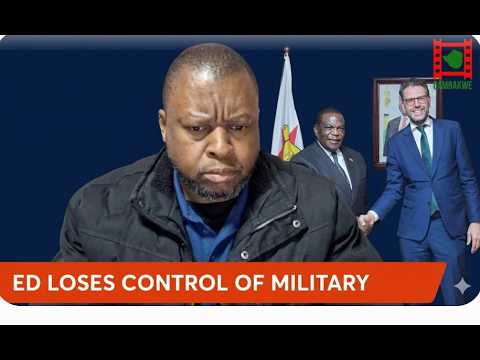
A live broadcast from an independent media outlet now alleges that President Emmerson Mnangagwa has lost control of Zimbabwe’s military – a development that, if confirmed, would mark the most serious challenge to his eight-year rule and threaten to unravel the fragile political stability of Southern Africa.
The claim, broadcast on 19 March 2025 under the title 'WATCH LIVE: Mnangagwa Loses Control Of Zimbabwe Military', has immediately sent shockwaves through Harare’s diplomatic and security circles. While the specific evidence presented in the broadcast remains unverified by independent sources, the very fact that such an allegation is being aired live reflects a deepening crisis of confidence in the relationship between the civilian presidency and the armed forces.
The Military’s Decisive Role
Zimbabwe’s military has never been a neutral institution. It was the Zimbabwe National Army – under the command of then-General Constantino Chiwenga – that removed Robert Mugabe in the November 2017 coup, bringing Mnangagwa to power. Since then, Mnangagwa has walked a tightrope, promoting loyalists while trying to curb the influence of the generals who made him. In recent months, tensions have escalated. The abrupt retirement of several senior officers, the unexplained reassignment of the air force commander, and the arrest of a high-ranking intelligence official on corruption charges have all been read as signs that Mnangagwa is attempting to consolidate control – a move that risks alienating the very institution that installed him.
If the allegation that Mnangagwa has 'lost control' of the military is true, it would represent a complete reversal of the power dynamic. Regional security analysts point out that the Zimbabwe Defence Forces are deeply factionalised, with loyalties divided between the Mnangagwa camp and that of Vice President Constantino Chiwenga, who remains a powerful figure despite his official downgrading. A fracture along those lines could lead to a standoff between competing military units, raising the spectre of armed confrontation.
Regional Fallout and the SADC Response
The implications for Southern Africa are immediate and severe. Zimbabwe is a lynchpin of the Southern African Development Community, and any instability in Harare reverberates from Pretoria to Lusaka. South Africa, already grappling with its own political uncertainty ahead of elections, views a stable Zimbabwe as essential to managing migration flows, cross-border trade and the energy grid that links the region. A military crisis in Zimbabwe could also embolden opposition movements across the region that have long pointed to Harare’s election-management as a model of flawed democracy.
Botswana has already expressed concern through diplomatic channels. Zambia’s President Hakainde Hichilema, who himself faced a military challenge early in his tenure, is reported to be monitoring the situation closely. The African Union’s Peace and Security Council has not yet commented, but sources inside the AU say an emergency briefing has been requested.
For ordinary Zimbabweans, the stakes could not be higher. The economy is already in a tailspin, with inflation exceeding 500% and the population enduring 18-hour power cuts daily. Any military power struggle would almost certainly halt the meagre foreign investment that has trickled in under Mnangagwa’s ‘Zimbabwe is Open for Business’ slogan. The bond market has already reacted: yields on Zimbabwe’s eurobonds spiked by 340 basis points within hours of the broadcast.
Southern Africa is watching. The continent remembers what happened after the 2017 coup: a brief period of hope followed by economic collapse and democratic erosion. A second military intervention, or a civil-military split, would not be a restart – it would be a disaster.