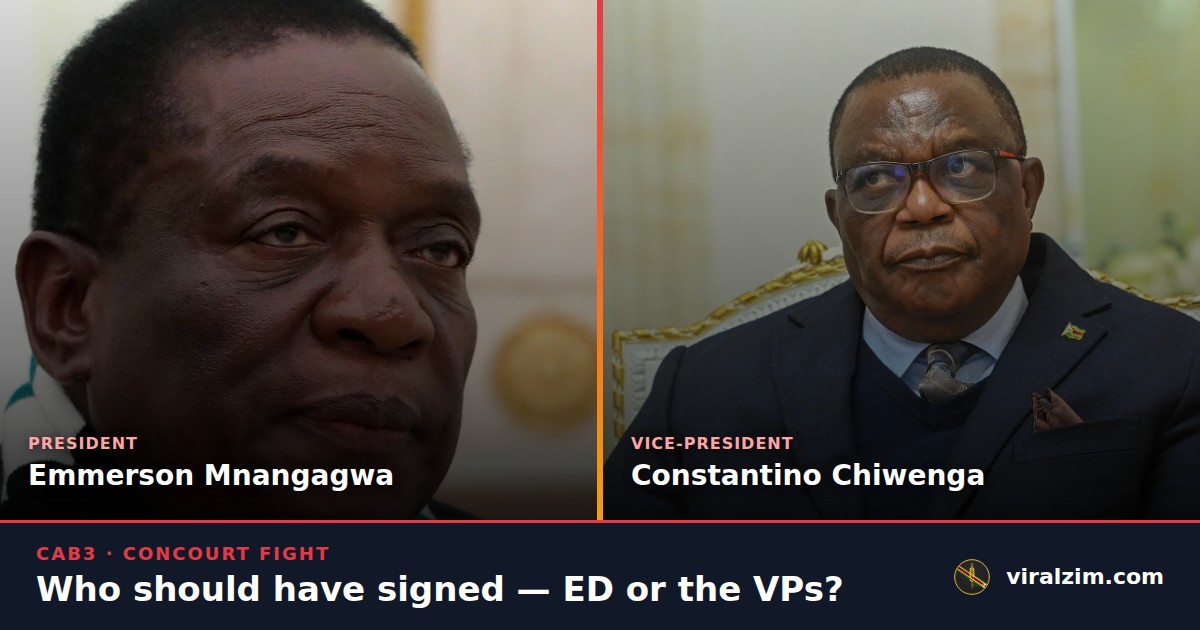
HARARE — President Emmerson Mnangagwa has effectively buried his political future by signing into law the Constitutional Amendment Bill No. 3 (CAB3), a move that former Finance Minister and opposition heavyweight Tendai Biti warns is the “final nail in the coffin” for Zimbabwe’s withering democracy and any hope of economic recovery. The sweeping amendments, rammed through a ZANU-PF-dominated parliament in a late-night session last week, eliminate the constitutional two-term limit for the presidency, extend the tenure of sitting legislators by two years without an election, and give the executive unprecedented power to appoint provincial governors directly. For a nation already suffocating under 87% informal employment and a public debt of US$18 billion, the signing is not merely a constitutional tweak—it is a self-inflicted political detonation.
Biti, a veteran of the democratic struggle and co-architect of the 2013 constitution that CAB3 systematically dismantles, spoke exclusively to journalists hours after the gazetting of the law. “Mnangagwa has just signed his own political death warrant,” Biti declared. “CAB3 turns the presidency into a monarchical institution, removes the last checks on executive overreach, and signals to the international community that Harare has no intention of re-engaging on legal or financial reform. This is the final nail in the coffin—not just for him, but for the entire post-2013 democratic experiment.” His words carry the weight of a man who helped midwife a charter that explicitly prevented such power consolidation, now shredded by the very leader who swore to uphold it.
A Constitutional Coup Disguised as Amendment
The geopolitical reverberations are immediate. Zimbabwe is a key node in the Southern African Development Community (SADC), and its internal implosion directly threatens regional stability. South Africa, which hosts over 3 million Zimbabwean economic exiles, will absorb a fresh wave of desperate migrants if CAB3 triggers the predicted crackdown and economic freefall. The rand could face devaluation pressure as trade volumes with Zimbabwe—already down 40% since 2022—plummet further. Zambia and Mozambique, both navigating their own debt restructuring programmes, will see cross-border informal trade disrupted, while Botswana’s diamond-dependent economy will lose a vital transit route for illicit financial flows that ZANU-PF elites rely on to bypass sanctions. Biti warned, “This isn’t a Zimbabwean crisis anymore; it’s a southern African crisis that will spill over into Johannesburg, Lusaka, and Maputo within 12 months.”
Economic Suicide in Real Time
“Mnangagwa is driving the economy off a cliff with the handbrake on,” Biti said, drawing on his experience as Finance Minister during the 2009 dollarisation era. “When you eliminate term limits, you destroy policy predictability. The African Development Bank, the IMF, and bilateral creditors will freeze engagement. The Lonrho deal, the Kariba floating solar farm, the Beitbridge modernisation—all these projects depend on governance benchmarks that CAB3 just obliterated. We are looking at a complete capital strike, and the ordinary people in Chitungwiza, Bulawayo, and Gweru will pay with their lives.”
The impact on Southern Africa’s energy and food security is already being recalibrated. Zimbabwe imports 65% of its maize from South Africa and Zambia; a currency collapse will render those imports unaffordable, triggering a hunger crisis that the World Food Programme admits it is not funded to manage. The Kariba Dam, which supplies power to both Zambia and Zimbabwe, relies on bilateral revenue-sharing agreements that will come under strain if Harare defaults on its obligations. Regional bank stocks, particularly those with Zimbabwean exposure like Standard Bank and FirstRand, saw a combined R12.3 billion wiped off in June alone as shareholders fretted about loan write-offs.
SADC’s double-edged silence further underscores the gravity. While the bloc’s election observer missions have historically been muted, the outright dismantling of term limits violates the African Union’s 2007 African Charter on Democracy, Elections and Governance, which prohibits unconstitutional changes of government—a category that legal scholars now widely argue includes “constitutional coups.” Botswana’s former President Ian Khama has called for Zimbabwe to be suspended from SADC, while South Africa’s ruling ANC, itself battling internal term-limit debates, has remained conspicuously quiet. Biti seized on this: “The ANC’s silence is a betrayal of its own liberation legacy. When we buried apartheid, we didn’t expect its comrades to applaud dictatorship in Harare.”
The human cost is already being tallied. Doctors Without Borders reports a 28% increase in severe malnutrition cases in Zimbabwe’s rural areas over the past quarter, directly correlated to reduced government health spending. Teachers’ unions have warned that the education sector will shut down in September if salaries are not paid in US dollars, raising the spectre of a lost generation reminiscent of the 2008 collapse. For Southern Africa, that means a permanent outflow of skilled labour—nurses, engineers, and agronomists—who will flood already saturated markets in Cape Town, Windhoek, and Gaborone, depressing wages and fueling xenophobic backlashes.
Mnangagwa, for his part, has dismissed the criticism as “neo-colonial noise,” insisting at a Heroes’ Day rally that CAB3 is necessary to “consolidate stability and economic development.” But stability, as Biti noted, requires consent, and consent has just been surgically removed from Zimbabwe’s body politic. The final nail may not yet be driven into the coffin, but with this signature, the president has handed the hammer to his most ardent opponents—and the echoes will be heard from the Limpopo to the Congo.