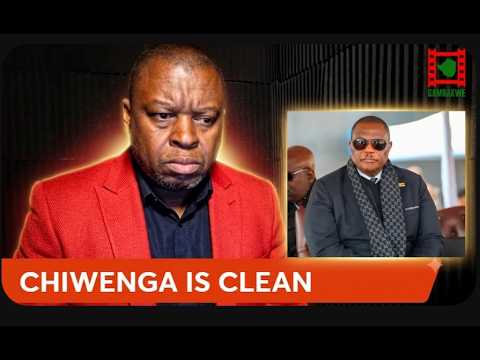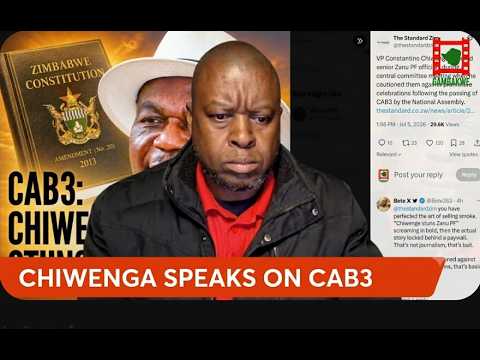
HARARE, Zimbabwe — Vice President Constantino Chiwenga delivered a rare nationwide address Friday, shattering weeks of carefully managed silence over the contentious Constitutional Amendment Bill No. 3 (CAB3) and warning that the ruling ZANU-PF party’s push to remake the country’s foundational law threatens to “overheat” the nation and unravel delicate economic progress.
The live broadcast, carried by state television and streamed globally, came as parliamentary committees concluded public hearings on the bill, which critics say is engineered to allow 82-year-old President Emmerson Mnangagwa to extend his grip on power beyond the current two-term limit. Chiwenga — the former army general who orchestrated the 2017 coup that toppled Robert Mugabe — chose his words carefully but left no doubt that the rushed timeline and lack of national consensus could backfire.
“A constitution is not a party document. It belongs to Zimbabweans, and they must be convinced that its amendments serve their everyday lives, not the ambitions of a few,” Chiwenga said. “If we fail to carry the people, we will harvest a storm we cannot control.”
The Vice President, who continues to command deep loyalty within the military and intelligence apparatus, stopped short of openly opposing President Mnangagwa. Yet his intervention transforms the CAB3 process from a factional whisper war into a public crisis that could fracture the ruling party ahead of critical regional meetings and an already fragile debt-restructuring timeline.
“What Chiwenga is doing is classic brinkmanship,” said Dr. Rashweat Mukundu, a Harare-based political analyst and researcher at the International Media Support. “He’s telling the Mnangagwa faction that a power grab through a constitutional backdoor will fracture the military-security establishment that installed this entire administration. It’s a shot across the bow.”
The Bill’s Content and the Succession Feud
CAB3 proposes amendments to 27 clauses of the 2013 Constitution. Among the most explosive provisions are the removal of the presidential two-term limit—clearing a path for Mnangagwa to contest 2028—and the introduction of a Prime Minister position that would answer directly to Parliament rather than the President. Pro-Mnangagwa loyalists argue the changes are necessary to “harmonise” the charter with developmental demands, but opposition lawmakers and civic groups label it a naked power grab.
The bill sailed through its second reading in the National Assembly in May 2025 with 203 votes, after Movement for Democratic Change MPs walked out in protest. Public hearings that followed were marred by low attendance, claims of voter intimidation, and a violent scuffle in Kwekwe where security forces dispersed demonstrators with teargas. The Zimbabwe Human Rights NGO Forum has documented at least 47 cases of harassment linked to the consultation process.
Chiwenga’s speech recognized those grievances. “We cannot pretend we are consulting when our citizens are afraid to speak,” he said, calling for “genuine, unfettered dialogue” before the bill returns to Parliament for a third reading. His words were widely interpreted as a signal that the military faction, which backed him for the presidency after Mugabe’s fall, will not automatically endorse a third-term Mnangagwa presidency.
Geopolitical Fallout for Southern Africa
The turmoil inside Zimbabwe’s succession politics is already rippling through the Southern African Development Community (SADC). Zambia and South Africa, which host millions of Zimbabwean economic refugees, are watching nervously. Ambassador Reuben Brigety II, the outgoing U.S. envoy to South Africa, warned in a recent interview that “constitutional manipulation in Harare will erode the credibility of the entire region’s democratic renaissance.”
African Union Commission Chairperson Moussa Faki has been silent on the amendment, but Western diplomats in Harare confirm that the International Monetary Fund and the African Development Bank have privately linked Zimbabwe’s US$4.5 billion debt-arrears clearance roadmap to “respect for constitutionalism and broad-based political consensus.” The roadmap, brokered in 2022, hinges on Zimbabwe demonstrating firm political reforms before creditors write off penalties. Chiwenga’s intervention puts that delicate bargain at risk.
Even more immediately, SADC is scheduled to hold its annual summit in Harare in August 2025. The hosting of the 16-member bloc was meant to showcase Zimbabwe’s return to normalcy. An open split between Mnangagwa and Chiwenga would transform the summit from a diplomatic triumph into a spotlight on internal decay, with jittery leaders questioning whether Zimbabwe can guarantee security and political stability during the high-level gathering.
The economic infrastructure corridors that thread through Zimbabwe are equally exposed. The US$7 billion Beitbridge border modernisation project—a public-private partnership with Zimborders Consortium—handles 60% of regional truck traffic. A succession crisis that triggers industrial action or military movements would choke the North-South Corridor, driving up logistics costs from Durban to Lubumbashi and threatening food and fuel supplies across at least five nations.
“Southern Africa cannot afford a Zimbabwe implosion right now,” said Dr. Peter Fabricius, a senior researcher at the Institute for Security Studies in Pretoria. “The region is already grappling with Mozambique’s insurgency, Eswatini’s pro-democracy protests, and a troubled post-election landscape in Botswana. Harare’s instability is the domino nobody wants to see fall.”
Chiwenga concluded his address with a call for “unity in purpose” but left the door open to further intervention. “I am a soldier,” he said. “I know that a war you cannot win must not be fought.” Whether those words describe his advice to Mnangagwa or a warning to the party at large, one thing is clear: the battle over Zimbabwe’s constitution is no longer being fought in the shadows.