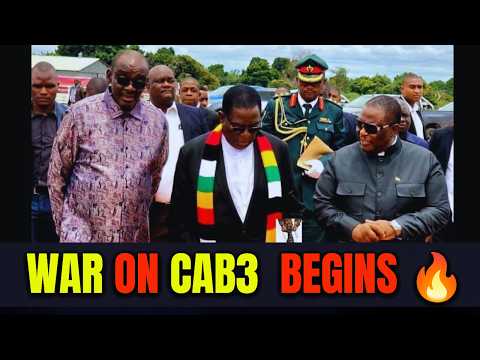
HARARE — Vice President Constantino Chiwenga’s sudden and dramatic arrival by helicopter at the burial of liberation hero Simon Bere on Tuesday has sent shockwaves through Zimbabwe’s political establishment, with analysts warning the display signals an intensifying power struggle at the top of ZANU-PF. The funeral, held at the National Heroes Acre, was intended to honor Bere’s decades-long service to the liberation struggle. Instead, it became a stage for what many observers describe as a carefully choreographed show of strength by the country’s second-highest official.
Witnesses reported that the whir of rotor blades interrupted the ceremony as a military helicopter descended into the normally restricted airspace above the shrine. Security personnel scrambled to clear a landing zone, and Chiwenga stepped out in full military regalia, saluting the casket before being escorted to the dais. The crowd, initially stunned, erupted in a mix of cheers and murmurs. Political analyst Dr. Tawanda Mushonga described the moment as ‘a deliberate, unmistakable assertion of authority — one that cannot be dismissed as mere protocol.’
Simon Bere, a former ZIPRA commander who later served as a ZANU-PF central committee member, died on April 8 at the age of 78. His funeral attracted senior party figures, including President Emmerson Mnangagwa’s loyalists, but the vice president’s entrance overshadowed all planned eulogies. ‘This is not how a vice president typically arrives at a hero’s burial. It was a message — to the party, to the president, and to the security apparatus — that Chiwenga remains a force to be reckoned with,’ said Eldred Masunungure, a professor of political science at the University of Zimbabwe.
Factional fault lines in plain sight
Zimbabwe’s state-controlled media, the Herald, reported the vice president’s arrival in a routine bulletin, but social media erupted with hashtags #ChiwengaStormsHeroesAcre and #PowerPlay2026 — a reference to the next ZANU-PF elective congress, when the party will choose its candidate for the 2028 presidential election. The timing of Bere’s funeral is particularly sensitive: Mnangagwa, 82, has signaled he intends to run again, a move that would require a change to the party constitution’s two-term limit. Chiwenga’s camp has quietly resisted that push, arguing it undermines internal democracy.
Geopolitical echoes across Southern Africa
Economic data adds urgency to the political calculations. Zimbabwe’s annual inflation officially stands at 175%, while the parallel-market exchange rate has collapsed. More than 80% of the workforce operates in the informal sector. Andres Guzman, a Harare-based economist at the Zimbabwe Coalition on Debt and Development, noted that ‘when political elites begin posturing at funerals instead of fixing the economy, ordinary Zimbabweans pay the price. The Chiwenga display distracts from the bread-and-butter crises — fuel shortages, electricity blackouts, soaring food costs.’
For the Southern African region, Zimbabwe’s fragility is a reminder that liberation-era allegiances can quickly turn into modern power struggles. As one retired Zimbabwean army colonel, who requested anonymity, put it: ‘Simon Bere represented the old guard — a generation that fought together but is now dying apart. The manner of Chiwenga’s arrival tore open a wound that has been healing badly for years.’ The colonel added that younger officers in the military are watching closely: ‘They will choose sides when the moment comes. This funeral may have been a rehearsal.’
As Zimbabwe grapples with its deepest economic crisis in a decade, the images of a vice president descending from the sky onto a hero’s grave will not fade quickly. They serve as a stark reminder that in ZANU-PF, loyalty is often measured in shows of force — and that the next succession battle may already be underway.