
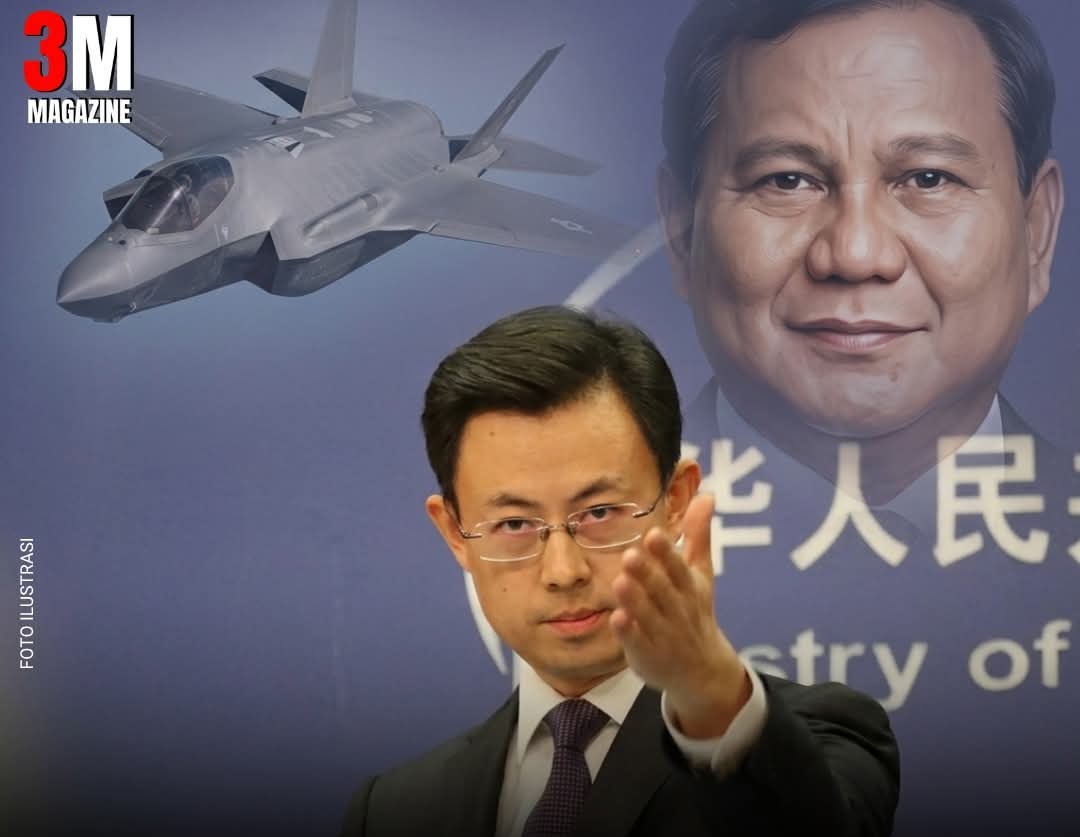
China has issued a direct warning to Indonesia over a proposed US overflight clearance arrangement that would grant Washington a broad, standing permission to use Indonesian airspace—arguing the deal could breach ASEAN commitments to respect members’ sovereignty and avoid actions that threaten the territorial integrity of other states.
The warning was delivered by China’s Foreign Ministry spokesman Guo Jiakun, who framed the issue as a test of ASEAN rules and regional responsibility. The dispute is not confined to aviation paperwork. It lands in a strategic corridor where Indonesia’s geography places it close to the South China Sea—one of the world’s most militarized maritime flashpoints—and where any shift in air access can quickly translate into changes in military posture, surveillance reach, and diplomatic pressure.
At the center of the controversy is a US request for what Beijing calls a “thorough air permit”: a blanket overflight clearance that could effectively pre-authorize US military use of Indonesian airspace rather than requiring case-by-case approvals. China argues that such a mechanism would not remain purely technical. It could be interpreted as enabling pressure on a third party involved in the South China Sea rivalry, undermining regional peace and stability.
Guo’s message was blunt: defense and security cooperation should not target third countries or harm their interests, and it should not erode the sovereignty and territorial integrity of ASEAN members. In China’s framing, the ASEAN Charter and related regional agreements impose obligations on member states to avoid participating in policies or activities—including the use of territory—that threaten the sovereignty of other ASEAN states.
Indonesia, for its part, insists it has not granted unrestricted access. Jakarta says the overflight clearance request remains under internal consideration and is being examined carefully with attention to national interests and airspace sovereignty. Indonesia’s position is that the decision is not locked in by the mere existence of talks, and that any arrangement would still require further discussion through applicable technical mechanisms and national procedures.
That distinction matters politically. Indonesia has been deepening defense cooperation with Washington while maintaining its long-standing diplomatic doctrine of an independent, ‘free and active’ foreign policy. By emphasizing that overflight clearance is not automatically effective and remains subject to Indonesian processes, Jakarta is trying to prevent the arrangement from becoming a de facto alliance architecture.
Indonesia’s government has also drawn a line between cooperation and surrender of control. The principle is straightforward: no policy grants foreign parties free access to use Indonesian airspace. In practice, that principle becomes especially sensitive when the airspace in question sits near the strategic theater of the South China Sea, where military movements and intelligence operations can be read as signals in a broader contest over maritime rights and regional influence.
Even as Indonesia and the United States elevated their defense relationship to a ‘Major Defense Cooperation Partnership’ in Washington earlier this month, Indonesia has maintained that overflight clearance is not a pillar of that partnership. This gives Jakarta room to manage the political optics—cooperating with the US without conceding that it has accepted a standing framework that could constrain Indonesia’s future choices.
What’s really at stake: sovereignty, escalation risk, and regional leverage
China’s warning is designed to shape how Jakarta interprets the US proposal before it becomes operational. A blanket overflight clearance reduces friction for military movement and can normalize a posture that Beijing views as enabling escalation near its strategic periphery. In other words: even if Washington describes its request as routine operational planning or crisis-management readiness, the mechanism itself can still function as leverage in a competition over regional access.
Indonesia’s strategic geography makes the issue more than a bilateral dispute. The country sits astride critical air routes linking the Indian and Pacific Oceans and lies within reach of the South China Sea’s contested maritime space. That makes Indonesian airspace a valuable node for surveillance, logistics, and rapid deployment—capabilities that both Washington and Beijing treat as instruments of deterrence and interoperability.
From a geopolitical perspective, the dispute reflects a wider pattern: major powers seek access arrangements that can be activated quickly, while middle powers attempt to preserve decision-making autonomy. Indonesia is signaling it will not automatically accept a blanket framework. China is signaling it will treat any expansive overflight permission as a sovereignty and stability threat. And the United States is—at minimum—pushing an approach that aligns with pressure dynamics, even if it is framed as standard operational planning.
Indonesia’s insistence on sovereignty and procedural control is a reminder that access is never purely technical. It is political. And China’s warning shows that Beijing is prepared to challenge not only outcomes, but also the frameworks that could make future outcomes easier to implement.
How this dispute evolves will depend on whether Indonesia limits the scope of any overflight clearance to narrow, case-by-case permissions—or whether it allows a broader pre-authorization mechanism. For now, the message from Beijing is clear: a blanket approach is unacceptable. The message from Jakarta is equally clear: no decision has been finalized, and Indonesian sovereignty remains the boundary line.