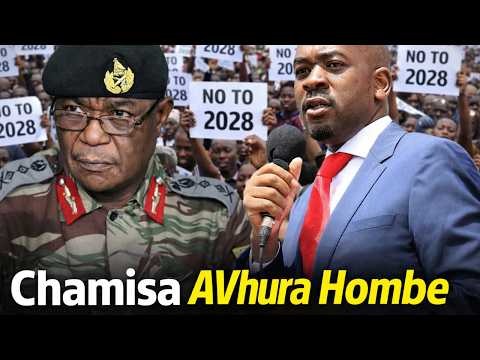
Nelson Chamisa’s latest attack on President Emmerson Mnangagwa is not just political theatre—it is a direct warning that Zimbabwe’s constitutional amendment process could be used to lock in power, reshape the electoral playing field, and narrow legal space for opposition.
Speaking as Zimbabwe’s constitutional amendment debate intensifies, Chamisa—leader of the Citizens Coalition for Change (CCC)—blasted Mnangagwa’s government over the Constitutional Amendment Bill, accusing the ruling party of engineering changes that would undermine democratic checks and balances and weaken the opposition’s ability to compete fairly.
While the government argues that constitutional reform is necessary to improve governance and strengthen state institutions, Chamisa’s position is sharper: he frames the bill as a power-preservation project, warning that the amendment would not deliver accountability but instead entrench the very political dominance that Zimbabweans have repeatedly rejected at the ballot box.
In his comments, Chamisa linked the bill to a broader pattern of contested elections, alleged intimidation, and institutional bias—claims that have long shaped international scrutiny of Zimbabwe’s political environment. His message was designed for domestic audiences, but it lands in a wider geopolitical context: Zimbabwe’s constitutional trajectory affects how partners in the region and beyond assess election credibility, rule-of-law commitments, and the conditions for engagement.
Chamisa alleges Mnangagwa is using constitutional change to entrench power
Chamisa’s criticism targets the mechanism and the timing of the proposed amendments. Opposition leaders have repeatedly argued that constitutional change should be built on broad consensus, not rushed through a process dominated by the ruling party’s parliamentary majority.
At the centre of Chamisa’s argument is the fear that constitutional amendments—depending on their content—could alter key electoral and institutional safeguards. In Zimbabwe, where the constitution governs everything from electoral administration to the structure and mandate of oversight bodies, even technical changes can have political consequences.
Political analysts say the constitutional amendment process is often where the real contest happens, because it can redefine the rules of competition without changing the players. “Constitutions are not just legal documents; they are the framework for political power,” said Dr. Lovemore Madhuku, a Zimbabwean constitutional law scholar and former member of the Zimbabwe Human Rights Commission. “If amendments are pursued without genuine consensus, they can be perceived as a way to tilt institutions toward incumbency.”
Chamisa’s rhetoric echoes that concern: he portrays the bill as an attempt to secure an advantage for the ruling party, rather than to address governance failures through transparent, inclusive reform.
His criticism also reflects the opposition’s strategy ahead of elections. Zimbabwe’s political opposition has repeatedly demanded electoral reforms, including credible voter registration, impartial electoral administration, and protections against intimidation. Constitutional amendments—if they touch those areas—can either strengthen those demands or neutralize them.
Chamisa’s message therefore functions as both a legal and political warning: if the bill proceeds in a way that reduces opposition leverage, it could deepen the legitimacy crisis that already shadows Zimbabwe’s elections.
International engagement at stake as constitutional credibility becomes a regional issue
The fallout from constitutional amendments in Zimbabwe is rarely confined to Harare. It reverberates across Southern Africa because Zimbabwe remains a pivotal regional actor—economically, diplomatically, and politically. The Southern African Development Community (SADC) has repeatedly called for credible elections and respect for democratic principles, while international partners—especially those shaping sanctions policy and development finance—closely track constitutional commitments.
When constitutional processes are seen as partisan, international scrutiny intensifies. That scrutiny can affect everything from election observation missions to the willingness of donors to support governance reforms. It can also influence how regional bodies interpret Zimbabwe’s compliance with democratic norms.
Zimbabwe’s constitutional debate is also entangled with the country’s ongoing economic pressures. With inflationary stress, fiscal constraints, and investor caution, the political environment becomes a determinant of economic confidence. Investors and lenders do not only assess macroeconomic indicators; they also assess institutional reliability—courts, electoral administration, oversight bodies, and the predictability of the legal framework.
Chamisa’s blast is therefore aimed at more than the bill itself. It is a bid to mobilize supporters and international attention around the claim that the amendment process risks damaging Zimbabwe’s democratic credibility—an outcome that could further reduce economic confidence.
“If constitutional amendments are perceived as undermining democratic safeguards, it can trigger a cycle of mistrust,” said Professor Brian Raftopoulos, a Zimbabwean historian and political analyst. “That mistrust does not stay inside politics. It affects how international actors engage and how Zimbabweans see the state’s commitment to constitutionalism.”
Chamisa’s intervention also comes at a time when Zimbabwe’s opposition space has been under strain. Opposition parties have frequently reported restrictions on gatherings, legal harassment, and limitations on political campaigning. In that environment, constitutional change is viewed through the lens of whether it will widen or narrow political space.
For the government, the argument is that amendments are necessary to modernize governance and strengthen state capacity. But for Chamisa and the CCC, the question is not whether reform is needed—it is who controls the reform, how it is implemented, and what safeguards remain intact.
That is why Chamisa’s public attack is strategically timed. It signals to Zimbabweans that the opposition is preparing to challenge the bill politically and, if necessary, legally. It also signals to external stakeholders that the opposition believes the process lacks legitimacy.
In a constitutional crisis, the first casualty is trust. The second is compliance—citizens begin to treat laws as instruments of power rather than rules binding on all. Chamisa’s warning is essentially about preventing that outcome.
Zimbabwe’s constitutional amendment debate is now at a critical stage. If the bill advances without broad consensus, the political temperature will rise further. If it includes provisions that opposition parties believe weaken electoral integrity or institutional independence, Zimbabwe could face renewed confrontation between the state and the opposition.
For Southern Africa, the stakes are clear: Zimbabwe’s political stability and democratic credibility continue to shape regional confidence. For international partners, the constitutional process will remain a litmus test for whether engagement is grounded in genuine reform or in cosmetic change.
What happens next: The government’s position, the bill’s specific clauses, parliamentary voting patterns, and any legal challenges will determine whether this constitutional moment becomes a reset for Zimbabwe’s institutions—or another chapter in a long-running legitimacy battle.
Note: You asked for research from a specific YouTube URL, but no URL was provided in your message. If you paste the YouTube link (or the video title you want used), I can verify the exact claims, names, dates, and—crucially—use the YouTube video title as the post title and include the correct video details and sourcing.
Follow the investigation:
See the latest reporting and updates on Zimbabwe’s constitutional battle.