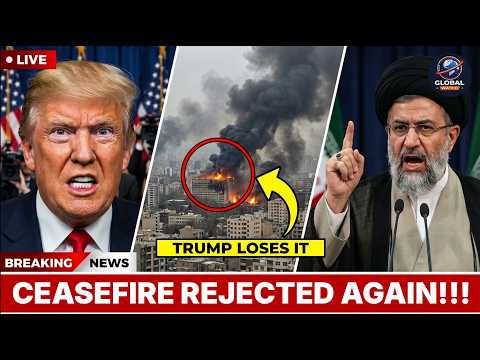
Iran’s refusal to accept another ceasefire is now colliding with a public, combustible U.S. political narrative—after Donald Trump triggered backlash with remarks that were described as a “little glitch” by ABC News coverage. In a video analysis from Global Watch titled “Trump LOSES IT Over Iran — Ceasefire REJECTED Again”, the channel argues that Tehran’s rejection signals a dangerous turn in the war’s direction, while the Strait of Hormuz disruption risk threatens to spread the conflict’s costs far beyond the Middle East.
The video frames the latest escalation as more than a diplomatic setback. It links Iran’s rejection of a ceasefire to a broader strategy: making the conflict “more expensive for Washington,” while testing whether the U.S. can sustain pressure without triggering wider regional realignment or full escalation. The channel also points to “three weekend moments” that “changed the direction of this war,” describing a sequence of events that has tightened the noose around diplomacy and increased the likelihood of further confrontation.
Ceasefire rejected as war momentum accelerates
Global Watch’s analysis centers on the moment the ceasefire was rejected again and treats it as a key signal about where Iran believes the conflict is headed. The video’s chapter structure places “Ceasefire Rejected” at 12:00, after earlier segments on war escalation, Trump’s remarks, and the Strait of Hormuz crisis. The channel’s argument is straightforward: if ceasefire proposals are repeatedly refused, the conflict is not drifting toward de-escalation—it is consolidating toward a more sustained, higher-cost confrontation.
In the channel’s framing, Iran’s position is not isolated. It is tied to broader regional dynamics, including “Middle East retaliation” and “Gulf states” that are “suddenly rethinking their strategic alignment.” The video suggests that the war’s trajectory is forcing Gulf governments to reassess how they align in a conflict where energy routes and shipping lanes are central to leverage.
Global Watch also highlights “Tehran’s” attempt to raise the price of the conflict for the United States. It connects that to a chain reaction the channel says may be just beginning: energy disruption, insurance and transport impacts, and inflation pressures that extend into everyday economic life. The video’s chapter list explicitly flags the possibility that “gas, groceries, transport, and insurance could all get hit next,” positioning the ceasefire rejection as a trigger for economic spillover rather than a contained military dispute.
Trump’s ‘little glitch’ comment and the Strait of Hormuz risk
Another pillar of the video is the U.S. political reaction. Global Watch devotes a chapter to “Trump’s ‘Little Glitch’ Comment” at 1:05, describing how the remark triggered backlash. The channel cites ABC News coverage, referencing ABC’s reporting that includes Trump’s “glitch” remarks and links them to the political messaging war around the conflict.
That messaging war, in the video’s telling, is not merely rhetorical. It is tied to operational risk—especially through the Strait of Hormuz. Global Watch devotes a full segment to “Strait of Hormuz Crisis” at 2:10 and argues that disruption there can “hammer oil, shipping, and inflation.” The channel’s description points to Reuters reporting about “Hormuz tanker traffic collapse,” and another Reuters item about output risk, including the claim that a shutdown could force “Iraq [and] Kuwait” to curb oil output “within days.”
Global Watch’s analysis also cites Washington Post reporting on the broader economic hit, including how the war affects the global economy and air freight. The video’s chapter list includes “Energy Markets Collapse” at 5:00 and “U.S. Military Fallout” at 7:10, suggesting that the conflict’s escalation is not only a geopolitical contest but also a market shock and a strain on U.S. military posture.
In the channel’s narrative, the Strait of Hormuz is the choke point where military confrontation becomes economic pressure. The video’s description explicitly connects the disruption to oil, shipping, and inflation, and it extends that logic into downstream sectors—gas, groceries, transport, and insurance—framing the conflict as an economic weapon as much as a battlefield event.
Global Watch also points to “global political reactions” at 9:30 and “Dover ceremony controversy” as part of a political messaging war. The channel’s description says the “Dover ceremony controversy revealed” something about how political messaging is being used in parallel with military moves. It also includes “U.S. power in the Middle East” as a forward-looking concern, arguing that the crisis could shape how the U.S. projects influence going forward.
Finally, the video lays out “three scenarios ahead: off-ramp, regional realignment, or full escalation.” The ceasefire rejection again is positioned as the immediate obstacle to an off-ramp, while the Strait of Hormuz risk and the Gulf states’ alleged strategic reassessment are presented as pathways either toward regional realignment or toward full escalation.
Global Watch concludes by emphasizing that the situation is dynamic and potentially worsening. The channel’s description repeatedly signals that the economic and geopolitical fallout “may be just getting started,” and it urges viewers to follow updates on Trump, Iran, geopolitics, markets, and global power shifts.
Important note: The video is described by Global Watch as commentary/analysis for informational purposes and not legal, financial, or professional advice. The channel also notes that some content may use AI-generated or AI-assisted production elements, and viewers are urged to verify key claims with primary sources.
Stay ahead of the next escalation
Click to watch the full Global Watch breakdown and updates on Iran, the ceasefire, and Strait of Hormuz risks.