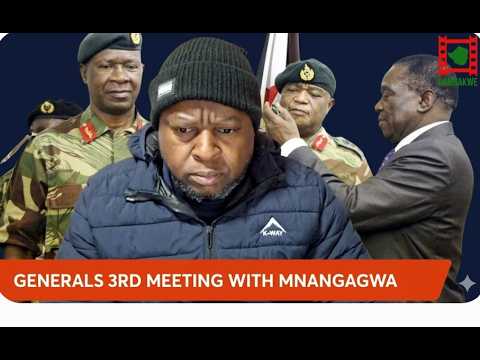
Harare, Zimbabwe — Zimbabwean President Emmerson Mnangagwa has convened his top army generals for a third undisclosed meeting in less than six weeks, a frequency of military consultations unseen since the 2017 coup that ousted Robert Mugabe. The closed-door session, confirmed by multiple security sources who spoke on condition of anonymity, is the clearest signal yet that factional infighting inside ZANU-PF has escalated to a point where the head of state feels compelled to personally secure the loyalty of the armed forces.
The meetings began in late March, accelerated after Vice President Constantino Chiwenga — the former army general who led the 2017 putsch — publicly hinted at a generational leadership transition. Chiwenga’s remarks, delivered at a party rally in Masvingo, were interpreted as a direct challenge to Mnangagwa, who is widely expected to seek a third term despite a two-term constitutional limit. ZANU-PF insiders say the military is now deeply split between officers loyal to Mnangagwa and those aligned with Chiwenga’s old guard.
Military Loyalty Under Microscope
Each of the three meetings has been held at State House without prior public announcement. The army’s top brass — including Zimbabwe Defence Forces General Philip Valerio Sibanda, army commander Lieutenant General Anselem Sanyatwe, and Air Marshal Elson Moyo — have been seen arriving in unmarked vehicles. Sources describe the atmosphere as tense, with Mnangagwa pressing generals for a public pledge of allegiance and the generals demanding clarity on retirement dates and post-service benefits.
“When a sitting president needs to meet the full general staff three times in a month, you are not discussing logistics,” said Dr. Tafadzwa Chikwanha, a Harare-based political analyst who studies civil-military relations in Southern Africa. “This is a leader who no longer trusts the chain of command and is trying to bind the army to him personally. That is a dangerous trajectory for any democracy.” Chikwanha’s assessment echoes warnings from the International Crisis Group, which noted in a February 2024 report that Zimbabwe’s military had become “the final arbiter of political succession” since Mugabe’s fall.
The Zimbabwean constitution vests command of the defence forces in the president, but since 2017, the military has openly asserted its role as a political kingmaker. The 2017 coup — initially called a “operation to weed out criminals” — displaced Mugabe after he attempted to fire then-Vice President Chiwenga. Now, retired generals like Brigadier General (Rtd) Mkhululi Nyathi argue the same logic could apply to Mnangagwa. “The army does not serve an individual; it serves the nation,” Nyathi said in a recent interview with the state-owned Herald. “But when internal party disputes threaten national stability, the uniformed institutions must intervene.”
Geopolitical Stakes for Southern Africa
South Africa, which depends on Zimbabwe for migrant labor and electricity imports, is watching closely. President Cyril Ramaphosa’s office has dispatched a senior mediator to Harare twice in the past month, though the details of those talks remain classified. Analysts say Pretoria fears a collapse of Zimbabwe’s fragile unity government if the military openly chooses sides. Meanwhile, China — Zimbabwe’s largest creditor and arms supplier — has privately urged Mnangagwa to manage the succession “without disruption to bilateral investment portfolios.”
Data from the Zimbabwe National Statistics Agency shows the economy contracted by 4.5% in 2023. Inflation has surged past 200%, and the Zimbabwe dollar has lost 80% of its value against the US dollar since January. Against this backdrop, any political crisis could accelerate capital flight. The International Monetary Fund has suspended the release of a $350 million loan tranche until political clarity emerges.
What Remains Unknown
Neither the presidency nor the Zimbabwe Defence Forces has issued a statement about the three meetings. Journalists were barred from covering any of the sessions, and the live-stream title “Mnangagwa Meets Zimbabwe Army Generals For the Third Time” posted on YouTube by a Harare-based media group is the only public record of the event. The lack of transparency has fueled speculation that a deal is being negotiated — possibly a timeline for Mnangagwa’s exit or a reshuffle of top military commands to remove Chiwenga loyalists.
Calls for comment to Defence Minister Oppah Muchinguri-Kashiri were not returned. The military’s public affairs directorate referred inquiries to State House, where a spokesperson said only that “routine consultations” had taken place. However, when asked about a possible fourth meeting, the spokesperson declined to answer and hung up.
The coming weeks are critical. Zimbabwe’s ruling party has scheduled an extraordinary congress for August, where formal candidacies for the 2028 elections are expected to be announced. If Mnangagwa fails to secure the army’s unequivocal backing before then, the congress could become a flashpoint. As one retired intelligence officer put it: “In Zimbabwe, elections are not decided at the ballot box. They are decided in the barracks.”
For Southern Africa, the stakes could not be higher. A military-backed transition in Zimbabwe would set a precedent that armed forces in the region can override constitutional processes with impunity. Zambia and Mozambique, both facing their own succession anxieties, are watching Harare for signs of what might come next.