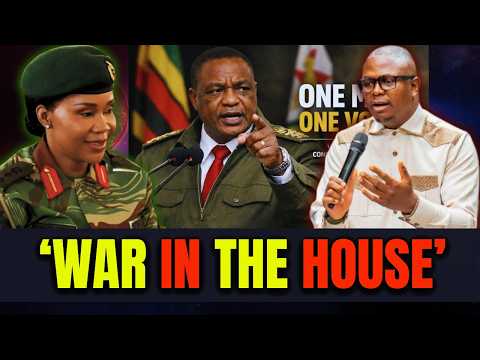
A bombshell accusation has rocked Zimbabwe’s political establishment: Miniyothabo Chiwenga, a prominent figure linked to Vice President Constantino Chiwenga’s faction, has publicly alleged that First Lady Auxillia Mnangagwa is actively supporting a convicted serial killer. The claim, made in a video that has since gone viral, threatens to deepen the already toxic rift within the ruling ZANU-PF party and raises urgent questions about the integrity of the country’s justice system.
While the full details of the allegation remain unverified, the explosive nature of the charge—coming from a member of the Chiwenga camp—signals a new and dangerous phase in the succession battle that has been simmering since President Emmerson Mnangagwa’s health came under scrutiny. At its core, the accusation suggests that the First Lady has used her influence to shield a murderer from prosecution. No official response has yet been issued from the First Lady’s office, and the Zimbabwe Republic Police have not confirmed any investigation. However, political analysts warn that the allegation, true or false, could destabilise the fragile coalition at the top of the state.
Who Is Miniyothabo Chiwenga and Why Does This Matter?
‘This is not a personal spat; it is a factional war being fought through proxies,’ explains Dr. Tafadzwa Chikwanha, a Harare-based political analyst. ‘Allegations of this magnitude are designed to discredit the First Lady and, by extension, the President. If they stick, they could weaken Mnangagwa’s grip ahead of the next party congress.’ The timing is critical: Zimbabwe is grappling with hyperinflation, a collapsing currency, and widespread poverty. Any distraction that paralyzes the presidency could have immediate consequences for governance and foreign investment.
The Serial Killer Case at the Centre of the Allegation
The allegation that Auxillia Mnangagwa has provided support—whether financial, legal, or logistical—to such a killer would be extraordinary. The First Lady has built a public reputation as a philanthropist, championing causes for women and orphans through her Angel of Hope Foundation. A direct link to a violent criminal would shatter that image and could invite international condemnation. ‘We have seen this pattern before in authoritarian states where powerful families are above the law,’ warns Dr. Chikwanha. ‘If the accusation is substantiated, it would confirm the worst fears about impunity at the highest levels.’
Geopolitical Repercussions for Southern Africa
The controversy does not stop at Zimbabwe’s borders. Southern Africa is already on edge. The SADC region is watching Zimbabwe’s leadership transition closely because of its history of election violence and economic collapse. A scandal involving the First Lady and a serial killer could trigger diplomatic isolation. ‘South Africa, Botswana, and Zambia have strong ties with Harare, but they cannot ignore a situation where state protection is allegedly afforded to a murderer,’ says Kabelo Mokoena, a regional security analyst at the Institute for Security Studies in Pretoria. ‘It would send a signal that Zimbabwe’s rule-of-law institutions are completely captured.’
Moreover, the scandal could affect donor relations. The European Union and the United States have maintained targeted sanctions against key Zimbabwean officials over human rights abuses. If the Mnangagwa administration is seen to be complicit in shielding a killer, those sanctions could be expanded. ‘The timing is particularly bad because Zimbabwe is trying to re-engage with the West and attract investment for its lithium mining sector,’ adds Mokoena. ‘A scandal of this nature could set back those efforts by years.’
At home, the implications are even more immediate. The ZANU-PF succession battle is not just about personalities; it is about the direction of the country. Constantino Chiwenga represents a hardline, military-backed faction that advocates for a return to command economics. President Mnangagwa’s camp, with Auxillia as a key figure, has pursued a cautious, engagement-oriented approach—albeit tainted by corruption allegations. ‘This accusation could be the spark that finally splits the party,’ warns Dr. Chikwanha. ‘If the Chiwenga faction decides to use this as a rallying cry, we could see defections, resignations, or even a backroom challenge to the President.’
The Zimbabwean public, already exhausted by economic hardship, may now face prolonged political instability. Ordinary citizens in Harare’s high-density suburbs express a mixture of disbelief and resignation. ‘We hear these accusations every few months,’ says Tinashe Gumbo, a vendor in Mbare. ‘First it was about land, then diamonds, now a serial killer. We just want to be able to feed our children. The politicians can kill each other for all I care.’ Yet, as the scandal unfolds, it is impossible to ignore the potential for violence. Zimbabwe’s history is littered with instances where political infighting has escalated into bloodshed.