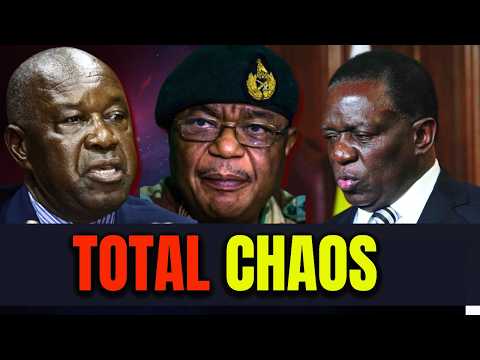
Constantino Chiwenga, Zimbabwe’s Vice President and former army general, has dramatically increased his personal security detail in what analysts describe as the most visible sign yet of an intensifying leadership battle inside the ruling ZANU-PF party. A live broadcast captured on Friday showed a convoy of at least eight armored vehicles, dozens of heavily armed members of the Presidential Guard, and mounted counter-surveillance units surrounding Chiwenga’s residence in Harare’s upscale Borrowdale suburb. The deployment, which sources say is a threefold increase from the standard vice-presidential escort, has triggered alarm across Southern Africa’s diplomatic corridors.
‘This is not a routine security upgrade,’ said Dr. Pedzisayi Ruhanya, a political analyst at the University of Zimbabwe who has studied military-civilian relations in Harare for two decades. ‘Chiwenga is signaling that he perceives a direct, imminent threat to his life. In the context of ZANU-PF’s internal factional warfare, that threat is almost certainly political. We are watching a preemptive move ahead of what many expect to be a decisive confrontation over who succeeds President Emmerson Mnangagwa.’
The former general, who led the 2017 military intervention that ousted Robert Mugabe, has long been seen as the front-runner in the succession race against Vice President Kembo Mohadi. However, recent months have seen a surge in rhetoric from Mnangagwa-aligned loyalists pushing for a third term for the 81-year-old president, a move that would require a constitutional amendment and that Chiwenga’s camp has publicly opposed. The security escalation comes just weeks after a leaked audio recording—whose authenticity has not been independently verified—purported to capture senior military officers discussing plans to ‘neutralize’ any politician who stands in the way of a Mnangagwa extension.
The Security Escalation: What We Know
While the Zimbabwean government has not issued an official statement, multiple independent security sources confirmed that Chiwenga’s protective detail now includes operatives from the Special Air Service and the Counter-Intelligence Unit—forces that typically answer only to the Commander of the Defence Forces. The visible presence of these elite units suggests that the military’s top brass may be splitting along factional lines. ‘When a vice president surrounds himself with troops who are not under the direct command of the president, you have entered crisis territory,’ said a retired Southern African Development Community (SADC) intelligence officer who spoke on condition of anonymity because of the sensitivity of the matter. ‘This is how coups begin—or how they are prevented.’