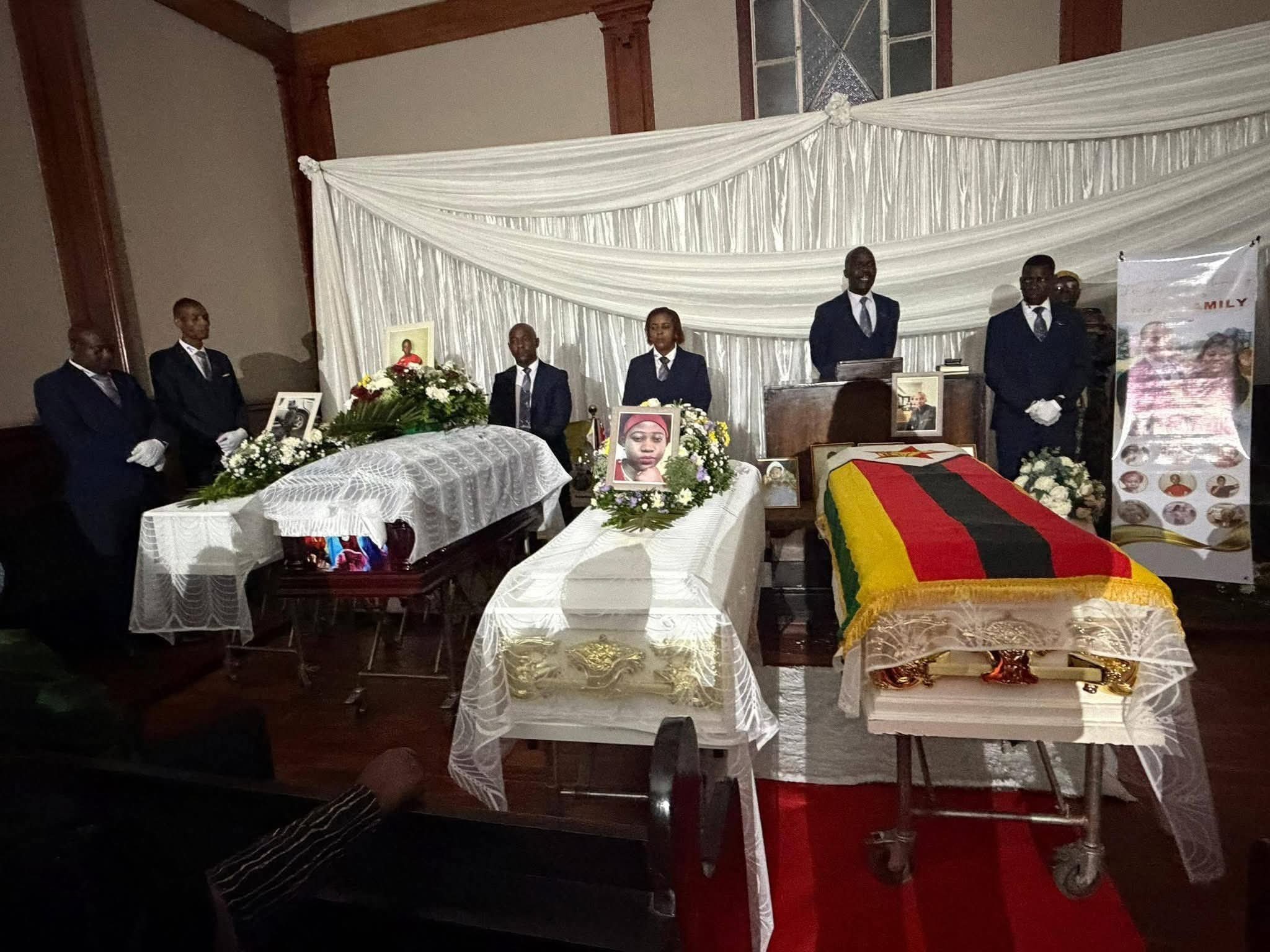
In Bulawayo, mourners gathered at Doves to lay to rest Tumelo Dube, his wife Antonetta, and their two children, Itumeleng and Rorisang, after a fatal car accident in Shangani. The tragedy has now deepened: the bodies have left Bulawayo for burial in Gwanda, where the family will be laid to rest. Across Zimbabwe, condolences poured in—an outpouring of grief that also exposes the brutal reality of road safety failures in Southern Africa.
At Doves in Bulawayo: a family cut down on the road
The funeral service at Doves in Bulawayo brought together relatives, neighbours and community members who came to mourn a family that was suddenly wiped out. According to the account circulating publicly, the accident occurred in Shangani—a location that is part of Zimbabwe’s wider travel network connecting communities across the province and beyond. The dead—Tumelo Dube, Antonetta Dube, Itumeleng and Rorisang—were transported for burial, with the bodies now reportedly leaving Bulawayo for Gwanda.
In Zimbabwe, funerals are more than ceremonies; they are social institutions that confirm who is alive, who is gone, and what a family’s future will look like. But in this case, the loss is not only emotional—it is structural. When a husband, wife and two children die together, it collapses the household immediately: schooling stops, income disappears, and extended family must scramble to absorb the shock.
Road crashes in Zimbabwe are not random misfortunes. They are driven by a predictable mix of speeding, vehicle condition, poor road design, inadequate enforcement, and—too often—delayed emergency response. In Southern Africa, the same patterns recur across borders, where traffic volumes rise faster than infrastructure and policing capacity. The Dube family’s deaths in Shangani therefore land in a wider regional pattern: families are paying with their lives for systemic weaknesses.
Zimbabwe road risk is a governance problem, not just “bad luck”
Zimbabwe has repeatedly recorded high road fatality figures in recent years, and the trend has been linked to enforcement gaps and infrastructure constraints. While exact crash statistics for Shangani in this specific incident are not provided in the public account, the broader national pattern is clear: road deaths remain one of the most preventable causes of premature death in the country.
Experts who track road safety in the region consistently argue that crashes are often the endpoint of failures across the system—vehicle roadworthiness, driver behaviour, speed management, and emergency care. A senior road safety analyst at a regional transport research unit (speaking generally about Southern Africa’s crash patterns) has previously noted that “when enforcement is inconsistent and roads are poorly maintained, risk becomes normalised—drivers learn that consequences are unlikely.” That normalisation is what turns a single trip into a catastrophe.
For Zimbabwe, the implications are immediate. The country’s economy is already under pressure—fuel costs, vehicle affordability, and maintenance backlogs mean more cars operate beyond safe limits. When families like the Dubes are killed, the economic damage compounds: households lose labour, children lose education continuity, and caregivers face long-term stress.
Geopolitically, road safety is also a regional governance issue. Zimbabwe’s links to SADC trade and mobility mean that traffic corridors—both formal and informal—carry not only goods but also people travelling for work, school, and family obligations. If enforcement and standards are weak across the region, the risk travels with the vehicles.
What this death means for families across Bulawayo, Gwanda and beyond
The Dube family’s deaths will reverberate in Bulawayo and Gwanda—not only because the funeral is being held in Bulawayo, but because the burial is set for Gwanda. In practical terms, relatives will now coordinate the burial logistics, manage grief, and confront the immediate needs of surviving dependants. In many Zimbabwean communities, the loss of a nuclear family unit forces extended families to absorb school fees, food security and medical obligations.
There is also a public health and social stability angle. When children die, the trauma spreads. Communities often respond by tightening informal safety norms—discouraging night travel, pushing for seatbelts, and urging drivers to slow down. But without enforcement and safer infrastructure, those norms fade under economic pressure.
Zimbabwe’s road safety authorities—through the police and transport regulators—have a duty to ensure that crash investigations are thorough and that lessons are translated into action. The public account of the accident in Shangani does not yet detail speed, vehicle condition, weather, or whether seatbelts were worn. That absence is exactly why accountability matters: families deserve answers, and the public deserves prevention.
In Southern Africa, the cost of road deaths is not just human. It drains national budgets through emergency response, disability support, and lost productivity. For Zimbabwe, where public services are already stretched, every preventable death intensifies the strain.
Mourners speak: grief, prayers—and demands for answers
In the immediate aftermath of such tragedies, Zimbabweans often respond in two ways: they grieve publicly and they ask questions privately. The public message accompanying the funeral notes that “many people are sending their condolences to the Dube family” and that the family should “rest in peace.” That sentiment is common—but it also signals that the community expects more than sympathy. It expects clarity on how the crash happened and what steps will be taken to prevent similar deaths.
Local leaders and community members typically call for safer driving and better road discipline, especially on routes where enforcement is inconsistent. While specific quotes from officials are not included in the public account you provided, the pattern across Zimbabwe is that councillors, traditional leaders and church representatives attend funerals and urge the public to treat road safety as a collective responsibility.
Road safety advocates in Zimbabwe have repeatedly called for visible enforcement—speed checks, sobriety controls, and vehicle roadworthiness inspections—paired with public education that is not just seasonal. The reason is straightforward: grief alone cannot stop crashes; enforcement and engineering can.
From burial to prevention: what must happen next
The bodies leaving Bulawayo for burial in Gwanda marks the next stage of the family’s journey through loss. But the national responsibility does not end at the gravesite. Zimbabwe must treat road deaths like the preventable public emergency they are.
First, crash investigations must be completed transparently. If authorities determine speed was a factor, then speed enforcement must be intensified on the relevant stretch of road. If vehicle defects were involved, then roadworthiness checks must be tightened—especially for passenger and family vehicles travelling long distances. If road conditions contributed, then maintenance and safety improvements must follow quickly rather than being postponed until another family is buried.
Second, emergency response readiness must be assessed. In many Southern African crashes, the difference between survival and death can be minutes. That means improving ambulance coverage, strengthening coordination between police and health services, and ensuring that crash sites are secured quickly.
Third, Zimbabwe’s road safety messaging must be sustained and local. Communities in Bulawayo, Gwanda and across Matabeleland should receive targeted guidance on routes and risk periods—especially where night travel, fatigue and speeding are common.
Finally, the Dube family’s tragedy should be a catalyst for stronger accountability in Zimbabwe’s road governance. Condolences are necessary. But prevention is the only response that honours the dead fully.