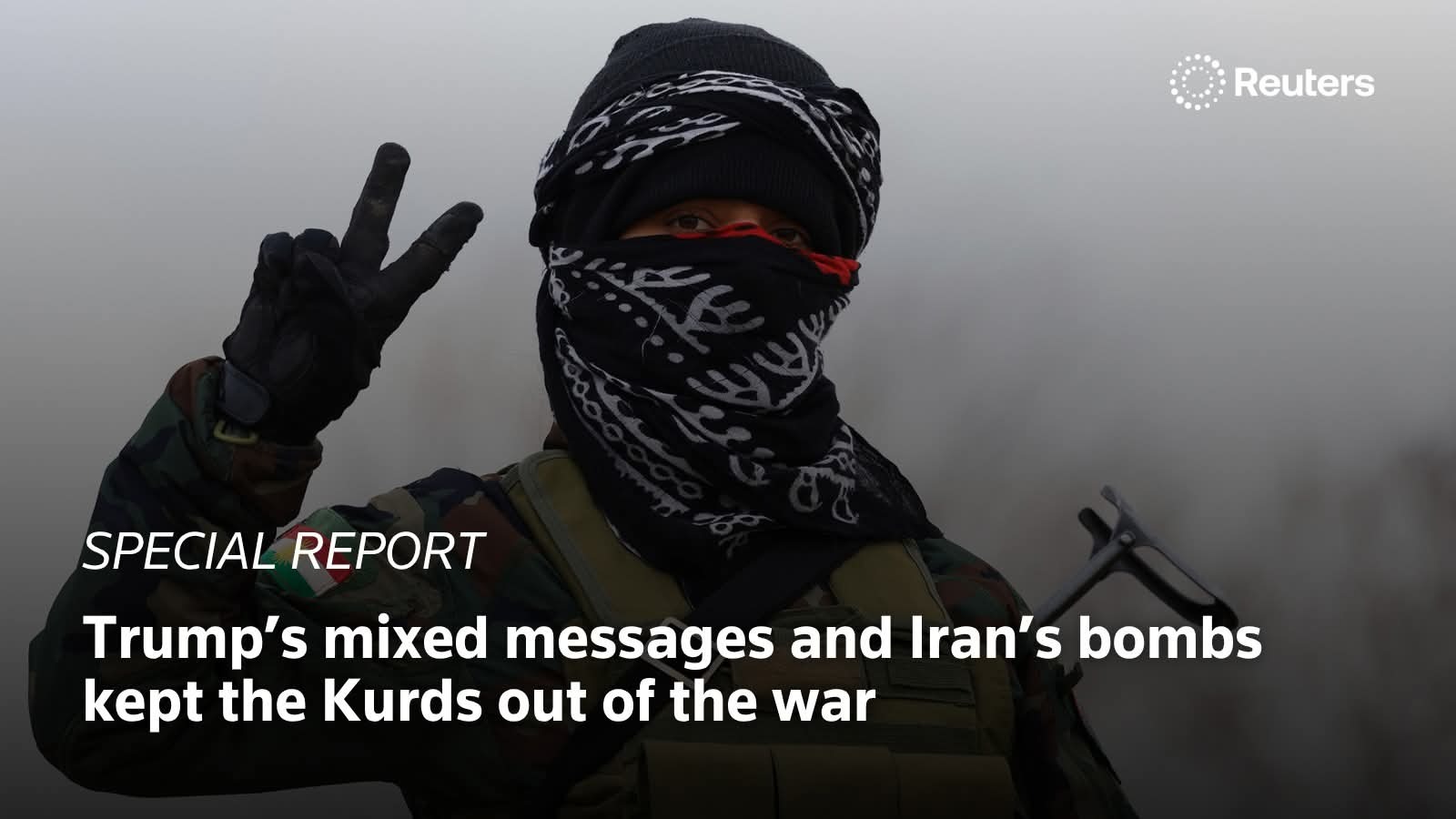
WASHINGTON—President Donald Trump sent conflicting signals this week about whether Kurdish forces based in Iraq should play a role in the fight against Iran-linked threats, according to Reuters. On Day 6 of his remarks, Trump suggested an assault by ‘Iranian Kurds’ based in Iraq would be ‘wonderful.’ By Day 8, he reversed course, saying, ‘We are not looking to the Kurds going in’ and that he had ‘ruled that out.’
The whiplash shift is not just a rhetorical problem. In a war where operational decisions can be irreversible within hours, inconsistent messaging can reshape battlefield calculations for armed groups, influence Tehran’s counter-moves, and unsettle allies who rely on Washington for strategic clarity. For Zimbabwe and Southern Africa, the consequences are indirect but real: regional instability accelerates global energy and shipping volatility, strains humanitarian systems, and intensifies diplomatic competition for influence—pressures that often land hardest on countries already managing economic stress and governance challenges.
From ‘wonderful’ to ‘ruled that out’
Reuters reported that Trump’s statements changed over a matter of days, creating uncertainty about U.S. intent regarding Kurdish participation. On one day, he appeared to welcome an assault by Kurdish forces described as aligned with Iranian interests and operating from Iraq. On the next, he explicitly said the U.S. was not seeking Kurdish forces to ‘go in’ and claimed he had ‘ruled that out.’
That sequence matters because Kurdish groups in northern Iraq are not a single actor. They include formations with differing political alignments, varying levels of coordination with Baghdad, and distinct relationships with Turkey, Iran, and the U.S. When Washington’s position shifts publicly—even in informal remarks—armed groups interpret it as either permission, restraint, or a signal to adjust tactics.
In the days when Trump’s remarks were made, the broader strategic context was already volatile. Iran’s regional posture—through proxies and aligned militias—has repeatedly collided with U.S. and allied interests in Iraq and Syria. Kurdish forces, meanwhile, have been both a battlefield instrument and a political bargaining chip: they fight when they believe the threat is immediate, and they negotiate when they believe their autonomy is at risk.
Trump’s reversal therefore lands in a high-stakes environment where messaging can affect everything from artillery targeting to the willingness of local commanders to move across contested lines. It also complicates diplomacy. U.S. partners—especially those with troops, intelligence assets, or training missions in the region—need consistent guidance to avoid accidental escalation.
“In wars like this, public signals are not merely commentary—they are interpreted as operational cues,” said a former senior intelligence official who requested anonymity due to ongoing policy work. “When leadership contradicts itself within days, it creates a vacuum that local actors fill with their own assumptions. That can lead to actions Washington never intended.”
That dynamic is particularly dangerous in Iraq, where the state’s monopoly on force is contested and where multiple security structures—formal and paramilitary—operate under overlapping authorities. Kurdish units may coordinate with Iraqi forces at times, but they can also act independently when they believe Baghdad’s decisions are too slow or too constrained.
Tehran, Baghdad, Ankara: a three-way pressure system
Trump’s conflicting Kurdish signals arrive amid intensified pressure from Iran and its networks, alongside the persistent security concerns of Iraq’s neighbors. Turkey has long treated Kurdish autonomy in northern Iraq as a direct threat to its internal security, and it has repeatedly conducted cross-border operations against groups it designates as terrorist organizations. Iran, meanwhile, has sought to maintain influence through allied militias and political leverage, aiming to deter U.S. and partner actions that could limit its strategic depth.
Baghdad sits at the center of this pressure system. Iraq’s government wants to preserve sovereignty and avoid becoming a permanent battlefield, but it also faces real constraints: limited control over all armed actors, contested legitimacy, and the constant risk that any movement by one faction triggers retaliation by another.
In such a setting, U.S. messaging can become a lever. If Kurdish forces believe the U.S. is tacitly supportive, they may accelerate operations. If they believe Washington is withdrawing support, they may pause, reposition, or seek alternative backers. Either way, the uncertainty increases the odds of miscalculation.
Reuters’ account of Trump’s Day 6 and Day 8 statements underscores the challenge: even when U.S. policy is consistent behind closed doors, public remarks can still produce battlefield friction. That friction is not contained to the Middle East. It feeds into global markets and migration flows—two channels that often reach Southern Africa through energy prices, food import costs, and humanitarian funding pressures.
For Zimbabwe, the connection is not about Kurdish forces directly. It is about the downstream effects of instability. When conflicts in the Middle East intensify, crude prices and refined fuel costs tend to rise or remain volatile, and that volatility affects countries that import fuel and electricity. Zimbabwe’s economy is already sensitive to energy costs and foreign currency availability. Any global shock that tightens financing conditions or increases import bills can worsen inflationary pressures and reduce fiscal space for social priorities.
There is also a diplomatic and security dimension. When Washington’s posture toward regional actors appears inconsistent, other powers—Russia, Iran, Turkey, and Gulf states—often exploit the uncertainty to expand influence, offer alternative security arrangements, or push competing narratives. For Southern African states that rely on stable international partnerships for trade, development funding, and multilateral voting alignment, a more fragmented global order can translate into fewer predictable outcomes at the UN and in international financial institutions.
“The ripple effects are real even when the conflict is geographically distant,” said an Africa-focused geopolitical analyst. “Southern Africa is exposed through commodity markets, shipping insurance, and the global risk premium. Instability in a major energy region changes the calculus for investors and lenders. That matters for countries like Zimbabwe that are already managing debt, currency shortages, and energy constraints.”
While Zimbabwe is not a direct participant in Middle East operations, it is part of the same global system where conflict drives costs and reshapes aid priorities. Humanitarian crises can also redirect donor attention and funding. When major emergencies compete for resources, countries with chronic needs—food security, health systems, and disaster preparedness—often face funding gaps.
Moreover, inconsistent U.S. signals can influence how armed groups and governments interpret legitimacy and external support. That can prolong conflicts, increase civilian displacement, and raise the likelihood of regional spillover—conditions that can intensify migration pressures that eventually reach Europe and beyond, indirectly affecting global policy priorities and budgets.
In the Reuters report, the core issue is straightforward: Trump’s public statements about Kurdish involvement in the war shifted sharply between Day 6 and Day 8. But the operational meaning is complex. In conflict zones, ambiguity is rarely neutral; it becomes a tool that local actors use to justify decisions.
As the war continues, the key question for policymakers in Washington and for partners across the region is whether the U.S. can restore clarity. For observers in Africa, the question is whether the resulting instability will translate into higher costs, tighter financing, and more pressure on already strained economies and humanitarian systems.
Source: Reuters (link provided by user): https://reut.rs/4cf6rJS